i Short answer
The account becomes part of your deceased estate. Once the broker is told of the death, it freezes the account, may close open positions under its terms, and pays the balance only to the executor appointed by the Master of the High Court, not to family members directly. Any trading authority you gave someone ends at death. The balance counts towards your estate for estate duty, which is 20% on the dutiable estate above the R3.5 million abatement, and towards the executor's fee, which can be up to 3.5% of gross assets plus VAT (SARS, estate duty) (SARS, VAT).
Open leveraged positions are the main risk: they keep moving until someone with authority closes them. The estate duty calculator estimates the duty on an estate that includes trading accounts.
📋 ON THIS PAGE
1. What does the broker do when an account holder dies?
On receiving a death certificate, the broker freezes the account: no new trades, no withdrawals and no logins by anyone else. It then waits for letters of executorship, the document from the Master of the High Court that names the executor. A trading authority or power of attorney you signed while alive stops having effect at death, so the person you authorised can no longer act, as explained in giving someone trading authority.
2. What happens to open positions?
That depends on the client agreement. Many brokers close all positions once they are notified, at the prevailing market price; some leave them open until the executor instructs otherwise. Either way, positions keep gaining or losing until closed, and swaps keep being charged, as described in what is a CFD rollover. A leveraged position left open for weeks can lose much of the account's value before anyone with authority can act. If a loss exceeds the balance and the broker has no negative balance protection, the shortfall becomes a claim against the estate.
⬇ Download this summary (PNG) · Free to share with the credit “Source: TradeAnswers” (CC BY 4.0).
3. How does the money reach the estate?
Report the death
Family or the executor sends the broker the death certificate and the account details.
Appoint the executor
The Master of the High Court issues letters of executorship, or letters of authority for smaller estates.
Executor claims the funds
The executor gives the broker the letters, ID and the estate bank account details.
Broker pays the estate
The balance goes to the estate's late account, not to heirs; heirs are paid when the estate is finalised.
The process usually takes months. The money is distributed according to the will, or the intestate succession rules if there is none.
4. What tax and costs apply? A worked example
Assumptions (hypothetical example): a single person dies leaving a R600,000 trading account, a R2,500,000 home and R1,200,000 of other assets, with no debts, nothing left to a spouse and no other deductions. Rates are from the estate duty and donations tax page; the executor's fee is shown at the maximum tariff, which is often negotiated down.
| Item | Amount |
|---|---|
| Gross estate: R600,000 + R2,500,000 + R1,200,000 | R4,300,000 |
| Less estate duty abatement | (R3,500,000) |
| Estate duty at 20% on R800,000 | R160,000 |
| Executor's fee at up to 3.5% of R4,300,000, plus 15% VAT | up to R173,075 |
On top of these, assets are treated as disposed of at market value on the date of death for capital gains tax, with an exclusion of R440,000 in the year of death; and trading profit up to the date of death goes on the deceased's final income tax return. Assets left to a surviving spouse are deductible for estate duty and can roll over for capital gains tax, which changes the figures above substantially. The exclusion is on the capital gains tax rates page.
5. What about joint accounts and offshore brokers?
With a joint account, the broker's terms decide whether the survivor can carry on; often the account is frozen until the executor confirms the deceased's share, so check before relying on it, as covered in joint trading accounts. An account with an offshore broker is still part of a South African resident's estate, but the broker may require its own country's probate documents, which adds cost and months. Crypto adds the problem of keys, covered in what happens to my crypto when I die.
6. What can you do now to make it easier?
- Keep a list of every broker, account number and the legal entity that holds it
- Keep a valid will that covers trading and offshore accounts
- Use stop-losses, so positions cannot run unlimited while no one can act
- Keep large balances out of leveraged accounts
- Tell your executor where the list is, not your passwords
★ Why It Matters
The gap between death and an executor's appointment can be weeks. For a leveraged account with open positions and no stops, that gap is the biggest financial risk, larger than the estate duty.
✕ Common mistakes
- Relying on a trading authority after death. It ends at death.
- Family logging in to close trades. It breaches the broker's terms and can complicate the estate.
- Leaving positions without stops. They keep moving while no one has authority.
- Forgetting offshore accounts in the will. They are part of the estate and slower to reach.
Key Takeaways
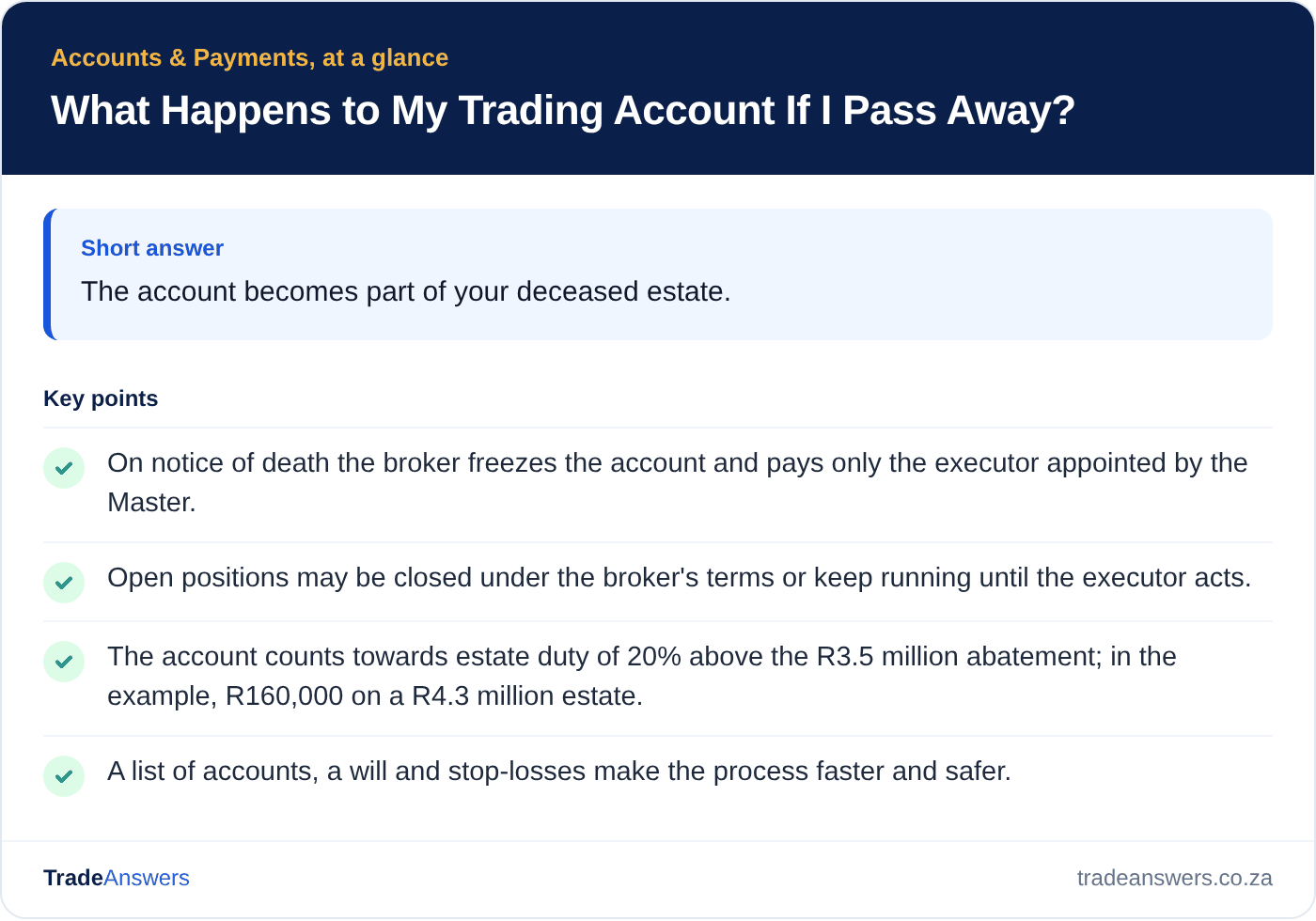
- On notice of death the broker freezes the account and pays only the executor appointed by the Master.
- Open positions may be closed under the broker's terms or keep running until the executor acts.
- The account counts towards estate duty of 20% above the R3.5 million abatement; in the example, R160,000 on a R4.3 million estate.
- A list of accounts, a will and stop-losses make the process faster and safer.
Frequently asked follow-up questions
Can my family withdraw the money from my trading account after I die?
No. The broker pays the balance only to the executor appointed by the Master of the High Court, into the estate's account. Heirs receive it when the estate is distributed.
Will the broker close my open trades when I die?
Many brokers close positions once notified of the death; some wait for the executor. Check your client agreement, because positions keep gaining or losing until closed.
Is my trading account subject to estate duty?
Yes. It forms part of your estate. Estate duty is 20% on the dutiable estate above the R3.5 million abatement, and 25% on the part above R30 million; assets left to a spouse are deductible.
Does a power of attorney let someone manage my account after death?
No. A power of attorney or trading authority ends at death. Only the executor can act for the estate.
What should I leave for my executor?
A list of every broker, account and the legal entity holding it, kept with your will. Passwords are not needed and should not be shared; the executor works through the broker's formal process.
