i Short answer
Genuine readiness to start trading combines four things: capital you can honestly afford to lose, a basic working knowledge of how orders, leverage, and risk actually function, a written risk management approach, and enough demo experience to have tested your process under realistic conditions.
Missing any single one of these does not mean trading is impossible, but it does mean the risk of an avoidable, costly early mistake is meaningfully higher than it needs to be.
📋 ON THIS PAGE
- Do you have genuinely disposable capital?
- Do you understand the actual mechanics, not just the concept?
- Do you have a written risk management approach?
- Have you tested your process on a demo account meaningfully?
- Have you thought through your emotional response to a loss?
- What if you are not fully ready across every item?
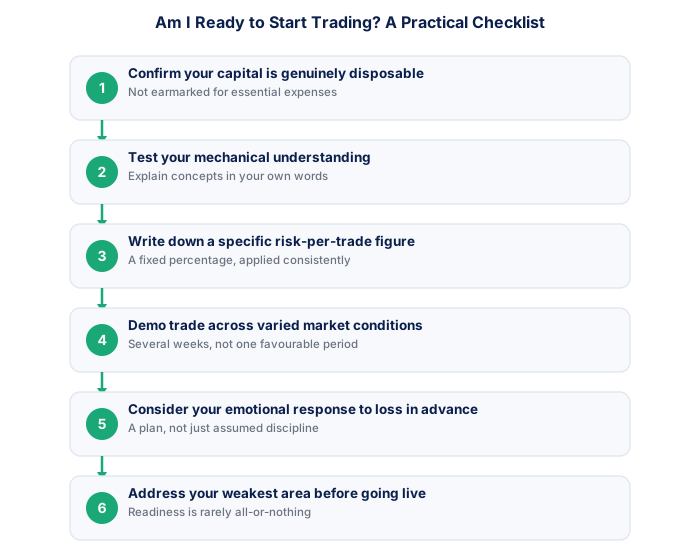
1. Do you have genuinely disposable capital?
The most basic and most frequently ignored readiness question is whether your intended trading capital is money you can afford to lose entirely without it affecting your essential financial obligations, rent, debt repayments, or emergency savings. This is not a formality, it is the single factor most connected to trading with a clear head rather than under financial pressure.
If your intended capital comes from an emergency fund, a loan, or money earmarked for a near-term essential expense, that is a genuine readiness gap to address before opening a live account, regardless of how confident you feel about your strategy.
2. Do you understand the actual mechanics, not just the concept?
Being able to explain, in your own words, how leverage amplifies both gains and losses, how a stop-loss order actually functions, and how pip or point value translates into monetary risk for your specific position size, is a reasonable practical bar for basic mechanical readiness.
This is different from having watched educational content about these concepts, genuine readiness means you could explain them clearly to someone else without referring back to notes, since that level of internalisation is what actually holds up under the pressure of a live, moving position.
- 100+ demo trades completed with consistent rules
- Positive expectancy over full demo sample
- Every demo trade documented in journal
- Written trading plan: entry, exit, position sizing
- FSCA-regulated broker chosen and FSP verified
- Starting capital is genuinely disposable
- Backup connectivity tested
Open a demo account
Choose an FSCA-regulated broker and open a demo with realistic capital (R50,000-R100,000).
Write your trading rules
Define entry criteria, stop-loss method, and position sizing before the first demo trade.
Trade for 2-3 months
Complete at least 50-100 trades across varied market conditions.
Journal every trade
Record rationale, emotional state at entry, and outcome for each position.
Evaluate against your rules
Only move to a live account when performance consistently meets your benchmark.
3. Do you have a written risk management approach?
A specific, written answer to "how much of my account am I willing to risk on a single trade" is a core readiness marker, commonly a small, fixed percentage like one or two percent, applied consistently rather than decided fresh each time based on how confident a particular setup feels.
If you cannot currently state your maximum acceptable loss per trade and per day as a specific number, close that gap before committing real capital, since discovering your actual risk tolerance in real time during a losing streak is a considerably more expensive way to learn it.
4. Have you tested your process on a demo account meaningfully?
Demo trading readiness is not about a single profitable week, it is about having traded your intended approach across enough sessions and market conditions, including losing streaks, to have some genuine sense of how you personally react when a plan is not immediately working.
A demo period of at least several weeks, covering a reasonable range of market conditions rather than one unusually calm or unusually trending period, gives a more honest picture of readiness than a shorter period that happened to align with favourable conditions.
5. Have you thought through your emotional response to a loss?
Genuine readiness includes having at least considered, in advance rather than only in the moment, how you are likely to respond emotionally to a meaningful loss, and having some plan for managing that response, whether that is a mandatory break after a loss, a hard daily loss limit, or simply awareness of your own tendency toward revenge trading.
This is admittedly harder to self-assess honestly than the more mechanical items on this list, but even a basic acknowledgement that this matters, rather than assuming discipline will simply hold automatically, is a far better starting position than not having considered it at all.
6. What if you are not fully ready across every item?
Few beginning traders check every box completely, and that alone is not a reason to indefinitely delay starting. The more useful approach is honestly identifying your specific weakest area, most commonly capital adequacy or risk management specificity, and deliberately addressing that gap before committing meaningful capital.
Starting with a deliberately small position size while continuing to build the weaker areas in parallel is a reasonable middle path for someone who is broadly, though not completely, ready, rather than treating readiness as an all-or-nothing gate.
The transition from demo to live trading is one of the most psychologically significant steps in a trader's development, and the gap between demo performance and early live performance is a well-documented phenomenon. The primary driver is emotional: real capital at risk changes decision-making in ways that are invisible during demo trading. Common manifestations include premature exit from winning positions to lock in profit, reluctance to enter valid setups due to fear, and difficulty accepting losses that felt mechanical on demo but feel painful with real money. The practical solution is to start live trading with an amount small enough that the monetary amounts do not produce strong emotional reactions while still requiring genuine real-money decision-making. Starting with one to three months of discretionary income is a useful benchmark for calibrating this initial live capital.
★ Why It Matters
Worth treating this checklist as a genuine, honest self-assessment rather than a formality to get past quickly, since the areas you are tempted to skip over fastest are often exactly the ones that most need deliberate attention before real capital is at risk.
✕ Common mistakes
- Funding a live account with money earmarked for essential expenses. This is the single factor most connected to trading under damaging financial pressure.
- Confirming understanding of concepts only in theory, not in your own words. Genuine mechanical readiness holds up under pressure; passive familiarity often does not.
- Skipping a written, specific risk-per-trade figure. Discovering your real risk tolerance during a live losing streak is an expensive way to learn it.
- Demo trading only during a short, favourable market period. A brief calm period gives an overly optimistic picture of real readiness.
How much money should I start with as a beginner trader?
Start with an amount you can afford to lose entirely without financial hardship. For most South African beginners, R5,000 to R20,000 is a realistic starting range for a live account. Use a demo account until your performance justifies the step to real capital.
What is the single most important skill for a new trader to develop?
Discipline - consistently following a defined plan regardless of emotional state - is the most frequently cited factor separating traders who improve from those who do not. Technical skill and market knowledge develop over time; discipline must be practised from the first demo trade.
Key Takeaways
- Genuine readiness to start trading combines four things: capital you can honestly afford to lose, a basic working knowledge of how orders, leverage, and risk actually function, a written risk management approach, and enough demo experience to have tested your process under realistic conditions.
- Do you have genuinely disposable capital?.
- Do you understand the actual mechanics, not just the concept?.
- Do you have a written risk management approach?.
- Have you tested your process on a demo account meaningfully?.
Frequently asked follow-up questions
How long should I demo trade before going live?
This varies by individual, but several weeks covering a genuine range of market conditions is a more meaningful benchmark than any fixed number of days alone.
Is there a minimum amount of capital I need to be 'ready'?
There is no fixed minimum tied to readiness itself; the more relevant question is whether your chosen amount is genuinely disposable, regardless of its absolute size.
What if I fail this checklist but still want to start trading?
Identifying your specific weakest area and deliberately addressing it, while starting with meaningfully reduced position size, is a more measured approach than either full avoidance or ignoring the gap entirely.
