i Short answer
A lot is a standardised unit of position size position size: a standard lot equals 100,000 units of the base currency, a mini lot 10,000, and a micro lot 1,000.
📋 ON THIS PAGE
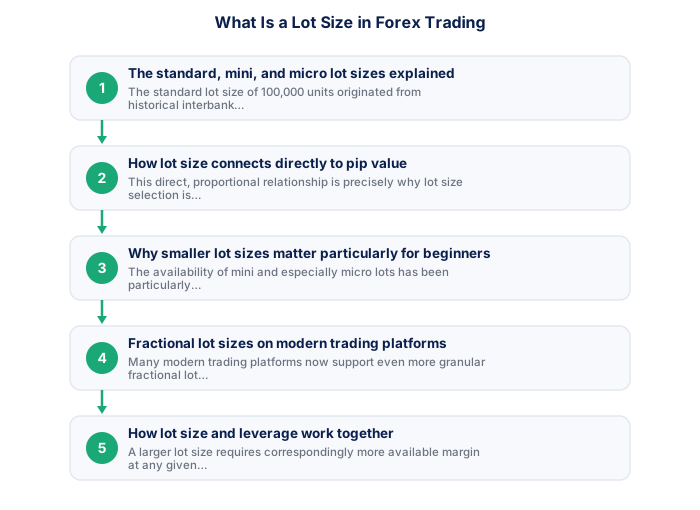
- The standard, mini, and micro lot sizes explained
- How lot size connects directly to pip value
- Why smaller lot sizes matter particularly for beginners
- Fractional lot sizes on modern trading platforms
- How lot size and leverage work together
- Calculating the appropriate lot size for your specific risk tolerance
- What each lot size means in rand risk
1. The standard, mini, and micro lot sizes explained
The standard lot size of 100,000 units originated from historical interbank trading conventions, where this size represented a typical, standardised transaction size between major financial institutions. As retail forex trading developed and expanded to a broader range of traders with varying capital levels, brokers introduced smaller standardised sizes, mini lots (10,000 units, one-tenth of a standard lot) and micro lots (1,000 units, one-hundredth of a standard lot), to accommodate smaller account sizes and more granular position sizing.
These standardised sizes give a consistent reference point across different brokers and traders when discussing position size, similar to how the pip gives a standardised unit for discussing price movement. Together, lot size and pip value form the foundation for calculating actual monetary risk and exposure on any given forex position.
note that that not every broker offers all three sizes, or labels them identically. Some platforms extend the pattern further with nano lots (100 units), while others blend mini and micro conventions into their own branded terminology. Checking your specific broker's exact lot size definitions, rather than assuming they match the standard convention exactly, avoids confusion when calculating position size on a new platform.
2. How lot size connects directly to pip value
The monetary value of a single pip movement scales directly with your chosen lot size, a standard lot's pip value is ten times that of a mini lot, and one hundred times that of a micro lot, for the identical underlying price movement. This direct, proportional relationship is exactly why lot size selection is the practical mechanism through which traders implement their position sizing calculations.
Understanding this connection helps explain why position sizing calculations ultimately resolve into a specific lot size recommendation, the lot size is the actual, concrete trading decision that operationalises your broader risk percentage and stop-loss distance calculations into an executable trade.
- P = Position size in lots
- R = ZAR amount at risk (1-2% of account)
- S = Stop distance in pips from entry
- V = Pip value per lot for this instrument
Set account risk %
Define maximum capital at risk per trade, typically 1-2%.
Measure stop distance
Find your stop-loss level on the chart before calculating size.
Calculate pip value
Use the instrument-specific pip value for your lot size.
Compute position size
Position size = (ZAR at risk) / (stop pips x pip value).
Confirm free margin
Ensure required margin fits within your available free margin.
This proportional relationship is worth internalising as a quick mental shortcut: if you already know a standard lot's approximate pip value for a given pair, you can estimate a mini or micro lot's pip value simply by moving the decimal point, without needing to recalculate from scratch each time. This kind of quick estimation is useful for sanity-checking a platform's calculated figure before confirming a trade.
3. Why smaller lot sizes matter particularly for beginners
The availability of mini and especially micro lots has been particularly significant for beginning traders and those with smaller starting capital, since trading only in full standard lots would require considerably larger account sizes to maintain sensible risk percentages per trade. Micro lots specifically let even quite small accounts maintain disciplined, appropriately-sized position sizing rather than being forced into disproportionately large positions simply because standard lot sizing was once the only available option.
This evolution in available lot sizing has genuinely democratised access to disciplined forex trading practice, making sound risk management practically achievable even for traders starting with more modest capital amounts.
| Account | Risk % | Max loss (ZAR) | At 1:30 leverage | Notional position |
|---|---|---|---|---|
| R50,000 | 1% | R500 | 1:30 | R15,000 |
| R50,000 | 2% | R1,000 | 1:30 | R30,000 |
| R50,000 | 5% | R2,500 | 1:30 | R75,000 |
| R100,000 | 1% | R1,000 | 1:30 | R30,000 |
- Access larger positions with less capital
- Amplifies returns on winning trades
- Short-selling available without share borrowing
- Losses amplified equally, 10x leverage, 10x loss
- Overnight financing reduces long-term returns
- Margin calls can force closure at worst moments
This matters in practice beyond simply making smaller accounts viable. Trading micro lots while still learning a strategy lets a newer trader experience real, live market conditions, including the genuine psychological pressure of real money at risk, with a monetary risk small enough that mistakes made during this learning phase remain financially manageable rather than account-threatening.
4. Fractional lot sizes on modern trading platforms
Many modern trading platforms now support even more granular fractional lot sizing beyond the standard, mini, and micro categories above, allowing position sizes specified to several decimal places of a standard lot, giving essentially continuous, finely-tuned position sizing rather than being constrained to these specific traditional size categories alone.
This fractional capability makes precise position sizing calculations, working backward from your risk percentage and stop-loss distance, considerably more practically achievable, since you're not forced to round to the nearest standard, mini, or micro lot increment, but can instead specify the exact, precisely calculated position size your risk management approach actually calls for.
This granularity is particularly useful once your calculated position size, based on account risk percentage and stop-loss distance, falls between two standard increments. Rounding down to the nearest whole micro lot, for example, means slightly under-risking relative to your predetermined percentage, while rounding up means slightly exceeding it, fractional sizing removes the need to accept either compromise.
5. How lot size and leverage work together
Your chosen lot size determines the total notional position value, while leverage determines how much of your own account capital (margin) is actually required to open and maintain that position size. A larger lot size requires correspondingly more available margin at any given leverage ratio, connecting lot size selection directly to these margin and leverage concepts.
Understanding all three concepts together, lot size, leverage, and margin, gives the complete picture needed to understand exactly how a specific trading decision translates into actual capital requirements and risk exposure, rather than understanding any single concept in isolation without this broader, connected context.
- Confirm account equity
- Calculate 1-2% risk in ZAR
- Identify stop-loss level from chart
- Measure stop distance in pips
- Look up pip value for instrument
- Compute position size
- Verify required margin fits free margin
A helpful way to keep these three concepts straight: lot size answers "how big is this position," leverage answers "how much of that size am I personally funding versus borrowing," and margin answers "how much of my own capital does this specific combination actually require right now." Each answers a related but distinct question, and conflating them is a common source of confusion for newer traders.
6. Calculating the appropriate lot size for your specific risk tolerance
The appropriate lot size for any specific trade is calculated by working backward from your predetermined risk percentage and your strategy's stop-loss distance for that trade, rather than choosing a lot size first based on habit or what feels intuitively appropriate without this calculation.
Most modern platforms include built-in calculators that handle this lot size calculation automatically once you input your risk parameters, removing much of the manual arithmetic burden while still requiring you to understand the underlying principle: lot size should be a calculated output of your risk management approach, not an arbitrary starting input chosen independently of that calculation.
Treating this calculation as a mandatory step before every trade, rather than an occasional exercise, is what actually makes it valuable. A lot size that was appropriate for last week's trade, on a different instrument with a different stop-loss distance, has no particular reason to also be appropriate for today's trade, even if it feels familiar or comfortable to simply reuse.
A micro lot of 1,000 units carries a pip value around $0.10, far more accessible.
A standard lot controls 100,000 units with approximately $10 pip value. A micro lot controls 1,000 units with approximately $0.10 pip value, making it far more accessible for smaller accounts.
★ Why It Matters
Worth double-checking the first time you trade a new instrument: confirm what one lot actually represents for that instrument, since the definition can differ between forex pairs, indices, and commodities on the same platform. An assumption carried over from forex can produce a very differently-sized position elsewhere.
✕ Common mistakes
- Assuming lot size definitions are identical across forex, indices, and commodities. The exact meaning can differ between instrument types on the same platform.
- Defaulting to standard lot sizes regardless of account size. Mini and micro lots often better match smaller accounts' actual risk capacity.
- Not recalculating lot size precisely for your specific risk percentage. The mathematically correct figure is often an oddly specific decimal, not a round number.
- Confusing lot size with leverage when planning a trade. These are related but distinct components of the overall sizing decision.
Does this change my margin call risk?
No. The stop protects the trade; the margin level protects the broker. A position sized so that its stop is far away can trip the second before it reaches the first. margin calculator page covers it in full.
Could this cost me more than my deposit?
With protection in place, no. Without it, a weekend gap or a sharp news move can fill a stop far past its level and leave a debit. Leverage against margin in practice covers it in full.
7. What each lot size means in rand risk
Lot sizes become concrete once converted into rands per pip. On dollar-quoted majors, a standard lot of 100,000 units runs at roughly $10 per pip, which at an exchange rate near R16 is about R160. A mini lot is around R16 per pip and a micro lot roughly R1.60. On USD/ZAR the figure is fixed in rands rather than dollars, at about R10 per pip on a standard lot, because the rand is the quote currency.
Those numbers set the minimum viable account size more firmly than any broker minimum does. Risking 1% on a R10,000 account means R100 per trade, which a micro or small mini position with a sensible stop can accommodate. The same rule on a R1,000 account allows R10 of risk, which the spread largely consumes before the market moves. How much capital you need covers where the arithmetic starts working, and the beginner's path covers the sequence before the first live lot.
Key Takeaways
- A lot is a standardised unit of position size, with a standard lot equal to 100,000 units of the base currency. Learn how lot sizes scale your trade exposure.
- A lot is a standardised unit of position size: a standard lot equals 100,000 units of the base currency, a mini lot 10,000, and a micro lot 1,000.
- The standard, mini, and micro lot sizes explained.
- How lot size connects directly to pip value.
- Why smaller lot sizes matter particularly for beginners.
For a side-by-side breakdown of the three conventions, see standard, mini and micro lots explained.
Frequently asked follow-up questions
Can I trade fractional lots smaller than a micro lot?
Many modern platforms support this level of granularity, though availability varies by broker. Checking your platform's minimum supported lot size will clarify this for your situation.
Does lot size terminology apply to non-forex instruments too?
Similar position sizing concepts apply broadly, though the specific terminology and unit conventions can differ for instruments like gold, indices, or shares.
Is trading larger lot sizes always riskier?
Larger lot sizes mean larger monetary impact per pip of movement, which makes appropriate lot size selection relative to your account size and risk tolerance more important than the absolute lot size in isolation.
Can I trade less than a micro lot if my account is very small?
Some brokers do offer even smaller fractional sizing below a standard micro lot; checking your specific broker's minimum trade size confirms what's available for your particular account.
Is trading a full standard lot common among retail traders?
This is less common for typical retail accounts given the capital this requires, with most retail trading occurring at mini, micro, or fractional sizes instead.
Does my broker's platform automatically calculate the correct lot size for my risk tolerance?
Many platforms include position size calculators, that translate your risk percentage and stop-loss distance into the appropriate corresponding lot size automatically.
Can lot size affect the spread I'm charged on a trade?
Generally the spread itself is typically quoted independently of lot size, though your total cost in monetary terms naturally scales with however large a position you actually trade.
