i Short answer
A trading strategy is a defined, repeatable set of rules for when to enter, exit, and how to size positions consistently across many trades. Yes, you genuinely need one.
Trading without a defined strategy is the clearest path toward gambling-like, undisciplined outcomes.
📋 ON THIS PAGE
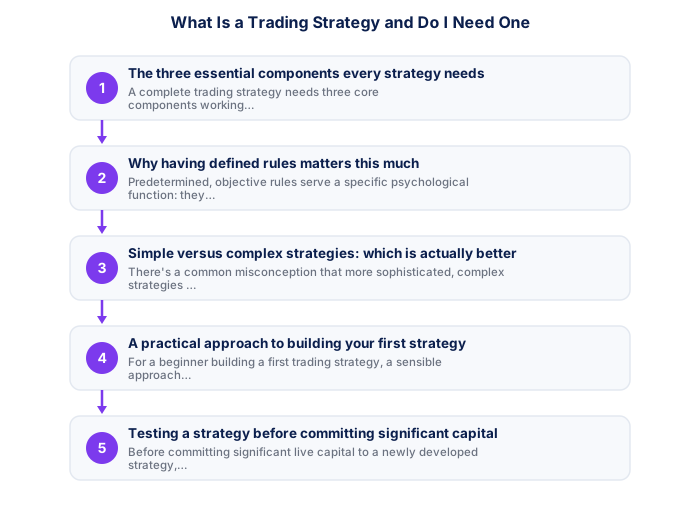
- The three essential components every strategy needs
- Why having defined rules matters this much
- Simple versus complex strategies: which is actually better
- A practical approach to building your first strategy
- Testing a strategy before committing significant capital
- Knowing when to adjust a strategy versus when to stay disciplined
1. The three essential components every strategy needs
A genuinely complete trading strategy needs three core components working together. First, clear entry criteria, specific, objective conditions that must be met before opening a position, whether based on technical indicators, price patterns, fundamental triggers, or some combination. Second, clear exit criteria covering both how you'll take profit on a winning trade and, critically, where you'll cut losses on a losing one through a predetermined stop-loss level. Third, a defined position sizing and risk management approach, typically expressed as a fixed percentage of account capital risked per trade.
A strategy missing any one of these three components is genuinely incomplete. Having clear entry signals without defined exit and risk rules, for example, leaves the most psychologically difficult decisions, when to cut a loss, how much to risk, to be made reactively in the moment, exactly the gap that tends to produce the undisciplined, emotion-driven outcomes that make trading psychology and risk management so important.
2. Why having defined rules matters this much
Predetermined, objective rules serve a specific psychological function: they shift critical decisions away from the moment of maximum emotional pressure (while a trade is actively open and your money is genuinely at risk) to a calmer moment of deliberate planning, before emotional pressure has had a chance to distort judgement. This timing shift is genuinely significant, since the same person making the identical decision in a calm planning context versus a real-time, emotionally charged trading context can reach very different conclusions.
A defined strategy also creates the foundation for honest performance evaluation over time, without consistent rules applied trade after trade, it becomes difficult to determine whether your trading approach actually works, since each trade's outcome reflects a unique, non-repeatable decision-making process rather than a consistent, testable methodology that can be evaluated and refined based on accumulated evidence.
- Quantifiable rules remove subjectivity
- Backtestable on historical data
- Works consistently when edge is genuine
- Clear entry/exit criteria reduce hesitation
- Past performance does not guarantee future results
- Risk of overfitting to historical data
- Market regimes change, edges decay
- Requires discipline through drawdown periods
- Price and volume patterns
- Works on any liquid instrument
- Faster to learn basics
- Ignores fundamental context
- Economic and financial data
- Better for longer timeframes
- Deeper knowledge required
- Ignores entry precision
3. Simple versus complex strategies: which is actually better
There's a common misconception that more sophisticated, complex strategies, combining numerous indicators, intricate conditional rules, and elaborate decision trees, are inherently superior to simpler approaches. In practice, many experienced, consistently successful traders favour relatively simple, well-understood strategies with a small number of clear, easily-followed rules, precisely because simplicity makes consistent, disciplined execution genuinely easier to sustain over time, particularly under real psychological pressure.
Complex strategies can become difficult to execute consistently in real-time trading conditions, and the additional complexity doesn't reliably translate into improved actual results, a moderately effective strategy executed with disciplined consistency frequently outperforms a theoretically superior but practically difficult-to-execute-consistently complex strategy, since execution discipline matters at least as much as the underlying strategy logic itself.
- Written entry/exit rules with zero ambiguity
- Backtested on minimum 3 years of data
- Walk-forward tested on out-of-sample data
- SA-specific events included in test period
- Maximum drawdown within personal tolerance
- 100+ live demo trades with consistent performance
4. A practical approach to building your first strategy
For a beginner building a first trading strategy, a sensible approach involves starting with a small number of well-understood technical concepts, perhaps a trend-following approach using a moving average, combined with a momentum confirmation from RSI, defining specific, objective rules for exactly when these signals constitute a valid entry, setting a clear, consistent stop-loss rule (for example, a fixed percentage below entry, or based on a specific technical level like recent support), and defining a fixed risk percentage per trade (commonly 1-2% of account capital).
Writing these rules down explicitly, rather than keeping them as a vague mental framework, creates genuine accountability and a clear reference point for both real-time decision-making and later honest performance review, this written documentation step is simple but genuinely valuable, and skipping it is a common reason strategies drift or get applied inconsistently over time without the trader necessarily noticing this drift happening.
| Win rate | 1:1 RR | 1.5:1 RR | 2:1 RR |
|---|---|---|---|
| 40% | Losing | Break even | Profitable |
| 50% | Break even | Profitable | Profitable |
| 55% | Profitable | Profitable | Profitable |
| 60% | Profitable | Profitable | Profitable |
5. Testing a strategy before committing significant capital
Before committing significant live capital to a newly developed strategy, testing it thoroughly on a demo account across a meaningful sample size of trades (commonly suggested as 50-100 or more) and varied market conditions provides genuine evidence about whether the strategy's logic produces reasonable, consistent results, separate from and prior to introducing the additional psychological complexity that comes with the demo-to-live transition.
This testing phase should specifically include periods of different market conditions, trending markets, range-bound choppy markets, high and low volatility periods, since a strategy that performs well in one specific type of market condition may perform poorly in a meaningfully different one, and genuine confidence in a strategy benefits from testing across this variety rather than just one favourable, consistent market period.
6. Knowing when to adjust a strategy versus when to stay disciplined
A genuinely difficult, ongoing judgement call for any trader is distinguishing between a strategy needing adjustment based on accumulated evidence of poor performance, versus simply experiencing a normal, expected losing streak that a fundamentally sound strategy will eventually recover from given enough additional trades. Abandoning or significantly changing a strategy after just a handful of losing trades, without sufficient sample size to draw a statistically meaningful conclusion, is a common mistake that can prevent a genuinely viable strategy from ever getting a fair, complete test.
A more disciplined approach involves predetermining, in advance, what specific evidence (a defined sample size of trades, or a specific drawdown threshold) would actually justify reconsidering or adjusting a strategy, rather than making this judgement reactively and emotionally in the immediate aftermath of any single difficult losing trade or short losing streak, this predetermined threshold, decided calmly in advance, provides the same kind of psychological benefit as the predetermined entry and exit rules discussed earlier in this piece.
Without one, verification of an edge and deliberate improvement are not possible.
A defined trading strategy makes entry criteria objective, consistent, and reviewable. Without one, verifying whether a genuine edge exists and making deliberate, targeted improvements both become impossible.
★ Why It Matters
Something worth testing as a specific check on your own approach: try writing your strategy's rules out in full sentences for someone else to follow exactly, gaps and ambiguities you didn't notice while trading intuitively often become obvious the moment you try to write them down precisely.
✕ Common mistakes
- Trading without any defined, repeatable rules. This is the clearest path toward gambling-like, undisciplined outcomes.
- Assuming a strategy in your head is sufficient without writing it down. Written rules hold up better under pressure than memorised ones.
- Changing strategy rules trade by trade based on feel. This makes it impossible to fairly evaluate whether the strategy actually works.
- Not testing a strategy before committing real capital to it. See backtesting as the step that validates a strategy before live use.
Key Takeaways
- A trading strategy is a defined set of rules for entries, exits, and risk management. Yes, you genuinely need one, here's why and how to build one.
- A trading strategy is a defined, repeatable set of rules for when to enter, exit, and how to size positions consistently across many trades.
- Trading without a defined strategy is the clearest path toward gambling-like, undisciplined outcomes.
- The three essential components every strategy needs.
- Why having defined rules matters this much.
See also: What Is a Golden Cross and Death Cross in Trading? and What Is MACD and How Do Traders Use It?.
Frequently asked follow-up questions
Can I use someone else's trading strategy directly?
You can use a publicly shared strategy as a starting framework, but thoroughly testing it yourself and adapting it to your own risk tolerance and understanding is important, since blindly following a strategy you don't fully understand undermines the disciplined execution that makes strategies work.
How do I know if my strategy has a genuine edge?
This requires testing across a meaningful sample size of trades and honestly reviewing whether results are consistent with a real statistical edge, rather than simply being the result of a short favourable or unfavourable run of normal variance.
Should beginners create their own strategy or use an established one?
Many beginners start by learning and testing established, well-documented strategy frameworks before developing the experience to create or meaningfully customise their own, this is a reasonable, common learning progression.
