i Short answer
Stopping revenge trading starts with recognising the specific emotional triggers that precede it: urgency, frustration, and a strong felt need to immediately "fix" a recent loss.
A predetermined rule, like a mandatory cooling-off period after a loss beyond a defined size, gives you a concrete mechanism to interrupt the pattern.
📋 ON THIS PAGE
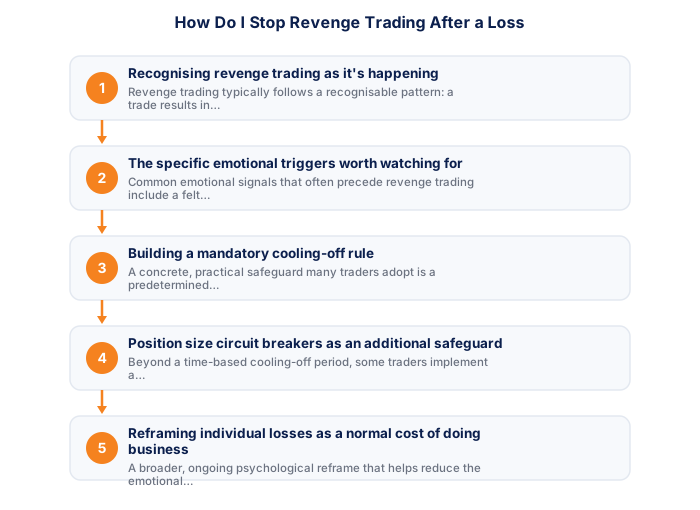
- Recognising revenge trading as it's happening
- The specific emotional triggers worth watching for
- Building a mandatory cooling-off rule
- Position size circuit breakers as an additional safeguard
- Reframing individual losses as a normal cost of doing business
- Recognising when to step away from trading entirely for the day
1. Recognising revenge trading as it's happening
Revenge trading typically follows a recognisable pattern: a trade results in a loss, often larger or more frustrating than anticipated, followed almost immediately by entering a new trade, frequently with a larger position size than usual, and often without the trade genuinely meeting your own predetermined entry criteria, driven primarily by an urgent emotional need to immediately recover the prior loss rather than by any sound, objective trading rationale.
The defining, distinguishing feature isn't simply trading again soon after a loss (which can be entirely legitimate if a new, genuine signal happens to occur) but rather the specific underlying motivation: trading driven by the emotional need to "win back" a loss immediately, rather than trading because your actual strategy's objective rules have generated a new, valid signal independent of the recent loss.
One practical marker worth checking: did this new trade meet your written entry criteria before the prior loss happened, or only after? If a setup only became 'valid' in your mind once the urge to recover a loss appeared, that timing itself is a strong signal the trade is being driven by emotion rather than by your actual strategy.
2. The specific emotional triggers worth watching for
Common emotional signals that often precede revenge trading include a felt sense of urgency or impatience (wanting to act immediately rather than waiting for your strategy's next genuine signal), frustration or anger specifically directed at the market, your broker, or yourself following the loss, and a specific mental narrative along the lines of "I need to make this back" or "the market owes me this," which reflects emotional reasoning rather than the objective, strategy-based reasoning that should genuinely drive trading decisions.
Building self-awareness around these emotional and mental signals, noticing when they arise, ideally before acting on them, is a learnable skill that improves with deliberate practice and honest self-reflection, often supported by detailed trading journal entries that capture emotional state alongside objective trade details.
- FSCA-regulated broker verified at fsca.co.za
- Demo account tested for minimum 60 days
- Trading plan written: entry, exits, position sizing
- Risk per trade defined (1-2% of account)
- Backup internet connection tested for load shedding
- Tax implications understood
Physical sensations are often easier to notice in the moment than the underlying thought pattern itself, a tightened jaw, a faster heartbeat, an urge to act immediately rather than pause. Treating these physical cues as an early warning system, worth pausing on the moment they appear, can catch the pattern before it fully develops into an actual impulsive trade.
3. Building a mandatory cooling-off rule
A concrete, practical safeguard many traders adopt is a predetermined cooling-off rule: a mandatory waiting period, decided in advance during a calm moment, before any new trade can be opened following a loss beyond a specific defined size or following a defined number of consecutive losing trades. This rule should be specific and concrete enough to be unambiguous in the moment (for example, "after any single loss exceeding 2% of account capital, no new trades for the rest of the trading day") rather than vague enough to be easily rationalized away under emotional pressure.
The specific value of this rule lies precisely in its predetermined nature, deciding the rule in a calm planning moment, well before any actual loss has occurred, removes the need to make a sound judgement call about whether to pause trading at exactly the moment (immediately following a frustrating loss) when sound judgement is hardest to maintain.
Writing this rule down somewhere you'll actually see it in the moment, a sticky note on your monitor, a pinned note in your trading journal, matters more than it might seem. A rule that exists only as a vague intention held in memory is far easier to talk yourself out of than one you have to consciously override in writing.
4. Position size circuit breakers as an additional safeguard
Beyond a time-based cooling-off period, some traders implement a position-size-based circuit breaker: a rule preventing any new position from exceeding your normal, predetermined position sizing (for example, your standard 1-2% risk per trade) regardless of how strongly you might feel motivated to "size up" following a loss in an attempt to recover it more quickly. This directly targets one of revenge trading's most damaging specific manifestations, the tendency to increase position size precisely when emotional state is least conducive to sound risk-taking decisions.
Combining a time-based cooling-off rule with a position-size circuit breaker provides two independent, mutually reinforcing safeguards against the revenge trading pattern, since even if one safeguard is somehow circumvented or rationalized away in a moment of weakness, the other remains in place as a backup protection against the most severe potential consequences.
| Item | Detail |
|---|---|
| Regulator | FSCA, fsca.co.za |
| Exchange control | SARB, resbank.co.za |
| Tax authority | SARS, sars.gov.za |
| JSE hours | 09:00-17:00 SAST Mon-Fri |
| Best forex session | 15:00-17:00 SAST |
| CGT annual exclusion | R50,000 (individuals) |
Some platforms allow setting a maximum position size limit directly at the account level, removing the possibility of oversizing a trade even if you're determined to in the moment. Where this feature is available, it turns a self-imposed rule into a genuine technical safeguard, one less thing that depends purely on willpower during exactly the moment willpower is least reliable.
5. Reframing individual losses as a normal cost of doing business
A broader, ongoing psychological reframe that helps reduce the emotional intensity driving revenge trading involves genuinely internalising that individual losing trades are a normal, expected, and unavoidable part of even a profitable trading strategy, rather than viewing each loss as a personal failure or an injustice requiring immediate emotional correction. A strategy with a real statistical edge can still lose on the majority of individual trades in some cases, while remaining genuinely profitable overall due to favourable risk-reward ratios on the winning trades.
This reframe isn't simply a matter of intellectually understanding this statistical reality (which most traders can articulate clearly) but internalising it emotionally enough that individual losses don't trigger the intense, urgent emotional response that drives revenge trading, this deeper internalisation typically develops gradually through accumulated experience and deliberate reflection, rather than being something achieved instantly simply by reading or understanding the concept intellectually.
A useful exercise for building this internalisation is reviewing your own trading journal specifically for how often a losing trade was actually a correct, rules-based decision that simply didn't work out this particular time, as opposed to a genuine mistake. Seeing concretely, in your own data, how many 'good' trades still lost money helps the statistical reality feel less abstract and more like a pattern you've personally observed.
6. Recognising when to step away from trading entirely for the day
Beyond specific rules around position sizing and cooling-off periods, developing genuine self-awareness about when your current emotional state simply isn't conducive to sound trading decisions, regardless of whether any specific rule has technically been triggered, and being willing to step away from trading entirely for the remainder of a session or day is a valuable, broader psychological skill beyond any single specific rule or safeguard.
This requires a degree of honest self-monitoring that some traders find genuinely difficult to maintain consistently, particularly because the same emotional state driving revenge trading impulses can also make it harder to honestly recognise that state as a problem in the moment, this is precisely why having concrete, predetermined rules (the cooling-off period, the position-size circuit breaker) as a backup is valuable even for traders who generally have decent emotional self-awareness, since rules provide a safeguard that doesn't depend entirely on accurate real-time self-assessment during exactly the moments when that self-assessment is hardest to make reliably.
What sits underneath is loss aversion, the finding that the pain of a loss outweighs the pleasure of the same gain.
Structural safeguards remove the decision from that emotional moment.
Revenge trading typically follows a recognisable pattern of urgency after a loss. A predetermined cooling-off rule or position-size circuit breaker removes that decision from the emotional moment.
★ Why It Matters
A rule worth testing on yourself: a mandatory 30-minute window away from the platform after any loss beyond your normal size, before placing anything new, the specific delay matters less than having a fixed, non-negotiable number rather than a vague intention to 'calm down first'.
✕ Common mistakes
- Trading again immediately after a loss without any pause. A predetermined cooling-off period interrupts the pattern before it starts.
- Relying on willpower alone in the moment. A specific, predetermined rule works better than relying on calm judgement right after a loss.
- Increasing position size to recover the loss faster. This is the clearest, most damaging signature of revenge trading.
- Not recognising the specific emotional triggers that precede it. Urgency and frustration are common early warning signs worth noticing.
Will my stop fill at the price I set?
Not a standard stop. It triggers a market order, and the fill depends on what the book holds at that moment. stop-loss against mental stop covers it in full.
Should I move my stop to breakeven?
Breakeven removes the loss and adds a new way to exit early. On a volatile instrument it stops more trades than it saves. Stop-loss against mental stop covers it in full.
Key Takeaways
- Revenge trading means impulsively trying to recover a loss with a larger, riskier trade. Learn to recognise it and build practical safeguards against it.
- Stopping revenge trading starts with recognising the specific emotional triggers that precede it: urgency, frustration, and a strong felt need to immediately "fix" a recent loss.
- A predetermined rule, like a mandatory cooling-off period after a loss beyond a defined size, gives you a concrete mechanism to interrupt the pattern.
- Recognising revenge trading as it's happening.
- The specific emotional triggers worth watching for.
Frequently asked follow-up questions
Is it ever okay to trade again immediately after a loss?
Yes, if a new trade genuinely meets your strategy's objective entry criteria independent of the prior loss; the concern is specifically trading driven by emotional urgency rather than genuine, objective signals.
How long should a cooling-off period typically last?
This varies by individual and trading style, but many traders use anywhere from the rest of the trading day to 24 hours following a loss beyond their defined threshold; the specific duration matters less than having a clear, predetermined, consistently applied rule.
Can a trading journal help with revenge trading?
Yes, journaling your emotional state alongside trade details helps build pattern recognition about your own specific revenge trading triggers, supporting earlier recognition and intervention over time.
