i Short answer
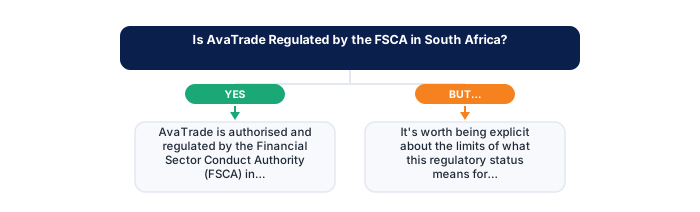
Yes. AvaTrade is authorised and regulated by the Financial Sector Conduct Authority (FSCA) in South Africa under FSP number 45984.
This means South African clients are dealing with a broker that has met the FSCA's capital, conduct, and disclosure requirements, with formal recourse if something goes wrong.
📋 ON THIS PAGE
1. What the FSP 45984 licence actually covers
Holding an FSCA Financial Services Provider licence is not a rubber stamp, it requires an entity to demonstrate ongoing compliance with a defined set of obligations. For AvaTrade's South African operation, this includes maintaining minimum capital adequacy levels appropriate to the scale of client funds it holds, keeping client deposits in segregated bank accounts separate from the company's own operating capital, employing key individuals who meet fit-and-proper standards set by the regulator, and submitting to periodic audits and reporting obligations that the FSCA can review at any time.
The licence also obligates AvaTrade to follow specific marketing and disclosure rules aimed at South African clients specifically, for example, prominently disclosing the percentage of retail client accounts that lose money trading CFDs, a standard risk warning requirement across FSCA-regulated CFD providers. This is why you'll see a loss-percentage statistic disclosed clearly on regulated brokers' marketing materials and account opening pages; it's not optional messaging, it's a compliance requirement tied directly to the licence.
It's worth checking the specific licence categories listed against your intended use, an FSP licence can cover different specific categories of financial service, confirming the categories relevant to forex and CFD trading specifically are included, rather than assuming any FSP licence automatically covers this particular activity.
2. How to verify this independently
Rather than taking any broker's regulatory claims at face value, including the claims in this article, independent verification takes only a few minutes and is worth doing as standard practice before opening any live trading account. manage to the FSCA's official register search tool at fsca.co.za, and search either for "AvaTrade" by name or directly for FSP number 45984. The register will display the current licence status, the categories of financial services the licence covers, and the date the licence was granted.
If the search returns an active status with forex and CFD-related licence categories listed, that confirms the regulatory claim. If the entity doesn't appear, appears with a different name than expected, or shows a suspended or withdrawn status, treat that as a serious discrepancy worth investigating further before proceeding with any deposit. This verification habit is useful well beyond AvaTrade specifically, apply the same five-minute check to any broker before trusting them with your funds.
- Search FSP name or number at fsca.co.za
- Confirm licence is current and not suspended
- Check scope covers forex and CFD activity
- Confirm client funds in segregated accounts
- Read FSCA enforcement actions history
- Test customer support before depositing
- Client funds legally segregated
- FSCA complaints process available
- SA consumer protections apply
- ZAR account, no FX conversion costs
- Some offshore brokers offer wider instruments
- Regulatory overhead passed on in spreads
- Stricter position limits for retail clients
- FICA verification required before trading
- Client funds segregated
- Formal FSCA complaints process
- SA consumer protections apply
- ZAR account available
- Fund safety not guaranteed
- Overseas disputes only
- SA law does not apply
- Currency conversion costs
It's worth making this specific check a habit for any broker you're considering, not just when a claim seems questionable, a quick, routine verification takes only a few minutes and provides direct, reliable confirmation rather than relying on trust in marketing material alone.
3. AvaTrade's regulation in other jurisdictions
Beyond its FSCA authorisation for South African clients, AvaTrade operates as a multi-jurisdiction broker with separate licences in several other major regulatory regions. These include authorisation from the Central Bank of Ireland (where its EU entity is based), the Australian Securities and Investments Commission (ASIC), Japan's Financial Services Agency (FSA), and the Abu Dhabi Global Market's Financial Services Regulatory Authority, among others depending on the specific client jurisdiction being served.
Each of these regulators imposes its own specific rules, for instance, European and UK-style regulators (under MiFID-derived frameworks) tend to impose stricter retail leverage caps than some other jurisdictions, meaning the exact trading conditions available to a South African client under FSCA rules may differ somewhat from those available to a client under, say, ASIC rules in Australia. This is normal and reflects each regulator's own risk framework rather than any inconsistency on AvaTrade's part.
It's worth researching the specific regulatory standards each jurisdiction applies if you want a deeper understanding, different regulators impose genuinely different requirements around leverage limits, client fund protections, and disclosure standards, worth knowing which specific framework applies to your own account.
4. Why operating under multiple regulators is a meaningful signal
Maintaining active licences across several major regulatory jurisdictions simultaneously is operationally demanding, each regulator has its own capital requirements, audit cycles, and compliance staff expectations, and falling out of compliance in one jurisdiction can create reputational and regulatory complications in others. Brokers that have sustained multi-jurisdiction licensing over many years (AvaTrade was founded in 2006) have generally demonstrated a level of institutional staying power and compliance infrastructure that newer, single-jurisdiction or unlicensed operators have not yet had the opportunity, or the willingness, to build.
This isn't a guarantee of anything regarding your individual trading outcomes, but it is a reasonable proxy for operational legitimacy when comparing brokers, a firm juggling compliance obligations across five or six serious regulators has considerably more to lose from cutting corners with client funds than an outfit operating from a single, lightly-regulated jurisdiction with minimal oversight.
| Protection | FSCA Regulated | Offshore Unregulated |
|---|---|---|
| Client fund segregation | ✓ Required | Varies by broker |
| SA complaints process | ✓ Available | ✗ Not available |
| SA consumer law applies | ✓ Yes | ✗ No |
| ZAR account available | ✓ Typically | Often USD/EUR only |
It's worth using this multi-jurisdiction operating history as one factor among several in your broader broker evaluation, discussed elsewhere on this site, rather than the sole basis for your decision, combining this signal with independent reviews and your own direct experience gives a more complete picture.
5. What FSCA regulation does not protect against
It's worth being explicit about the limits of what this regulatory status means for you as a trader, because conflating "regulated" with "safe from loss" is one of the most common misunderstandings among newer traders. FSCA oversight addresses broker conduct, fair dealing, fund segregation, accurate disclosure, not market outcomes. If you open a leveraged CFD position and the market moves against you, no regulator steps in to cover that loss; that's the normal, expected functioning of a high-risk financial instrument operating exactly as designed.
The statistic AvaTrade and other FSCA-regulated brokers are required to disclose, the percentage of retail clients losing money on CFDs, typically in the 70-80% range industry-wide, exists precisely because regulators want this distinction to be unmistakably clear to every client before they deposit a single Rand.
6. How client fund segregation works in practice
One of the more concrete protections that comes with FSCA authorisation is the requirement to hold client funds in segregated bank accounts, kept entirely separate from the company's own operational and corporate funds. In practical terms, this means that if AvaTrade's South African entity were to face financial difficulty as a business, client deposits sitting in segregated accounts are meant to be protected from being absorbed into the company's general creditors' pool, they remain identifiable as client money rather than company assets.
This is a meaningfully different risk profile from depositing with an unregulated broker, where there may be no legal requirement for fund segregation at all, and client deposits can effectively become indistinguishable from the broker's own operating capital, a structure that has directly contributed to total client fund losses in past collapses of unlicensed operators both in South Africa and internationally.
It's also worth knowing that any FSCA-regulated broker operating in South Africa is bound by POPIA (the Protection of Personal Information Act), which governs how your personal and financial data must be collected, stored, and protected.
A broker's own website claim is not sufficient confirmation.
Always verify a broker's FSCA status directly on the official FSCA FSP register at fsca.co.za. A broker's own website claim is not sufficient confirmation.
★ Why It Matters
Worth checking directly rather than just trusting a broker's own claim: search the specific FSP number on the FSCA's own register yourself, a surprising number of traders accept a broker's stated regulatory status without ever independently verifying it on the regulator's own database.
✕ Common mistakes
- Assuming international recognition implies South African regulation automatically. Each jurisdiction's licence must be confirmed separately.
- Not checking if the licence covers your specific account type. Some licences don't extend to every product or account tier.
- Ignoring licence status changes after initially opening an account. Periodic re-checking matters since regulatory status can change.
Key Takeaways
- Yes, AvaTrade holds an FSCA licence (FSP 45984) for South African clients. Learn what this regulation covers, how to verify it, and AvaTrade's global licences.
- AvaTrade is authorised and regulated by the Financial Sector Conduct Authority (FSCA) in South Africa under FSP number 45984.
- This means South African clients are dealing with a broker that has met the FSCA's capital, conduct, and disclosure requirements, with formal recourse if something goes wrong.
- What the FSP 45984 licence actually covers.
- How to verify this independently.
Frequently asked follow-up questions
What does FSP 45984 mean exactly?
FSP stands for Financial Services Provider, it's the unique licence number the FSCA assigns to each authorised financial services entity, similar to a registration number that identifies the specific licensed business.
Does AvaTrade's FSCA licence cover crypto trading too?
Crypto asset service provision in South Africa now falls under a separate FSCA licensing category (CASP) introduced in 2023; check the specific licence categories listed on the FSCA register for the most current scope of what's covered under any given broker's authorisation.
If AvaTrade is regulated in multiple countries, which rules apply to me as a South African client?
Generally, the rules of the entity and jurisdiction you're actually onboarded under apply, for South African residents trading through AvaTrade's locally licensed entity, FSCA rules and leverage limits apply to your account.
Can I switch from AvaTrade's South African entity to one of its other regional entities?
This typically isn't a simple account transfer; opening an account under a different regional entity generally means a separate onboarding process under that jurisdiction's own specific rules and verification requirements.
Does AvaTrade publish its FSCA compliance history publicly?
Most brokers don't publish a detailed compliance history themselves, but any formal enforcement action the FSCA takes against a licensed entity is generally reflected in the regulator's own public records and notices.
