i Short answer
A margin call occurs when your account equity falls below a required threshold relative to your used margin, prompting your broker to request funds or close positions.
Understanding this mechanic and applying disciplined position sizing are the most reliable ways to avoid it.
📋 ON THIS PAGE
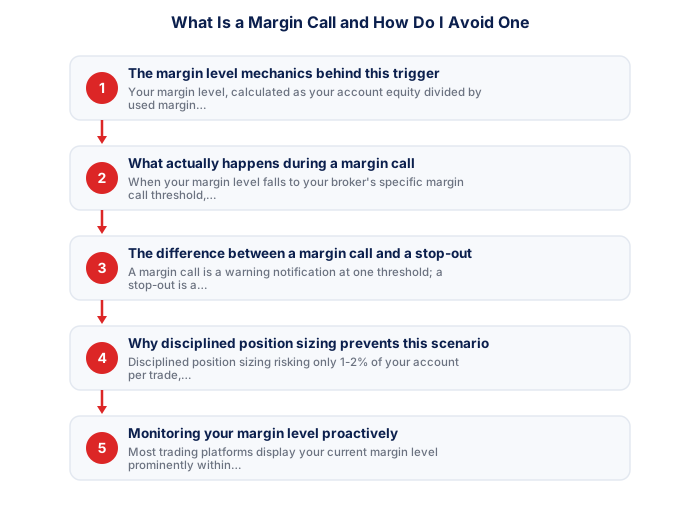
1. The margin level mechanics behind this trigger
Your margin level, calculated as your account equity divided by used margin and expressed as a percentage, determines how much buffer exists between your current account standing and the point where your broker takes protective action. As open positions move against you, equity decreases relative to used margin, lowering this percentage progressively toward the specific threshold that triggers a margin call.
It helps to picture this as a continuously updating figure rather than something calculated only occasionally. Every tick of price movement on an open position recalculates your equity in real time, which means margin level isn't a static number you check once and forget, it's constantly shifting alongside live market prices for as long as you hold open positions.
| Margin Level | Typical Status |
|---|---|
| Above 100% | Healthy, new trades allowed |
| Around 100% | Margin call warning zone |
| Below stop-out level (varies by broker) | Automatic position closure |
2. What actually happens during a margin call
When your margin level falls to your broker's specific margin call threshold, you typically receive a notification (via platform alert, email, or sometimes SMS) indicating that your account requires attention, either through depositing additional funds to restore your margin level, or by closing some existing positions to reduce your used margin relative to remaining equity.
The specific threshold that triggers this notification varies by broker, commonly somewhere in the region of 100% margin level, though the exact figure is worth confirming directly with your own broker rather than assuming a universal standard applies. This single number is genuinely worth knowing in advance, since it tells you exactly how much adverse movement your open positions can absorb before this stage is reached.
- P = Position size in lots
- R = ZAR amount at risk (1-2% of account)
- S = Stop distance in pips from entry
- V = Pip value per lot for this instrument
Set account risk %
Define maximum capital at risk per trade, typically 1-2%.
Measure stop distance
Find your stop-loss level on the chart before calculating size.
Calculate pip value
Use the instrument-specific pip value for your lot size.
Compute position size
Position size = (ZAR at risk) / (stop pips x pip value).
Confirm free margin
Ensure required margin fits within your available free margin.
3. The difference between a margin call and a stop-out
A margin call is a warning notification at one threshold; a stop-out is a more severe, automatic action at a lower threshold, where your broker's system automatically begins closing positions, typically starting with the most unprofitable one, without requiring your manual action. Understanding both thresholds for your specific broker and account type helps clarify exactly how much buffer you genuinely have before each respective action triggers.
Thinking of these as two separate warning lines, rather than one single event, is a useful mental model: crossing the first line is your cue to act voluntarily, while crossing the second means the decision has effectively been taken out of your hands. The gap between these two thresholds is exactly the window in which your own deliberate choices still matter more than the broker's automated system.
| Account | Risk % | Max loss (ZAR) | At 1:30 leverage | Notional position |
|---|---|---|---|---|
| R50,000 | 1% | R500 | 1:30 | R15,000 |
| R50,000 | 2% | R1,000 | 1:30 | R30,000 |
| R50,000 | 5% | R2,500 | 1:30 | R75,000 |
| R100,000 | 1% | R1,000 | 1:30 | R30,000 |
- Access larger positions with less capital
- Amplifies returns on winning trades
- Short-selling available without share borrowing
- Losses amplified equally, 10x leverage, 10x loss
- Overnight financing reduces long-term returns
- Margin calls can force closure at worst moments
4. Why disciplined position sizing prevents this scenario
Disciplined position sizing, risking only 1-2% of your account per trade, with appropriately calculated stop-loss distances, keeps your overall margin usage at a level where normal market fluctuation, even adverse fluctuation up to your predetermined stop-loss, shouldn't realistically bring your margin level anywhere near the call or stop-out thresholds.
This is worth stating plainly: a trader who consistently applies proper position sizing should rarely, if ever, actually experience a margin call under normal market conditions, since their maximum planned loss on any single position, or even several simultaneous positions, falls well short of the margin usage that would push their account anywhere near these thresholds. A margin call is, in that sense, often a signal that position sizing discipline broke down somewhere upstream of the immediate situation.
5. Monitoring your margin level proactively
Most trading platforms display your current margin level prominently within the account summary, allowing proactive monitoring rather than waiting for an automatic notification. Checking this figure periodically, particularly when holding multiple simultaneous positions given the correlation risk involved, helps you stay aware of your genuine buffer before any concerning threshold is approached.
Building this into a simple daily or per-session habit, glancing at margin level before adding any new position, particularly if you already hold open trades, costs very little time and catches a developing issue well before it becomes urgent. Waiting for an automatic notification means, by definition, you're only finding out after the situation has already reached a predefined danger threshold.
- Confirm account equity
- Calculate 1-2% risk in ZAR
- Identify stop-loss level from chart
- Measure stop distance in pips
- Look up pip value for instrument
- Compute position size
- Verify required margin fits free margin
6. What to do if you actually receive a margin call
If you do receive a margin call, calmly assessing your situation, rather than panicking or making hasty, emotionally-driven decisions, and choosing deliberately between depositing additional funds, if this genuinely makes sense given your broader financial situation, or accepting the reduction in position exposure through closing some positions, represents the more disciplined response to this situation.
It can help to have decided, in advance and while thinking clearly, which of these two responses you'd actually choose under different circumstances, rather than working it out for the first time in the stressful moment a margin call actually arrives. A trader who has already thought through 'if this happens, I will do X' has a concrete plan to follow, rather than facing an unfamiliar decision under pressure for the first time.
A margin call is a warning from your broker that your margin level is falling. If it continues falling to the stop-out level, positions are automatically closed. Smaller positions and stop-losses prevent this.
★ Why It Matters
Worth checking specifically with your own broker rather than assuming a universal figure: the exact margin level percentage that triggers a call versus the lower level that triggers a stop-out, these two distinct thresholds and the gap between them varies by broker and is worth knowing in advance.
✕ Common mistakes
- Running leverage and position sizes without a buffer against this threshold. A thin margin buffer leaves little room for normal price fluctuation.
- Assuming a margin call only happens during extreme, rare events. It can occur whenever margin requirements aren't met, more often than traders expect.
- Ignoring combined margin usage across multiple simultaneous positions. Combined exposure, not just one trade, determines proximity to a margin call.
Does this change my margin call risk?
They answer to different things. The stop is a price you chose. The margin call is arithmetic on your equity, and a distant stop does nothing to delay it. margin calculator page covers it in full.
Could this cost me more than my deposit?
Protection is standard for retail accounts at licensed brokers. It is the professional classification and the offshore entity that remove it. Leverage against margin in practice covers it in full.
Key Takeaways
- A margin call occurs when your account equity falls below a required threshold, prompting your broker to request additional funds or close positions.
- A margin call occurs when your account equity falls below a required threshold relative to your used margin, prompting your broker to request funds or close positions.
- Understanding this mechanic and applying disciplined position sizing are the most reliable ways to avoid it.
- The margin level mechanics behind this trigger.
- What actually happens during a margin call.
Frequently asked follow-up questions
Does every broker use the same margin call threshold?
No, specific thresholds vary by broker and sometimes by account type; checking your specific broker's documentation clarifies the exact figures applicable to your account.
Can I avoid margin calls entirely by using very low leverage?
Lower leverage generally provides more buffer, though disciplined position sizing remains important regardless of your specific leverage setting.
Is a margin call a sign I'm a bad trader?
Not necessarily a character judgement, but it is a clear signal that your current position sizing or risk management warrants review.
