i Short answer
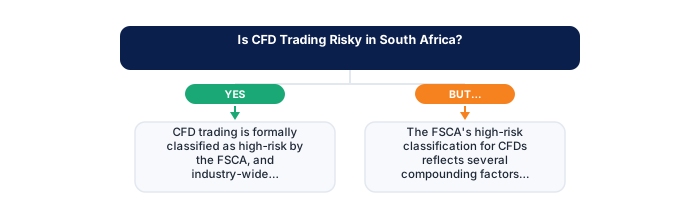
Yes. CFD trading is formally classified as high-risk by the FSCA, and industry-wide disclosures show that 70-80% of retail clients lose money trading CFDs.
This isn't a South Africa-specific issue, it's a consistent pattern across virtually every regulated market globally, reflecting something structural about the product itself.
📋 ON THIS PAGE
- Why CFDs are classified as high-risk specifically
- Leverage as the primary risk driver
- Why this risk pattern is globally consistent
- How regulation manages, but doesn't eliminate, this risk
- Comparing CFD risk to other South African investment options
- Practical ways to reduce, not eliminate, your risk exposure
1. Why CFDs are classified as high-risk specifically
The FSCA's high-risk classification for CFDs reflects several compounding factors built into the product structure itself: standard use of leverage that amplifies both gains and losses, relatively low barriers to entry (small minimum deposits and simple account opening, which can attract participants without adequate preparation or capital), pricing complexity (spreads, overnight financing charges, and sometimes other fees that create a persistent cost drag), and the speed at which positions can move significantly in short timeframes compared to many traditional, unleveraged investment products.
This classification isn't a judgment that CFDs are an illegitimate financial product, they serve genuine purposes for hedging and speculation among experienced market participants, but it does trigger specific regulatory obligations around disclosure and marketing that don't apply to lower-risk product categories, precisely because the regulator has determined the risk profile warrants this additional scrutiny and consumer protection.
note that that no single one of these factors alone would necessarily justify this classification, plenty of unleveraged products have low entry barriers, and plenty of leveraged products carry simpler fee structures. It's specifically the combination, leverage plus accessibility plus cost complexity plus speed, that produces a risk profile regulators have judged warrants this heightened category.
2. Leverage as the primary risk driver
Leverage is the single largest contributor to the elevated risk profile of CFD trading specifically. A relatively modest, normal market price movement, the kind that occurs routinely without representing any unusual event, translates into a significantly amplified percentage gain or loss relative to a leveraged trader's actual deposited capital, compared to the much smaller percentage impact the same price move would have on an unleveraged direct investment in the underlying asset.
This amplification cuts both ways mathematically, but the practical, observed effect across large numbers of retail traders skews heavily toward losses, largely because the same leverage that makes occasional large wins possible also makes it easy to sustain large losses quickly, particularly for traders without disciplined risk management actively limiting position sizes relative to their account capital.
- D = Drawdown as decimal (e.g. 0.25 = 25%)
- 25% drawdown = needs 33% to recover
- 50% drawdown = needs 100% to recover
- 75% drawdown = needs 300% to recover
It can help to picture this asymmetry concretely: a trader without leverage who loses on a position loses only what they actually committed to that position, and simply has less capital for the next opportunity. A leveraged trader who loses can lose that same percentage many times faster, potentially exhausting the capital needed to recover from a single bad stretch before genuine statistical edge, if it exists, has had a fair chance to play out across enough trades.
| Investment Type | Leverage | Typical Risk Level |
|---|---|---|
| CFD trading | Yes, amplifies both gains and losses | High |
| Unit trusts | No | Low to moderate |
| JSE direct share ownership | No | Moderate |
| Retirement annuities | No | Low |
3. Why this risk pattern is globally consistent
The 70-80% retail loss statistic for CFDs appears with remarkable consistency across regulated markets in Europe, the UK, Australia, and South Africa, despite these jurisdictions having different specific regulatory frameworks, different typical client demographics, and different local market conditions. This consistency strongly suggests the underlying driver is something structural about the product itself, the combination of leverage, cost structure, and typical retail trading behaviour patterns, rather than something specific to any particular country's market conditions or regulatory environment.
This global consistency is worth keeping in mind specifically because it counters a common, mistaken assumption that poor South African trading outcomes might reflect some local market disadvantage or inferior local broker quality, the same broad pattern shows up wherever this product category is offered to retail clients under comparable regulatory disclosure requirements.
- Position size calculated before every entry
- Stop-loss defined from chart structure before entry
- Total open risk below 5% of account at any time
- No adding to losing positions under any circumstances
- Trading paused if monthly drawdown reaches 10%
- Stops never moved further away once position is open
This also means the solution isn't found by searching for a 'better' broker or jurisdiction where the odds are supposedly friendlier, since the pattern holds regardless of broker or country. The meaningful lever available to any individual trader is their own discipline, risk management, and realistic expectations, not the specific regulatory environment or platform they happen to be using.
4. How regulation manages, but doesn't eliminate, this risk
Ask specifically whether your account is ring-fenced against a negative balance. FSCA should be stated in the agreement rather than in support chat.
None of these measures change the underlying statistical reality that most retail clients lose money trading CFDs, they specifically address conduct and worst-case-scenario risks, while leaving the core market risk (that leveraged speculation is genuinely difficult to do profitably and consistently) entirely intact, exactly as it should, since eliminating that risk would require eliminating the product's fundamental nature.
| Drawdown | Recovery needed | At 20%/yr | At 10%/yr |
|---|---|---|---|
| 10% | 11.1% | 7 months | 14 months |
| 25% | 33.3% | 19 months | 38 months |
| 50% | 100.0% | 4+ years | 7+ years |
| 75% | 300.0% | Never at 10%/yr | Never at 10%/yr |
It's worth being clear-eyed about what this means practically: a fully compliant, properly regulated broker, doing everything right by FSCA standards, can still be the venue through which the large majority of its retail clients lose money, simply because that outcome reflects the product's inherent risk rather than any regulatory failure. Regulation and profitability are answering entirely different questions.
5. Comparing CFD risk to other South African investment options
For context, it's worth comparing CFD trading's risk profile to other common South African investment vehicles. Unit trusts and retirement annuities, for example, typically involve no leverage, longer investment horizons, and professional fund management, producing a meaningfully different risk and return profile historically associated with positive long-run average outcomes for patient investors, even though individual fund performance varies and short-term losses remain possible.
Direct share ownership on the JSE, while carrying genuine market risk and no guarantee of positive returns, similarly lacks the leverage amplification that drives much of CFD trading's elevated risk statistics. This comparison isn't meant to suggest CFDs are categorically worse as a financial product, they serve different purposes, including short-term speculation and hedging that other instruments don't easily support, but understanding the meaningfully different risk profiles helps put CFD-specific statistics into broader context.
This comparison is worth returning to whenever CFD trading starts to feel like a primary wealth-building strategy rather than what it more realistically is for most retail participants, a higher-risk, shorter-term speculative or hedging activity best pursued with capital you could genuinely afford to lose, sitting alongside, rather than replacing, longer-term investment approaches better suited to building wealth patiently over time.
6. Practical ways to reduce, not eliminate, your risk exposure
While CFD trading's high-risk classification is structural and can't be eliminated through any technique, several practices can meaningfully reduce the severity of typical losses without changing the fundamental nature of the product. These include using leverage well below the maximum available, applying strict, consistent position sizing based on a small fixed percentage risk per trade, maintaining adequate account capitalisation rather than trading with minimal deposits, and building genuine strategy testing and discipline before committing significant capital.
None of these practices flip the statistical odds in a guaranteed way, even disciplined traders following sound risk management can and do experience losses, but they meaningfully reduce the likelihood of the most severe, account-ending outcomes that disproportionately affect undisciplined or undercapitalised retail traders specifically.
CFD leverage amplifies both gains and losses equally. Negative balance protection prevents your account going below zero, but losses up to your full deposit remain entirely possible.
★ Why It Matters
Worth sitting with this specific number: the published 70-80% loss rate among retail CFD clients isn't a South African anomaly, it's remarkably consistent across every jurisdiction that publishes this data, which suggests the issue is structural to the product and leveraged trading generally, not specific to any one market or broker.
✕ Common mistakes
- Treating regulation as a guarantee against losing money. Regulation addresses conduct and disclosure, not trading outcomes.
- Ignoring the structural reasons behind the consistently high loss rate. Leverage and short-term trading patterns appear to be significant contributing factors.
- Not adjusting personal risk management in light of this published statistic. The data is a meaningful input for setting realistic expectations.
Key Takeaways
- Yes, the FSCA classifies CFDs as high-risk instruments, with 70-80% of retail accounts losing money. Understand why and how regulation manages this risk.
- CFD trading is formally classified as high-risk by the FSCA, and industry-wide disclosures show that 70-80% of retail clients lose money trading CFDs.
- This isn't a South Africa-specific issue, it's a consistent pattern across virtually every regulated market globally, reflecting something structural about the product itself.
- Why CFDs are classified as high-risk specifically.
- Leverage as the primary risk driver.
See also: Can I Retire Early in South Africa? and How Do I Actually Make Money Online in South Africa?.
Frequently asked follow-up questions
Are some CFD instruments riskier than others?
Yes, instruments with higher typical volatility (certain commodities, some emerging-market currency pairs, individual volatile shares) generally carry higher practical risk than comparatively lower-volatility major instruments, independent of the leverage applied.
Does South Africa have higher CFD risk than other countries?
No, the available evidence suggests South African retail CFD loss statistics are broadly in line with the global pattern observed across other regulated markets, rather than reflecting any specific local disadvantage.
Can professional or experienced traders reduce this risk meaningfully?
Experienced traders with tested strategies and disciplined risk management can and do achieve better individual outcomes than the aggregate statistic suggests, though the aggregate statistic itself reflects the reality that this is genuinely difficult to achieve consistently.
Does the published loss percentage ever change over time?
Yes, brokers typically update this disclosed figure periodically based on their own current client data, so checking the most recent published statistic for any specific broker gives the most accurate picture.
Is CFD trading riskier than buying and holding JSE shares directly?
Generally yes, given the leverage typically involved in CFD trading, compared to the unleveraged nature of direct share ownership, though both carry genuine market risk.
