i Short answer
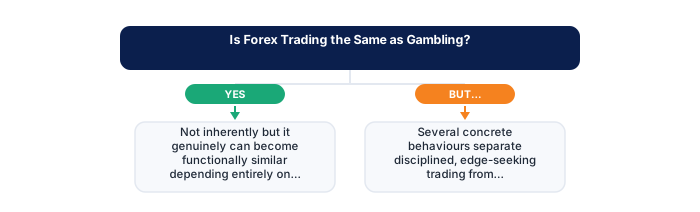
Not inherently, but it can become functionally similar depending on how you approach it.
Systematic trading with tested analysis and defined risk management differs structurally from gambling; impulsive trading with no strategy behaves a lot like it.
📋 ON THIS PAGE
1. The structural differences that matter
In most conventional forms of gambling, casino games, lottery tickets, many sports betting structures, the odds are mathematically fixed against the player by design, and no amount of skill development changes the underlying statistical edge held by the house over a large enough number of plays. Roulette pays out at odds that guarantee the casino a long-run profit regardless of any individual player's strategy or skill, because the game's structure makes this mathematically inevitable.
Trading markets are structurally different: prices move based on the aggregated decisions, information, and behaviour of millions of other market participants, and a trader who develops genuine skill in reading patterns, managing risk, and executing consistently can, in principle, develop a real statistical edge over time, something that's mathematically impossible in fixed-odds gambling games by their very design. This structural possibility of skill-based edge development is the core distinction, even though it doesn't guarantee that any particular individual trader actually achieves it.
It's worth sitting with this distinction carefully, since it's the genuine foundation for why trading and gambling, despite superficial similarities, are structurally different activities, a fixed-odds game offers no path to a genuine, sustainable statistical edge regardless of skill, while markets genuinely do, provided that edge is properly developed and tested.
2. What having an "edge" actually means
An "edge" in trading refers to a systematic, demonstrable tendency for a particular strategy to produce profitable outcomes over a large enough sample of trades, even though any individual trade within that sample might lose. This is conceptually similar to how a casino's edge works, except inverted, a trader with a genuine edge wins more in total value across many trades than they lose, even while losing a meaningful percentage of individual trades along the way.
See also: How Do I Manage Trading Notification Volume?
Developing genuine edge requires rigorous strategy testing (often called backtesting and forward-testing), disciplined execution that doesn't deviate from the tested approach based on emotion, and enough trading volume over enough varied market conditions to distinguish a real statistical edge from simple short-term luck. This is genuinely difficult, time-consuming work, which is precisely why the majority of retail traders, who skip this process and trade more impulsively, don't actually develop or maintain a real edge, and their results end up resembling gambling outcomes in practice.
| Lot type | Size | USD/ZAR pip value | Min recommended account |
|---|---|---|---|
| Standard | 100,000 units | ~R1.00 | R100,000+ |
| Mini | 10,000 units | ~R0.10 | R10,000+ |
| Micro | 1,000 units | ~R0.01 | R1,000+ |
| Nano | 100 units | ~R0.001 | R100+ |
- V = Pip value in account currency
- E = Current exchange rate of quote vs account currency
- L = Lot size (100,000 standard / 10,000 mini / 1,000 micro)
- USD/ZAR example = 1 pip = R1 per standard lot
- Leveraged instrument
- Long and short available
- Overnight financing applies
- No ownership of asset
- Typically unleveraged
- Physical currency received
- No daily financing
- Currency ownership
It's worth being honest that developing genuine edge is considerably harder than casual trading content often suggests, the rigorous testing and disciplined execution this requires is precisely why so many traders who approach the activity casually end up experiencing outcomes that do resemble gambling, not because trading is inherently gambling, but because they haven't done the work that separates the two.
3. When trading functionally resembles gambling
Without a tested strategy, clear entry and exit rules, and consistent position sizing, trading decisions become driven largely by impulse, recent emotional state, or unverified tips from social media, under these conditions, outcomes become essentially random with respect to any actual market edge, while still carrying real transaction costs (spreads, financing charges) that create a structural drag similar to a casino's house edge. In this mode, trading and gambling become functionally very similar, even if the legal and regulatory framework around them remains entirely different.
This is one reason the high retail loss statistics regulators require brokers to disclose (typically 70-80% of retail CFD accounts losing money) exist: a large proportion of retail trading activity, in practice, resembles this undisciplined mode far more than it resembles the rigorous, edge-based approach that genuinely separates trading from gambling in theory.
It's worth checking your own trading honestly against this specific description, if decisions genuinely stem from impulse and emotion rather than a tested, written strategy, that's worth acknowledging directly rather than assuming the activity itself confers legitimacy regardless of how it's actually being conducted.
4. Comparing the house edge in gambling to trading costs
It's worth being explicit about the cost structures involved in trading, since they create a real headwind comparable in spirit to a casino's house edge, even though the mechanism is different. Every trade incurs a spread (the difference between buy and sell price), and leveraged positions held overnight typically incur financing charges. These costs accumulate with trading frequency, meaning a trader with no genuine edge, making essentially random decisions, will, on average, lose money over time purely from these transaction costs, in much the same way a roulette player with no edge loses to the house's built-in advantage over enough spins.
This is why having a genuine, tested edge matters so much practically: a strategy needs to overcome not just being "right" more often than wrong on price direction, but specifically needs to overcome the accumulated drag of transaction costs on top of that, which is a meaningfully higher bar than many beginning traders initially appreciate.
5. The concrete markers of disciplined, non-gambling trading
Several concrete behaviours separate disciplined, edge-seeking trading from gambling-like trading in practice. These include having a written, tested strategy with clear, objective entry and exit rules defined before entering any trade (rather than decided in the moment); applying a defined maximum risk percentage per trade (commonly 1-2% of account capital), consistently, regardless of how confident any individual trade feels; maintaining a trading journal that records the reasoning and outcome of every trade, enabling honest review of whether the strategy and execution are actually working over time; and accepting individual losing trades calmly as a normal, expected part of even a profitable strategy, rather than reacting emotionally or deviating from process after a loss.
Each of these practices exists specifically to counteract the impulsive, emotion-driven decision-making that makes trading resemble gambling, they're not arbitrary rules but direct, practical countermeasures against the specific behavioural patterns that erode any potential trading edge.
It's worth using this list as an honest, periodic self-check, reviewing your own practice against each specific marker gives a considerably more concrete, evidence-based answer to 'am I trading or gambling' than relying on a general sense of your own intentions or self-image.
6. Why the psychological experience can feel similar anyway
Even disciplined, edge-based trading shares some genuine psychological overlap with gambling, which is worth acknowledging honestly rather than dismissing. The uncertainty of any individual outcome, the dopamine response to wins and losses, and the potential for trading to become compulsive in ways that mirror gambling addiction are all real phenomena that affect even traders applying sound technical processes. This is part of why responsible trading education increasingly addresses psychological discipline and emotional regulation as seriously as it addresses chart analysis or strategy mechanics.
If you notice signs of compulsive trading behaviour, trading to chase losses, trading despite clear strategy signals to stop, or experiencing trading as primarily an emotional escape rather than a deliberate, process-driven activity, these are worth taking seriously and addressing directly, including seeking support if the pattern resembles problem gambling behaviour, regardless of the underlying financial instrument involved.
Without an edge or risk management, the practical difference narrows.
Disciplined trading with a statistically verified edge, adjustable position sizing, and genuine risk management differs meaningfully from gambling, where the house edge works against you.
★ Why It Matters
Something worth checking about your own approach specifically: whether you could explain your edge, in concrete statistical terms, to someone else, traders who can't articulate why they expect to win over time, beyond 'the chart looked right', are closer to gambling than they may realise, regardless of how they label what they're doing.
✕ Common mistakes
- Treating every trade as an independent bet rather than part of a tested system. A systematic approach differs structurally from gambling even when outcomes still feel uncertain.
- Chasing losses in a way that mirrors classic gambling behaviour. This pattern, more than the activity itself, is what resembles gambling most closely.
- Ignoring whether your own approach has ever been genuinely backtested. See backtesting as the step that distinguishes a tested edge from a hunch.
Key Takeaways
- Not inherently, but it can become similar without discipline. Learn the structural differences between trading and gambling, and what separates them.
- Not inherently, but it can become functionally similar depending on how you approach it.
- Systematic trading with tested analysis and defined risk management differs structurally from gambling; impulsive trading with no strategy behaves a lot like it.
- The structural differences that matter.
- What having an "edge" actually means.
See also: How Much Do Forex Traders Actually Earn in SA?.
Frequently asked follow-up questions
Can someone with no trading experience develop a genuine edge quickly?
Genuine, demonstrable edge typically takes meaningful time and a large enough sample of trades across varied conditions to establish with confidence, there's no reliable shortcut, regardless of marketing claims suggesting otherwise.
Is day trading more like gambling than longer-term position trading?
Not inherently due to time frame alone, but the higher frequency of day trading does mean transaction costs accumulate faster, and the speed of decision-making can make emotional, undisciplined behaviour more likely without strict process controls.
If I keep a trading journal, does that guarantee I'm not gambling?
A journal alone doesn't guarantee edge, but consistently reviewing it honestly to assess whether your strategy and execution are actually working over time is one of the most useful practical tools for distinguishing genuine skill development from gambling-like behaviour.
Do casinos and trading platforms use similar psychological design tricks?
Some trading apps do borrow engagement techniques, like frequent notifications or gamified visuals, that echo casino design, which is exactly why being aware of these influences and managing screen time matters for staying in a disciplined mindset.
Can a profitable trader still have a gambling problem?
Yes, profitability doesn't rule this out; someone can have a genuinely sound strategy on paper while still experiencing compulsive, anxiety-driven engagement with markets that mirrors problem gambling, which is worth taking seriously regardless of financial results.
