What this page covers
Liquidity decides what a trade costs beyond the published fees. A share that trades heavily has a narrow spread and absorbs size; a thin one does neither, and the difference is larger than the brokerage.
| Group | Typical characteristics |
|---|---|
| Large resource counters | Highest turnover, narrow spreads, move with commodity prices |
| Big four banks | Deep and consistent, sensitive to rate decisions |
| Dual listed industrials | High turnover, price set partly offshore |
| Large retailers | Good liquidity, driven by domestic consumer data |
| Listed property | Moderate, sensitive to the long bond yield |
| Small caps | Thin, wide spreads, hard to exit in size |
| Liquidity | Typical spread | Practical effect |
|---|---|---|
| Top 40 constituent | A few basis points | Fills close to the screen price |
| Mid cap | Wider | Some slippage on size |
| Small cap | Materially wider | The spread can exceed a day's move |
| Illiquid counter | Very wide | Exiting may take days or move the price |
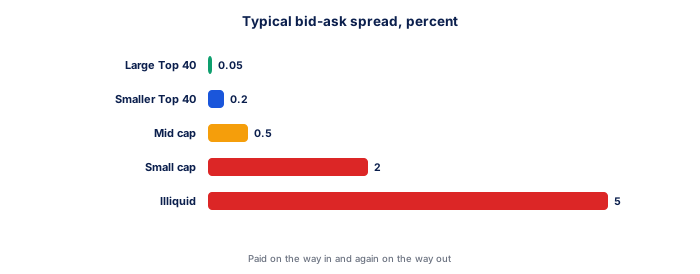
| Spread | Typical share | Round trip cost |
|---|---|---|
| 0.05% | Large Top 40 constituent | about R100 |
| 0.20% | Smaller Top 40 name | about R400 |
| 0.50% | Mid cap | about R1,000 |
| 2.00% | Small cap | about R4,000 |
| 5.00% | Illiquid counter | about R10,000 |

Download this data
Every table on this page as a spreadsheet, with the source and the date it was checked in the header rows.
⬇ Download CSVHow these figures work
Liquidity is the ability to transact size without moving the price. It shows up in two numbers: the spread between bid and offer, and the depth of the order book at each level.
The published fees are visible and fixed. The spread is neither, and on a thin counter it is the larger cost by a wide margin. It is also paid twice, on entry and on exit.
★ A worked example
Two purchases of R100,000, one in a Top 40 constituent and one in a small cap.
The Top 40 share has a spread of about 0.1%. Buying at the offer and selling at the bid costs roughly R100 on the round trip, plus the published fees.
The small cap has a spread of 2%. The same round trip costs about R2,000 in spread alone, twenty times more, before a single fee. The share has to rise 2% just to return to breakeven on the spread, and the book may not hold R100,000 at one level anyway.
✕ Common mistakes
- Judging cost by brokerage alone. On a thin counter the spread dwarfs every published fee.
- Using market orders in illiquid shares. A market order takes whatever the book offers. In a thin book that can be far from the last price.
- Assuming liquidity is constant. It thins into public holidays, around index rebalances, and in quiet periods before the close.
- Sizing a position without checking depth. A position that takes days to exit is a different risk from the same rand amount in a liquid share.
Notes on reading these figures
- Volume is published by the JSE daily and every broker platform shows it. Checking it before entering is the cheapest risk control available.
- A wide spread is a cost paid twice, on entry and on exit. On a thin counter it can exceed everything the trade needs to overcome.
- Liquidity is not constant. It thins into public holidays, around index rebalances, and in the minutes before the closing auction on a quiet day.
To put these figures to work, the JSE Indices Reference runs the arithmetic on your own numbers, and JSE Trading Cost Schedule covers the same ground in ordinary language. Why liquidity matters and The most actively traded JSE shares go into the detail this table only summarises.
Terms used on this page
Put this table on your own site
The table below can sit on your own page and stays current without you editing anything.
- Preview the embeddable table as it will appear on your site
To put the live table on your own page, paste this where you want it to appear. It stays current without you editing anything.
<iframe src="https://www.tradeanswers.co.za/embed/ref-most-actively-traded-jse-shares.html" width="100%" height="620" style="border:0" title="Most Actively Traded JSE Shares"></iframe>Free to use with attribution. The link back to this page is built into the embed.
Frequently asked questions
How do I check liquidity before trading?
Look at average daily volume and the current spread. Both are on every broker platform and published by the JSE.
What is a normal spread on the JSE?
A few basis points on a large Top 40 constituent, materially wider on a small cap, and very wide on an illiquid counter.
Does liquidity affect my stop?
Yes. In a thin book a stop is filled at whatever is available, which can be well beyond the level you set.
Why does volume spike at the close?
The closing auction sets the official price used for index and fund valuation, so index-tracking flow concentrates there.
Are resource shares always the most active?
They usually dominate turnover, because they are large and because commodity price moves generate trading in both directions.
Is high volume a buy signal?
No. It says the share is easy to trade, not that it is worth trading. Liquidity is a cost consideration, not a direction one.