i Short answer
A stop-loss automatically closes a losing position at a predetermined price, limiting further loss; a take-profit does the equivalent for winning positions, locking in gains.
Both execute automatically without requiring active, real-time monitoring once set. A trailing stop-loss is a related variant that automatically follows price in your favour. Try our free Take Profit Calculator to work through the numbers yourself.
📋 ON THIS PAGE
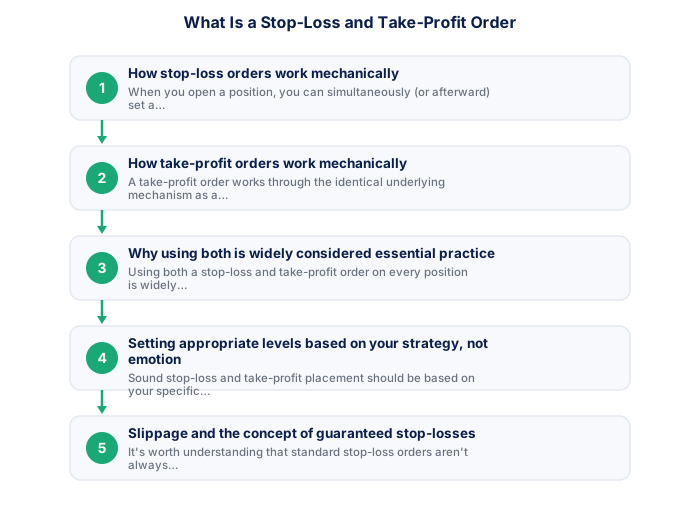
- How stop-loss orders work mechanically
- How take-profit orders work mechanically
- Why using both is widely considered essential practice
- Setting appropriate levels based on your strategy, not emotion
- Slippage and the concept of guaranteed stop-losses
- Common mistakes traders make with these specific orders
- Why a stop-loss cannot protect you over a weekend
1. How stop-loss orders work mechanically
When you open a position, you can simultaneously (or afterward) set a specific price level at which a stop-loss order will trigger, automatically closing the position if the market price reaches that level. For a long position, this stop-loss level sits below your entry price (since you're protecting against a price decline); for a short position, it sits above your entry price (protecting against a price increase).
Once set, this order remains active on the broker's server, monitoring the live market price continuously, and executes automatically the moment the specified price level is reached. Crucially, this happens regardless of whether you're actively watching your trading platform at that exact moment, which is exactly the practical value this order type provides for risk management without requiring continuous manual attention.
This server-side execution is worth understanding clearly, because it's what separates a genuine stop-loss order from simply having a mental plan to "close the position if it drops to X." A mental plan depends on you being available, alert, and willing to act on it in the moment, all three of which can fail under real pressure. A properly placed stop-loss order removes that dependency entirely, since the broker's system, not your own in-the-moment willpower, is what actually carries out the exit.
| Feature | Stop-Loss | Take-Profit |
|---|---|---|
| Purpose | Limits losses | Locks in gains |
| Triggers when price moves | Against you | In your favour |
| Subject to slippage | Yes, unless guaranteed | Less commonly an issue |
2. How take-profit orders work mechanically
A take-profit order works through the identical underlying mechanism as a stop-loss, just applied to the opposite, favourable price direction. For a long position, the take-profit level sits above your entry price; for a short position, it sits below your entry price. Once the market price reaches this predetermined favourable level, the position closes automatically, locking in the resulting profit without requiring you to actively monitor the position and manually close it at exactly the right favourable moment.
This automatic execution addresses a specific psychological challenge in trading psychology, the temptation to either close a winning position too early out of fear of losing unrealised gains, or hold it too long hoping for even further gains beyond what your original strategy and analysis actually justified, by predetermining the specific exit target in a calm planning moment, well before the emotional pressure of an actual live, profitable position might otherwise distort that exit decision.
- D = Drawdown as decimal (e.g. 0.25 = 25%)
- 25% drawdown = needs 33% to recover
- 50% drawdown = needs 100% to recover
- 75% drawdown = needs 300% to recover
It's worth being honest that a take-profit order does mean occasionally leaving further gains on the table if price continues moving favourably well beyond your target. Some traders address this by adjusting the take-profit level as a position develops, based on updated analysis, rather than treating the original level as permanently fixed, though doing this deliberately and infrequently, rather than constantly, matters for keeping the discipline benefit intact.
3. Why using both is widely considered essential practice
Using both a stop-loss and take-profit order on every position is widely considered essential, foundational practice among experienced, disciplined traders, specifically because it embeds the predetermined-rules approach to risk management and discipline directly into the mechanics of each individual trade, rather than relying on continuous active monitoring and in-the-moment judgement calls that are vulnerable to exactly these kinds of emotional pressures and biases.
Trading without a stop-loss specifically exposes you to the risk of an adverse price movement continuing far beyond what you would have rationally accepted had you predetermined a specific loss limit in advance. This is one of the most consistently cited, avoidable mistakes contributing to poor outcomes among many beginning traders.
- Position size calculated before every entry
- Stop-loss defined from chart structure before entry
- Total open risk below 5% of account at any time
- No adding to losing positions under any circumstances
- Trading paused if monthly drawdown reaches 10%
- Stops never moved further away once position is open
The take-profit side of this discipline matters just as much, even though its downside is less dramatic. Without a predetermined exit target, it's easy to drift into holding a winning position indefinitely on the hope of further gains, watching an unrealised profit gradually shrink back toward breakeven, or even into loss, simply because there was never a clear point at which "good enough" had been reached and the trade was meant to end.
4. Setting appropriate levels based on your strategy, not emotion
Sound stop-loss and take-profit placement should be based on your strategy's technical or fundamental analysis, for example, placing a stop-loss just beyond a relevant technical support or resistance level identified through chart analysis, or sizing the distance between entry and stop-loss based on the instrument's typical volatility, rather than being set arbitrarily or based on a fixed monetary amount you simply feel comfortable risking without reference to the actual technical or analytical context of the trade.
Working backward from your account's defined risk percentage per trade (commonly 1-2%) combined with your strategy-determined stop-loss distance gives you the appropriate position size for that trade, rather than the reverse approach of choosing a position size first and then setting a stop-loss wherever happens to fit that already-chosen size. This distinction in the order of these calculations genuinely matters for maintaining consistent, disciplined risk management across all your trades.
| Drawdown | Recovery needed | At 20%/yr | At 10%/yr |
|---|---|---|---|
| 10% | 11.1% | 7 months | 14 months |
| 25% | 33.3% | 19 months | 38 months |
| 50% | 100.0% | 4+ years | 7+ years |
| 75% | 300.0% | Never at 10%/yr | Never at 10%/yr |
A useful gut check: if you find yourself regularly adjusting your stop-loss distance to fit a position size you've already decided on, rather than the other way around, that's usually a sign the position size was chosen first for reasons unrelated to the trade's actual technical picture, worth pausing on before repeating the pattern across future trades.
5. Slippage and the concept of guaranteed stop-losses
It's worth understanding that standard stop-loss orders aren't always guaranteed to execute at exactly the specified price level, particularly during periods of extreme volatility or significant price gaps (where price jumps suddenly past your stop-loss level without trading at intermediate prices along the way). This phenomenon, called slippage, means your actual exit price can sometimes be somewhat worse than your originally specified stop-loss level during these extreme conditions.
Some brokers offer guaranteed stop-loss orders as a specific, sometimes additionally priced feature, which contractually guarantee execution at exactly your specified level regardless of slippage or gapping, giving additional certainty at a cost (often reflected in a wider spread or specific fee for this guarantee). Whether this additional certainty is worth its cost depends on your risk tolerance and how concerned you are about slippage risk for your particular trading style and the instruments you trade.
Slippage risk isn't evenly distributed across market conditions. It's most relevant around major scheduled news releases, unexpected geopolitical developments, or the open of a trading session after a period when markets were closed, precisely the moments when price can gap rather than move smoothly. Traders who tend to hold positions through these specific windows have more reason to weigh guaranteed stop-losses seriously than those who typically avoid holding positions through them.
6. Common mistakes traders make with these specific orders
Several common mistakes undermine the genuine value these order types provide: moving a stop-loss further away from entry after a position has already moved into loss, specifically to avoid realising that loss, directly undermining the predetermined-discipline benefit above and effectively recreating the exact emotional, in-the-moment decision-making these orders are specifically designed to remove from the process; setting stop-losses too tight relative to an instrument's normal, expected volatility, resulting in being prematurely stopped out of trades that would have eventually moved favourably had the stop-loss been placed with more appropriate distance; and forgetting to set either order entirely, leaving a position fully exposed to unlimited monitoring requirements and emotional, real-time decision-making that these order types specifically exist to avoid.
Avoiding these mistakes connects directly back to broader discipline-building practices in trading psychology. Treating your predetermined stop-loss and take-profit levels as genuinely fixed, calmly-decided commitments rather than flexible suggestions open to in-the-moment emotional revision is exactly what makes these order types valuable in actual practice, not just in theory.
A take-profit locks in your intended gain before greed can extend the trade.
A stop-loss limits your downside by automatically closing a losing position at your set level. A take-profit locks in the intended gain before greed tempts you to hold past your original target.
★ Why It Matters
Worth checking with your broker: whether they offer guaranteed stop-losses (at an extra cost) versus standard ones that can still suffer slippage during extreme gaps. This distinction matters considerably more during genuinely volatile, fast-moving conditions than in normal trading.
✕ Common mistakes
- Assuming a standard stop-loss guarantees an exact exit price. Slippage can still occur during fast-moving or gapping conditions.
- Not checking whether your broker offers a guaranteed stop option. This typically costs more but removes slippage risk entirely.
- Setting both orders without considering the instrument's typical volatility. A stop too tight for current conditions can trigger prematurely.
- Moving a stop-loss further away once price approaches it. This defeats the purpose of having set it in the first place.
7. Why a stop-loss cannot protect you over a weekend
A stop-loss executes when the market trades through your level. If the market never trades at that level, there is nothing to execute against. That is exactly what happens across a weekend: trading closes around midnight on Friday SAST and reopens on Sunday evening at whatever price reflects everything that happened in between, with no prices in the gap.
For South African traders this is a live risk rather than a theoretical one. Rating agency reviews, political developments and fiscal announcements frequently break over a local weekend, and USD/ZAR can reopen well away from Friday's close. A stop placed at R16.20 on a position that reopens at R16.60 fills at R16.60, not at the stop. The loss is whatever the gap turns out to be.
Key Takeaways
- A stop-loss automatically closes a losing position at a predetermined level; a take-profit does the same for winning positions. Learn how and why to use both.
- A stop-loss automatically closes a losing position at a predetermined price, limiting further loss; a take-profit does the equivalent for winning positions, locking in gains.
- Both execute automatically without requiring active, real-time monitoring once set.
- How stop-loss orders work mechanically.
- How take-profit orders work mechanically.
See also: What Does the Term Whipsaw Mean in Trading?.
Frequently asked follow-up questions
Can I set a stop-loss after I've already opened a position?
Yes, most platforms allow adding or modifying a stop-loss on an already-open position, though best practice is setting it immediately upon opening the position, before any emotional attachment to the trade's current performance develops.
Does a stop-loss guarantee I won't lose more than my set amount?
In most normal market conditions, yes, though extreme volatility or price gaps can occasionally cause slippage resulting in a slightly worse execution price than your exact specified stop-loss level, unless you've specifically opted for a guaranteed stop-loss feature.
Should beginners always use both a stop-loss and take-profit on every trade?
Yes, this is widely considered fundamental, essential practice for disciplined risk management, particularly important for beginners still building the psychological discipline that trading requires.
