i Short answer
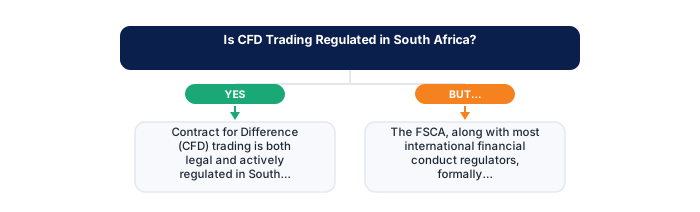
Yes, CFD trading is legal and closely regulated in South Africa. Any broker offering CFDs to South African clients needs an FSCA licence to do so lawfully.
Because the FSCA treats CFDs as high-risk instruments, providers face extra disclosure obligations, and any firm offering them without a licence is simply operating illegally.
📋 ON THIS PAGE
1. What a CFD actually is, mechanically
At its core, a Contract for Difference is simply an agreement with your broker to settle the difference in an asset's price between opening and closing a position, neither of you ever actually owns anything underlying. Open a CFD on gold, and if the price climbs 2% before you close out, the broker pays you the cash equivalent on your position size position size. Drop 2%, and you're the one paying. No gold bars, no share certificates, no currency ever changes hands.
That structure is exactly what gives CFDs their flexibility. You can bet on falling prices just as easily as rising ones, gain exposure to indices or commodities that would otherwise mean complicated ownership arrangements, and typically apply leverage to control a position bigger than your actual deposit. The same mechanism cuts both ways, though: leverage magnifies losses exactly as readily as it magnifies gains, which is precisely why CFDs carry more risk than owning the underlying asset outright.
It's worth sitting with this mechanical simplicity for a moment, since it's exactly what makes CFDs so flexible and, at the same time, exactly why they require this level of regulatory scrutiny, the same structure that lets you speculate on virtually any instrument through one account also means the underlying risk sits entirely on whether your view turns out correct.
2. Why regulators classify CFDs as high-risk
The FSCA, like most financial conduct regulators internationally, formally classifies CFDs as complex, high-risk instruments. That's not a blanket warning tacked on for legal cover, it reflects specific, documented concerns. Leverage, how fast a position can turn against you, and how easy these accounts are to open (low deposits, minimal friction) combine into a product that's genuinely riskier for an inexperienced retail trader than something like unleveraged shares or a unit trust.
None of this means CFDs are somehow illegitimate, institutional desks and experienced traders use them constantly for hedging and speculation. What the classification does is load providers with a heavier compliance burden: stricter disclosure, tighter marketing rules, and, in some jurisdictions more than others (Europe applies this more uniformly than South Africa does), leverage caps meant to limit how exposed any one retail account can get.
- Search FSP name or number at fsca.co.za
- Confirm licence is current and not suspended
- Check scope covers forex and CFD activity
- Confirm client funds in segregated accounts
- Read FSCA enforcement actions history
- Test customer support before depositing
- Client funds legally segregated
- FSCA complaints process available
- SA consumer protections apply
- ZAR account, no FX conversion costs
- Some offshore brokers offer wider instruments
- Regulatory overhead passed on in spreads
- Stricter position limits for retail clients
- FICA verification required before trading
- Client funds segregated
- Formal FSCA complaints process
- SA consumer protections apply
- ZAR account available
- Fund safety not guaranteed
- Overseas disputes only
- SA law does not apply
- Currency conversion costs
It's worth checking your specific broker's own disclosed loss statistic directly rather than relying on general industry figures, since this mandated disclosure gives you a concrete, provider-specific data point rather than an abstract, general risk classification alone.
3. What FSCA licensing requires of CFD providers
Offering CFDs legally to South African clients means holding an FSP licence under the category that covers derivative instruments, the bucket CFDs fall into. Getting there isn't a paperwork formality: applicants must show capital reserves proportional to the business they plan to run, put forward key individuals who clear fit-and-proper checks (competence, integrity, criminal record, regulatory history, the works), and build out systems for fund segregation, record-keeping, and complaint handling that the FSCA can actually audit.
And it doesn't end once the licence is granted. Providers stay under ongoing supervision, file periodic reports, and can face an FSCA audit or investigation at any point. Serious or repeated breaches carry real consequences too: fines, suspension, or losing the licence outright.
It's worth appreciating what this ongoing supervision actually means in practice, a licence isn't a one-time approval that then goes unchecked, providers face genuine, continuing accountability, which is part of why regulatory status remains a meaningful, current signal rather than a historical fact that could be outdated.
4. The mandatory risk disclosure rules
One requirement you'll actually see in plain sight: providers must disclose, clearly and prominently, what percentage of their retail clients lost money over roughly the past year. That's why almost every FSCA-regulated CFD broker's site shows a figure somewhere between 70% and 80%. It isn't a marketing choice, it's mandatory, and it exists so nobody can later claim they weren't warned about the realistic odds before putting money in.
Beyond that headline number, regulated providers also can't market language implying guaranteed or easy profits, have to spell out how leverage and margin calls actually work in their documentation, and need to lay out fees, spreads, and overnight financing charges in accessible terms before anyone finishes opening an account.
| Protection | FSCA Regulated | Offshore Unregulated |
|---|---|---|
| Client fund segregation | ✓ Required | Varies by broker |
| SA complaints process | ✓ Available | ✗ Not available |
| SA consumer law applies | ✓ Yes | ✗ No |
| ZAR account available | ✓ Typically | Often USD/EUR only |
It's worth reading these disclosures in full rather than skimming past them during account opening, they're specifically designed to give you an honest, upfront picture of what you're getting into, worth the few minutes it takes to actually absorb what's being disclosed.
5. How leverage limits work for retail CFD clients
South Africa doesn't codify a single fixed leverage cap the way the EU does under ESMA rules (1:30 on major forex pairs for retail clients, no exceptions). Here, limits vary more by broker and asset class, within whatever the FSCA considers acceptable risk management. In practice, though, most FSCA-regulated brokers still land somewhere comparable to international norms, typically 1:30 to 1:200 depending on the instrument and whether you're classified as retail or professional.
Worth checking a broker's specific leverage terms directly rather than assuming, this is one area where fully regulated providers can genuinely differ, and the ratio on offer has a direct, mechanical effect on how much your account moves for every unit the underlying asset does.
6. How to check a CFD broker's compliance status
Before opening a live account, go straight to the FSCA's public register at fsca.co.za and check the broker's FSP licence yourself. Confirm two things: that it's active, and that the licence category actually covers derivative instruments (the bucket CFDs sit in), not some unrelated financial service that just happens to share the company's name.
Beyond the licence itself, look for the mandatory loss-percentage disclosure somewhere on the broker's account opening pages. Seeing it is a decent basic compliance signal. Not seeing it, on a broker claiming to serve South African clients, is worth treating as a red flag rather than an oversight.
One more thing worth knowing: any FSCA-regulated broker here also has to comply with POPIA, the Protection of Personal Information Act, which governs how your personal and financial data gets collected, stored, and protected.
It doesn't regulate trade outcomes or guarantee profits.
FSCA regulation covers broker licensing, fund handling, and leverage limits. It doesn't and can't regulate individual trade outcomes or guarantee trading profits.
★ Why It Matters
Here's the distinction worth holding onto: FSCA regulation governs how the broker behaves and whether it's licensed, not how risky the CFD product itself is. A fully compliant, properly regulated broker can still hand you a product where most clients end up losing money. Regulation and risk simply aren't the same axis.
✕ Common mistakes
- Assuming a regulated broker means profitable outcomes. Even fully compliant brokers sit in a category where most clients still lose money.
- Skipping the disclosure requirements specific to CFDs. They exist precisely because of how the product is risk-classified.
- Confusing CFD-specific rules with general financial services regulation. CFDs come with extra obligations that go beyond standard licensing.
Key Takeaways
- Yes, CFD trading is legal and regulated by the FSCA in South Africa. Learn what makes CFDs high-risk, how brokers are licensed, and how to check compliance.
- Yes, CFD trading is legal and closely regulated in South Africa.
- Any broker offering CFDs to South African clients needs an FSCA licence to do so lawfully.
- What a CFD actually is, mechanically.
- Why regulators classify CFDs as high-risk.
Frequently asked follow-up questions
Are CFDs the same thing as forex trading?
Not quite, forex specifically means currency pairs, while CFDs are a broader contract structure that can wrap around currencies, indices, commodities, shares, you name it. Most retail forex trading in South Africa is technically executed through that same CFD-style structure anyway.
Can I lose more money than I put into a CFD trade?
With leverage, technically yes, unless your broker offers negative balance protection, which plenty of FSCA-regulated brokers now include as standard, capping your maximum loss at whatever you deposited.
Why do some brokers offer higher leverage than others on the same instrument?
It comes down to the broker's own risk management approach, what their licence specifically permits, and sometimes your account classification, retail versus professional or qualified investor.
Do CFDs trade on a public exchange like JSE shares do?
No. CFDs trade over-the-counter, directly between you and your broker, not through a centralised exchange. That's a big part of why the broker's own regulatory standing carries so much weight.
Does FSCA regulation apply differently to CFDs on shares versus CFDs on currencies?
The broad conduct framework stays the same across CFD products, but specific leverage limits and margin requirements shift by asset class, reflecting how differently volatile they typically are.
