i Short answer
Speculative capital is allocated for short-to-medium-term trading with explicit acceptance of higher risk and potential total loss.
Investment capital pursues longer-term, typically lower-risk growth, often through diversified holdings.
📋 ON THIS PAGE
1. Defining speculative capital clearly
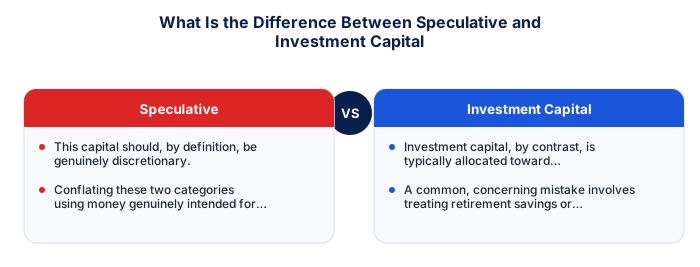
Speculative capital is money specifically set aside for activities like forex and CFD trading, where you explicitly accept a meaningful possibility of losing this capital entirely in exchange for the potential for relatively rapid gains. This capital should, by definition, be genuinely discretionary.
It's worth applying this same, honest test to your own trading capital allocation, discussed elsewhere on this site regarding defining discretionary capital, if losing this specific amount would genuinely, materially disrupt your life, it doesn't qualify as genuine speculative capital regardless of how you've mentally categorised it.
2. Defining investment capital clearly
Investment capital, by contrast, is typically allocated toward longer-term wealth building, retirement savings, diversified share portfolios, property, or other holdings intended to grow steadily over years or decades, generally with lower volatility and risk than leveraged speculative trading. This capital usually shouldn't be used for active trading given its different purpose and time horizon.
See also: What Is a Good Framework for Analysing USD/ZAR?
It's worth understanding why this category generally deserves a different, more conservative approach, capital earmarked for long-term goals, retirement, a home deposit, genuinely serves a different purpose than speculative trading capital, worth managing accordingly rather than exposing it to trading-level risk.
- FSCA-regulated broker verified at fsca.co.za
- Demo account tested for minimum 60 days
- Trading plan written: entry, exits, position sizing
- Risk per trade defined (1-2% of account)
- Backup internet connection tested for load shedding
- Tax implications understood
3. Why this distinction matters for your allocation decisions
Conflating these two categories, using money genuinely intended for long-term investment goals to fund speculative trading activity, or vice versa, undermines the specific purpose each category is meant to serve. Investment capital exposed to speculative trading risk could jeopardise long-term financial goals like retirement security, while excessive caution applied to genuinely speculative capital might prevent you from pursuing trading opportunities your risk tolerance would otherwise support.
It's worth reviewing your own current capital allocation honestly against this framework, checking whether any funds you're currently trading with genuinely belong in the investment category instead, worth correcting this if you find a genuine mismatch.
| Characteristic | Speculative Capital | Investment Capital |
|---|---|---|
| Purpose | Generate returns through active trading | Long-term wealth building |
| Time horizon | Short to medium term | Years to decades |
| Risk tolerance | High: can lose the full amount | Moderate: preserving principal matters |
| Instruments used | CFDs, leveraged forex, derivatives | Shares, ETFs, property, retirement funds |
| Leverage | Often used | Rarely or never |
| SARS treatment | Trading profits taxed as income | Capital gains may apply on long-term investments |
| Consequence of loss | Inconvenient: not life-altering | Serious: retirement or essential savings affected |
| South African allocation | Money you can afford to lose entirely | Pension, RA, TFSA, emergency fund |
4. Common mistakes blending these two categories inappropriately
A common, concerning mistake involves treating retirement savings or other long-term investment holdings as a source of additional trading capital during a period of trading enthusiasm or perceived opportunity. This blending directly contradicts the fundamentally different risk tolerance and time horizon these two capital categories are meant to reflect.
It's worth watching for this specific pattern in your own thinking, treating genuinely long-term investment capital as available for trading, or vice versa, both represent a category confusion worth actively guarding against through clear, deliberate separation.
| Item | Detail |
|---|---|
| Regulator | FSCA, fsca.co.za |
| Exchange control | SARB, resbank.co.za |
| Tax authority | SARS, sars.gov.za |
| JSE hours | 09:00-17:00 SAST Mon-Fri |
| Best forex session | 15:00-17:00 SAST |
| CGT annual exclusion | R50,000 (individuals) |
5. How much should typically go into each category
There's no universal percentage split appropriate for everyone, the right allocation depends on your specific financial goals, age, risk tolerance, and overall financial picture. However, the general principle, establishing emergency savings and core long-term investment goals first, before allocating any genuinely discretionary remainder toward speculative trading, gives a sensible sequencing framework regardless of the specific percentages involved.
It's worth working through this allocation deliberately for your own specific circumstances, rather than applying a generic percentage, your appropriate split depends on your genuine financial goals, timeline, and risk tolerance, worth thinking through carefully rather than defaulting to an arbitrary figure.
6. Revisiting this allocation as your circumstances change
As your broader financial circumstances evolve, income changes, progress toward specific investment goals, changing family circumstances, periodically revisiting how you've categorised and allocated capital between speculative and investment purposes ensures this allocation continues to genuinely reflect your current situation rather than an outdated, earlier decision.
The mathematics of recovery from drawdown is fundamental knowledge for any trader managing risk. A 10% drawdown requires an 11% gain to recover. A 25% drawdown requires a 33% gain. A 50% drawdown requires a 100% gain. A 75% drawdown requires a 300% gain to return to the starting equity level. This asymmetric relationship between losses and recovery is why controlling drawdown is mathematically more valuable than maximising returns. A trader who generates consistent 20% annual returns without a drawdown exceeding 15% will outperform a trader generating 40% returns but periodically experiencing 50% drawdowns, not just on a risk-adjusted basis but in absolute capital terms over a multi-year compounding period. Building a trading system around drawdown control as the primary objective, with returns as the secondary outcome, reflects the true mathematics of capital growth correctly.
Investment capital is for long-term wealth building with a lower risk profile.
Speculative capital for active trading should be money you can genuinely afford to lose entirely. Investment capital is meant for long-term wealth building with a different time horizon and risk expectation.
★ Why It Matters
Worth doing as a concrete exercise: physically separate these two pools into different accounts with different bank references, rather than mentally tracking the split within one combined balance. The physical separation seems to genuinely reduce the temptation to blur the line under pressure.
✕ Common mistakes
- Mixing speculative and investment capital within the same account. Physical separation into different accounts creates a meaningful psychological barrier against blurring the line.
- Treating long-term investment capital with the same risk tolerance as trading capital. These serve genuinely different purposes and warrant different risk treatment.
- Not having a clear, predetermined definition of which capital belongs to each category. Ambiguity here makes it easier to justify inappropriate risk-taking under pressure.
- Dipping into investment capital to fund a trading account during a rough patch. This undermines the very separation meant to protect long-term goals.
Key Takeaways
- Speculative capital is allocated for short-term trading with acceptance of higher risk, while investment capital pursues longer-term, typically lower-risk growth.
- Speculative capital is allocated for short-to-medium-term trading with explicit acceptance of higher risk and potential total loss.
- Investment capital pursues longer-term, typically lower-risk growth, often through diversified holdings.
- Defining speculative capital clearly.
- Defining investment capital clearly.
Frequently asked follow-up questions
Can I ever use investment capital for trading if I'm confident in a specific opportunity?
This generally isn't advisable given the fundamentally different risk tolerance and purpose these categories represent, regardless of confidence in any specific opportunity.
Is property considered investment capital?
Generally yes, property typically falls within longer-term investment capital given its usual time horizon and risk profile, distinct from short-term speculative trading.
Should retirement annuity contributions ever be reduced to fund trading?
This is generally not advisable, given retirement savings' specific long-term purpose and the genuine risk of speculative trading capital.
