i Short answer
The Kelly Criterion calculates a mathematically optimal bet size based on your strategy's edge and risk-reward odds.
Most retail traders use a more conservative fraction of this figure rather than the full, mathematically maximal amount.
📋 ON THIS PAGE
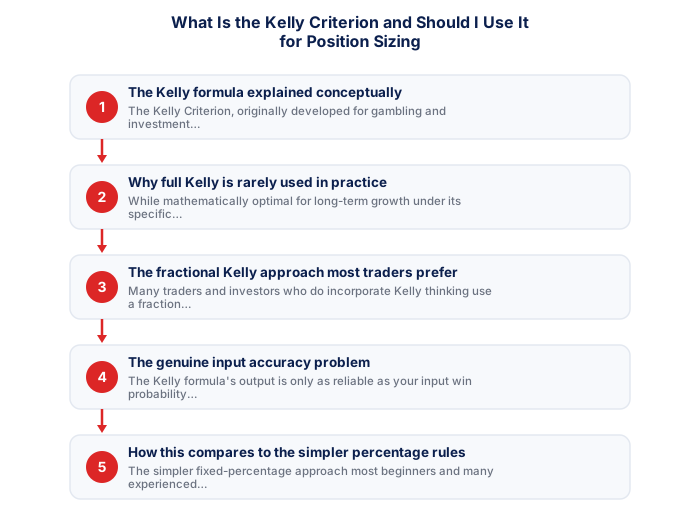
1. The Kelly formula explained conceptually
The Kelly Criterion, originally developed for gambling and investment contexts, calculates the theoretically optimal fraction of capital to risk on a given bet or trade, based specifically on your genuine probability of winning and the payout odds involved, aiming to maximise long-term capital growth mathematically given these specific inputs.
It's worth understanding this as a mathematically optimal formula under specific, idealised conditions, discussed further below, the theoretical elegance of Kelly doesn't automatically translate into practical suitability for genuine, real-world trading with imperfect information.
2. Why full Kelly is rarely used in practice
While mathematically optimal for long-term growth under its specific assumptions, full Kelly position sizing tends to produce extremely volatile, large swings in account value, including potentially severe short-term drawdowns, that most traders find genuinely uncomfortable and difficult to sustain psychologically, even if mathematically justified.
It's worth understanding why this theoretical optimum proves genuinely impractical, full Kelly sizing produces such significant volatility and drawdown, discussed elsewhere on this site regarding drawdown generally, that few traders could genuinely tolerate living through it even if their inputs were perfectly accurate.
- FSCA-regulated broker verified at fsca.co.za
- Demo account tested for minimum 60 days
- Trading plan written: entry, exits, position sizing
- Risk per trade defined (1-2% of account)
- Backup internet connection tested for load shedding
- Tax implications understood
3. The fractional Kelly approach most traders prefer
Many traders and investors who do incorporate Kelly thinking use a fraction of the full calculated figure, commonly a quarter or half of the mathematically optimal amount, deliberately sacrificing some theoretical long-term growth in exchange for meaningfully reduced volatility and drawdown, a trade-off most find considerably more sustainable in practice.
It's worth testing a few different fractional levels through backtesting if you're genuinely interested in this approach, discussed elsewhere on this site regarding backtesting generally, finding your own appropriate fraction requires understanding your personal tolerance for the resulting volatility.
4. The genuine input accuracy problem
The Kelly formula's output is only as reliable as your input win probability and odds figures, which themselves require a sufficiently large, representative sample to verify genuine edge. Applying Kelly sizing based on inaccurate or insufficiently sampled inputs can produce a genuinely poor, miscalibrated result despite the formula's mathematical elegance.
It's worth appreciating why this is Kelly's most significant practical limitation, the formula requires precisely accurate win rate and payoff estimates, discussed elsewhere on this site regarding sample size requirements, inputs that are genuinely difficult to know with confidence for most retail trading strategies.
| Item | Detail |
|---|---|
| Regulator | FSCA, fsca.co.za |
| Exchange control | SARB, resbank.co.za |
| Tax authority | SARS, sars.gov.za |
| JSE hours | 09:00-17:00 SAST Mon-Fri |
| Best forex session | 15:00-17:00 SAST |
| CGT annual exclusion | R50,000 (individuals) |
5. How this compares to the simpler percentage rules
The simpler fixed-percentage approach most beginners and many experienced traders use, like the 2% rule, avoids Kelly's input-accuracy sensitivity entirely, providing a more sound, if theoretically less precisely optimised, approach that doesn't depend on confidently knowing your exact win probability and odds in advance.
It's worth appreciating why the simpler fixed-percentage approach, discussed elsewhere on this site regarding the 2% rule, remains more practical for most retail traders, it doesn't require the precise statistical inputs Kelly demands, making it more sound to genuine estimation uncertainty.
6. A practical recommendation for most retail traders
For most retail traders, particularly those still developing genuinely validated, large-sample strategy statistics, the simpler percentage-based approach generally provides a more practical, reliable starting point than Kelly sizing, which becomes more genuinely useful once you have a longer, more confidently validated track record supporting accurate input figures.
The mathematics of recovery from drawdown is fundamental knowledge for any trader managing risk. A 10% drawdown requires an 11% gain to recover. A 25% drawdown requires a 33% gain. A 50% drawdown requires a 100% gain. A 75% drawdown requires a 300% gain to return to the starting equity level. This asymmetric relationship between losses and recovery is why controlling drawdown is mathematically more valuable than maximising returns. A trader who generates consistent 20% annual returns without a drawdown exceeding 15% will outperform a trader generating 40% returns but periodically experiencing 50% drawdowns, not just on a risk-adjusted basis but in absolute capital terms over a multi-year compounding period. Building a trading system around drawdown control as the primary objective, with returns as the secondary outcome, reflects the true mathematics of capital growth correctly.
Full Kelly maximises the theoretical long-run growth rate but requires a precisely accurate win rate estimate and produces aggressive position sizes. Most traders who use it apply half or quarter Kelly to reduce drawdown risk.
★ Why It Matters
Worth calculating: your full Kelly percentage, then deliberately using one-quarter or one-half of that figure in practice. Traders who use the full Kelly amount often find the resulting drawdowns are mathematically optimal for long-term growth but psychologically far harder to tolerate in the moment.
✕ Common mistakes
- Trusting an estimated win rate without accounting for estimation error. A slightly overestimated win rate can suggest a considerably larger position than your true edge supports.
- Not testing a fractional Kelly approach as a more conservative alternative. Many traders find one-quarter or one-half Kelly more sustainable in practice.
- Treating Kelly-suggested size as fixed rather than reassessing periodically. Updated statistics should feed into a recalculated, current figure.
Key Takeaways
- The Kelly Criterion calculates a mathematically optimal bet size based on edge and odds, though most retail traders use a more conservative fraction of it.
- The Kelly Criterion calculates a mathematically optimal bet size based on your strategy's edge and risk-reward odds.
- Most retail traders use a more conservative fraction of this figure rather than the full, mathematically maximal amount.
- The Kelly formula explained conceptually.
- Why full Kelly is rarely used in practice.
For the formula itself and where it came from, see what the Kelly Criterion is.
Frequently asked follow-up questions
Is Kelly Criterion sizing too advanced for beginners?
It's generally considered more suited to traders with already-validated, large-sample strategy statistics, rather than an ideal starting point for complete beginners.
Can I use a Kelly calculator to simplify this process?
Yes, various free online calculators automate this formula, though the genuine input accuracy problem remains regardless of calculation convenience.
Does fractional Kelly guarantee better results than fixed percentage sizing?
Not guaranteed. It represents a different mathematical approach with its own trade-offs, rather than a universally superior method for every trader's situation.
Is Kelly sizing ever appropriate for beginners?
Generally not recommended, since beginners typically lack the large-sample, verified edge data Kelly sizing assumes. The simpler fixed risk-percentage approach fits better while still building that track record.
Can Kelly sizing be applied to a discretionary, non-systematic strategy?
This is considerably harder, since Kelly relies on precise win rate and risk-reward inputs that discretionary strategies don't always produce as cleanly as fully systematic approaches.
Does using fractional Kelly eliminate drawdown risk entirely?
No. It reduces but doesn't eliminate drawdown risk. Drawdowns remain a normal part of trading even with conservative position sizing.
Is there a simple way to calculate my own Kelly percentage?
Free Kelly calculators are widely available online, you input your strategy's tested win rate and risk-reward ratio, though the real challenge is trusting those inputs given the estimation error problem above.
