i Short answer
FICA, the Financial Intelligence Centre Act, requires brokers to verify your identity and address before opening an account and processing significant transactions.
This is a legal requirement under South Africa's anti-money-laundering framework, not a broker-specific bureaucratic hurdle.
📋 ON THIS PAGE
- What FICA actually requires from brokers
- Typical documents you'll need to provide
- Why this requirement protects you, not just the broker
- When verification typically happens in the account process
- What happens if you don't complete verification
- Data protection considerations alongside FICA compliance
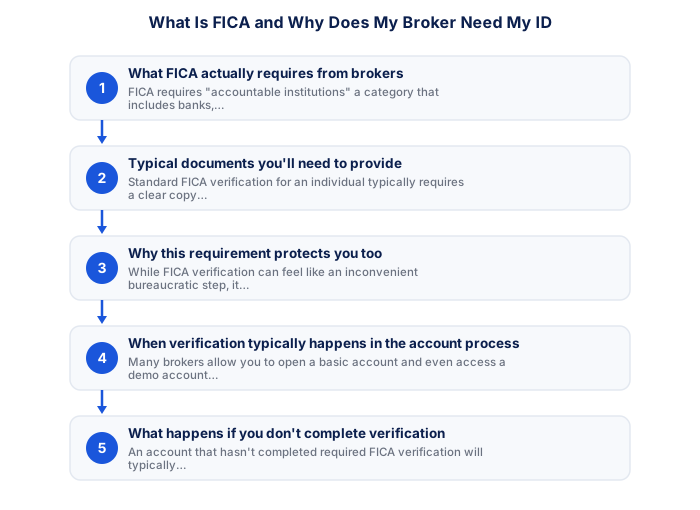
1. What FICA actually requires from brokers
FICA requires "accountable institutions", a category that includes banks, and financial services providers like forex and CFD brokers, to establish and verify the identity of their clients before establishing a business relationship, and to keep records of this verification along with ongoing transaction monitoring for patterns that might indicate money laundering or other illicit financial activity.
This isn't a discretionary practice some brokers choose to implement and others skip, it's a binding legal obligation, meaning any FSCA-regulated broker genuinely operating within South African law will require this verification, and a broker conspicuously skipping it entirely is itself a red flag regarding their overall regulatory legitimacy.
This obligation also extends beyond the initial account opening. Accountable institutions are required to keep verification records current and to monitor ongoing activity, which is why a broker might occasionally ask you to re-confirm or update your documentation years into an existing relationship, particularly if your personal details have changed or a routine compliance review flags your file for refresh.
See also: How Does Trading Real Estate Investment Trusts (REITs) Wo
2. Typical documents you'll need to provide
Standard FICA verification for an individual typically requires a clear copy of your South African ID document or passport, proof of residential address (commonly a recent utility bill, bank statement, or similar official document showing your name and address, usually required to be no older than three months), and sometimes proof of the source of funds you intend to deposit, particularly for larger amounts.
Most brokers now handle this process digitally, allowing you to photograph or scan these documents and upload them directly through their account opening portal or mobile app, with verification typically completed within a few business days, though this can sometimes be faster or require additional follow-up depending on document quality and any specific verification checks the broker's systems flag.
- Search FSP name or number at fsca.co.za
- Confirm licence is current and not suspended
- Check scope covers forex and CFD activity
- Confirm client funds in segregated accounts
- Read FSCA enforcement actions history
- Test customer support before depositing
- Client funds legally segregated
- FSCA complaints process available
- SA consumer protections apply
- ZAR account, no FX conversion costs
- Some offshore brokers offer wider instruments
- Regulatory overhead passed on in spreads
- Stricter position limits for retail clients
- FICA verification required before trading
- Client funds segregated
- Formal FSCA complaints process
- SA consumer protections apply
- ZAR account available
- Fund safety not guaranteed
- Overseas disputes only
- SA law does not apply
- Currency conversion costs
Document quality genuinely matters for how smoothly this process goes. A blurry photo, a cropped edge cutting off part of your ID number, or a utility bill with an address that doesn't clearly match what you entered on the application form are among the most common reasons verification gets delayed or kicked back for resubmission, small details worth double-checking before you upload anything.
3. Why this requirement protects you too
While FICA verification can feel like an inconvenient bureaucratic step, it serves a genuine protective function beyond simply satisfying regulatory compliance. Brokers operating within this verification framework are part of a broader system designed to prevent the financial sector from being used for illicit purposes, and your own participation in this verified system means your funds and transactions are part of a properly documented, traceable financial relationship rather than an informal arrangement with limited accountability.
This connects to the broader distinction between regulated and unregulated brokers: a broker skipping FICA verification entirely is operating outside the legal framework that provides much of the practical protection you'd otherwise have, making this verification step a genuine, if sometimes mildly inconvenient, signal of legitimate operation rather than empty box-ticking.
There's also a practical, personal benefit worth noting: verified accounts are generally easier to recover access to if you ever lose your login credentials or need to prove ownership of the account for any reason, including the less pleasant scenario of a dispute or an estate matter. An unverified or informally-documented relationship gives you far less to point to if you ever need to establish that the account and its funds are genuinely yours.
4. When verification typically happens in the account process
Many brokers allow you to open a basic account and even access a demo account before completing full FICA verification, but will require this verification to be completed before you can make your first deposit, or in some cases before you can process your first withdrawal, depending on the specific broker's exact process and risk policies. Some brokers require verification earlier in the process than others, so checking this specific sequence with your chosen broker helps set accurate expectations about when you'll need these documents ready.
Completing this verification proactively, well before you actually need to deposit or withdraw funds urgently, avoids delaying your first withdrawal. Submitting your documents early in your account setup process, rather than waiting until verification becomes an active blocker, is a simple, practical habit worth adopting.
| Protection | FSCA Regulated | Offshore Unregulated |
|---|---|---|
| Client fund segregation | ✓ Required | Varies by broker |
| SA complaints process | ✓ Available | ✗ Not available |
| SA consumer law applies | ✓ Yes | ✗ No |
| ZAR account available | ✓ Typically | Often USD/EUR only |
It's worth treating this as one of the first tasks on your account-opening checklist rather than something to handle later, precisely because the exact trigger point, first deposit, first withdrawal, or something else, varies by broker and isn't always obvious until you actually hit it. Having your documents ready from day one means you're never caught off guard by a verification requirement at an inconvenient moment.
5. What happens if you don't complete verification
An account that hasn't completed required FICA verification will typically face restrictions, commonly an inability to deposit funds beyond a minimal threshold, or an inability to withdraw funds at all, until verification is properly completed. This isn't the broker being deliberately obstructive; it reflects their own legal obligation not to process significant financial transactions for unverified clients under the FICA framework.
If you find your account restricted in this way, the practical solution is simply completing whatever specific verification steps the broker requires, submitting clear, current, and complete documentation, most delays in this process stem from incomplete or unclear document submissions rather than any deeper underlying problem.
If a submission is rejected, most brokers will specify the reason, whether it's image quality, a mismatch in details, or a document that's expired or outside the required date range. Reading this feedback carefully before resubmitting, rather than simply re-uploading the same document, saves an unnecessary additional round of back-and-forth with support.
6. Data protection considerations alongside FICA compliance
The personal documentation and information you provide for FICA compliance is also subject to South Africa's Protection of Personal Information Act (POPIA), which governs how this kind of sensitive personal data must be stored, used, and protected by the broker. A genuinely FSCA-regulated broker should have clear data protection and privacy policies addressing how your FICA documentation specifically is handled, stored securely, and not used for purposes beyond the legitimate verification and compliance functions it was collected for.
Reviewing a broker's privacy policy regarding how FICA-related documentation is handled is a reasonable, additional due diligence step, particularly given the sensitivity of the documents involved (ID copies, proof of address) compared to other, less sensitive account information.
If a dispute with the FSCA itself arises, for example over a licensing decision, the Financial Services Tribunal exists as an independent body where such decisions can be formally appealed, separate from the broker complaints process.
FICA requires brokers to verify your identity and address before opening an account. This is a legal obligation under South Africa's Financial Intelligence Centre Act, designed to prevent money laundering and fraud.
★ Why It Matters
Something worth doing proactively: keep a digital folder with current, valid copies of your ID and proof of address ready, rather than scrambling to source them when a broker requests fresh verification, documents that were valid at account opening can quietly expire over a multi-year relationship.
✕ Common mistakes
- Treating FICA verification as a broker-specific bureaucratic hurdle. It's a legal requirement under South Africa's anti-money-laundering framework, not broker discretion.
- Submitting documents with inconsistent personal details. Mismatches between documents can stall verification unnecessarily.
- Assuming FICA verification is a one-time requirement that never needs revisiting. Brokers can request fresh verification periodically or after certain triggers.
Key Takeaways
- FICA requires brokers to verify your identity before opening an account, as part of South Africa's anti-money-laundering framework. Here's what's required.
- FICA, the Financial Intelligence Centre Act, requires brokers to verify your identity and address before opening an account and processing significant transactions.
- This is a legal requirement under South Africa's anti-money-laundering framework, not a broker-specific bureaucratic hurdle.
- What FICA actually requires from brokers.
- Typical documents you'll need to provide.
See also: Why Did the FSCA Impose Record R2.89bn in Fines, and What It Means for You.
Frequently asked follow-up questions
Can I deposit any amount before completing FICA verification?
Most brokers restrict deposits beyond a minimal threshold, or sometimes any deposit at all, until verification is complete; specific thresholds vary by broker.
How long does FICA verification typically take?
Often a few business days for straightforward, clear document submissions, though this can extend if documents are unclear, incomplete, or trigger additional review.
Is FICA verification a one-time process?
Generally yes for standard verification, though brokers may periodically request updated proof of address or additional documentation, particularly if your circumstances change or as part of routine compliance refresh cycles.
What if my proof of address is in someone else's name, like a parent's?
Some brokers accept an affidavit or supporting letter confirming you reside at that address alongside the document holder's name; checking your specific broker's policy for this scenario avoids unnecessary delay.
Does FICA apply if I'm a foreign national living in South Africa?
Yes, FICA verification requirements generally apply based on residency and the account relationship itself, meaning foreign nationals opening a South African brokerage account typically face similar verification requirements, often using a passport and local proof of address.
