i Short answer
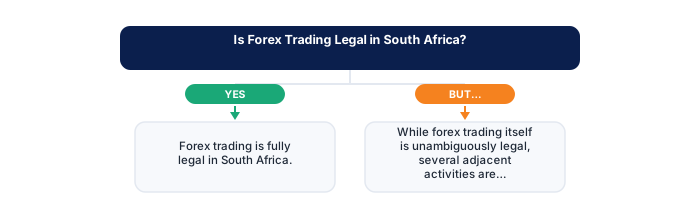
Yes. Forex trading is fully legal in South Africa, regulated by the FSCA (which licenses brokers) and SARB (which governs money moving offshore).
Most legal questions people run into are about which broker they use, not whether trading itself is allowed, it always is.
📋 ON THIS PAGE
1. Who regulates forex trading in South Africa
South Africa does not have a single, dedicated "forex regulator" the way some countries do. Instead, oversight is split between two institutions that each handle a different part of the picture. The FSCA is the market conduct authority, it licenses financial services providers, including forex and CFD brokers, and enforces rules about how those providers treat their clients. The SARB, separately, administers exchange control regulations that govern how South African residents move money across borders, which becomes relevant the moment you want to fund an account held by a broker based outside the country.
This two-body structure sometimes confuses newcomers, who expect one regulator to cover everything the way a single financial conduct authority might in other jurisdictions. In practice, it works reasonably well: the FSCA's job is consumer and market protection, while SARB's job is monetary policy and capital flow management. A trader doesn't usually need to think about SARB at all if they're using a broker that offers local ZAR accounts funded by domestic EFT, since the money never technically leaves the country in the way exchange control rules are designed to monitor.
For related context, see registering a company for trading, company structure has specific tax and legal implications.
2. What the FSCA actually does
The FSCA replaced the old Financial Services Board in 2018 as part of a broader "twin peaks" regulatory reform, and its job specifically concerns market conduct, fair treatment of clients, accurate marketing, proper disclosure, and operational integrity of financial services providers. A broker holding an FSCA licence (referred to as an FSP, or Financial Services Provider, number) has gone through an authorisation process that includes demonstrating adequate capital reserves, fit-and-proper standards for key individuals running the business, and systems to keep client money segregated from the company's own operating funds.
See also: What Is Algorithmic Trading and Can South Africans Use Trading Bots?
See also: Can I Trade Forex or Shares in a TFSA?
None of this eliminates the risk that you might lose money trading, that's a market risk, not a conduct risk, and the FSCA doesn't regulate market outcomes. What it does provide is a layer of accountability: if a broker misuses your funds, misrepresents its products, or behaves unfairly, you have a formal complaints process and ultimately legal recourse through a body that has the power to fine, suspend, or revoke that broker's licence. Brokers operating without this licence and serving South African clients are, by definition, operating illegally in this market, regardless of where they happen to be headquartered.
- SARB economic calendar checked for the week
- Next Eskom load shedding schedule reviewed
- GNU stability news reviewed
- Stats SA data releases noted
- Credit agency review dates checked
- US/global events that move EM risk noted
- Client funds segregated
- Formal FSCA complaints process
- SA consumer protections apply
- ZAR account available
- Fund safety not guaranteed
- Overseas disputes only
- SA law does not apply
- Currency conversion costs
3. What SARB controls and why it matters
The South African Reserve Bank, through its exchange control regulations, limits how much money a South African resident can move offshore in a calendar year without special authorisation. The relevant mechanism for most traders is the single discretionary allowance, currently set at R2 million per calendar year, which can be used for a wide range of purposes including funding an offshore trading account, travel, or gifts to family abroad. Moving money under this allowance generally doesn't require prior approval, you simply instruct your bank, and it processes the transfer, sometimes requesting a simple declaration of intended use.
If you need to move more than R2 million in a year, you fall into the territory of the foreign investment allowance, which permits up to R10 million annually but requires a tax clearance certificate from SARS confirming your tax affairs are in order before the transfer can proceed. This isn't usually relevant for retail traders depositing modest amounts to start out, but it's worth knowing the structure exists if your trading activity scales up significantly over time. It's also worth noting these two allowances are tracked separately from each other but combined across all your discretionary uses in a given year, so if you're also sending money abroad for property, education, or family support, those draw from the same overall caps.
| Event | Frequency | ZAR impact | Source |
|---|---|---|---|
| SARB MPC | 6x per year | High | resbank.co.za |
| Budget Speech | Annual (February) | Very high | treasury.gov.za |
| Credit reviews | Annual each agency | Very high | Agency sites |
| Stats SA CPI | Monthly | Medium | statssa.gov.za |
| Eskom stage | As needed | Low-medium | eskomsepush.com |
- SA context provides genuine informational edge
- ZAR pairs accessible via FSCA brokers in ZAR accounts
- Rand volatility creates larger intraday ranges
- 6 SARB meetings/year create regular macro setups
- Higher geopolitical risk than G10 pairs
- Load shedding creates unique operational disruptions
- SA rand liquidity thinner than major G10 pairs
- SA-specific news requires constant local monitoring
4. How to verify a broker is legitimate
Before depositing a cent with any broker claiming to serve South African clients, it's worth spending five minutes verifying their regulatory status directly rather than trusting marketing claims on their website. The FSCA maintains a public, searchable register of all licensed financial services providers, accessible at fsca.co.za. You can search by company name or by FSP number, most legitimate brokers display their FSP number somewhere on their website, often in the footer or on a dedicated regulatory information page.
When checking the register, confirm three things: that the entity name matches exactly (some unlicensed operators use similar-sounding names to legitimate licensed firms), that the licence status is shown as active rather than suspended or withdrawn, and that the licence category actually covers the products being offered to you (a licence covering one type of financial service doesn't necessarily extend to forex or CFD trading specifically). If a broker can't be found on the register at all, or actively discourages you from checking, treat that as a serious red flag rather than an oversight.
It's worth bookmarking the FSCA register rather than relying on a one-off check, since licence status can change. Checking again periodically, particularly before making a larger deposit or after a long period of not actively trading, costs a few minutes and confirms nothing has shifted with a broker's standing since you first verified it.
5. What crosses the line into illegal
While forex trading itself is unambiguously legal, several adjacent activities are not, and it's worth being precise about where the line actually sits. Trading through a broker that holds no FSCA authorisation and has no legal basis to serve South African clients is the most common issue, these operations exist, often marketed aggressively through social media, and clients using them have essentially no legal protection or recourse if something goes wrong, including outright fraud.
Beyond unlicensed brokers, schemes that promise guaranteed returns from forex trading, frequently structured as "investment pools" where a manager trades on your behalf with promised fixed monthly returns, are a recurring source of fraud cases in South Africa and have repeatedly been flagged by the FSCA as unauthorised financial services. Genuine forex trading carries real, variable risk; any product promising fixed or guaranteed profits from market speculation should be treated with extreme scepticism regardless of how it's marketed. Finally, deliberately structuring transfers to circumvent SARB allowance limits, or using unlicensed channels to move money offshore for trading purposes, can expose you to exchange control violations separate from anything related to the trading itself.
A useful pattern to watch for across most of these fraud cases: the promise of consistency where genuine markets don't offer it. Legitimate trading, even when profitable over time, involves losing trades and variable monthly results; any scheme presenting trading returns as smooth, guaranteed, or immune to normal market drawdowns is describing something that doesn't match how real markets actually behave, regardless of how convincing the surrounding marketing appears.
6. Why ZAR accounts simplify the legal picture
A growing number of FSCA-regulated brokers now offer ZAR-denominated trading accounts that can be funded directly via local EFT from a South African bank account. This matters for the legal picture because it sidesteps most of the SARB exchange control considerations entirely, your money stays within the domestic banking system rather than crossing the border to fund an account held by a foreign entity, even though the underlying trading platform might give you access to the same global forex pairs and instruments.
For most beginner and intermediate traders, this is the simplest and lowest-friction way to participate in the market while staying clearly within both FSCA and SARB rules: pick an FSCA-licensed broker that supports ZAR accounts, fund it via EFT, and you've avoided the entire question of offshore allowances and cross-border declarations that otherwise apply.
This simplicity is also why ZAR accounts tend to be the more sensible default for South African beginners specifically, rather than an offshore account chosen for marginally different spreads or product range. Removing an entire category of regulatory consideration from your trading setup, particularly while you're still building fundamental trading skill, is a genuine practical advantage worth weighing against any small differences offshore accounts might otherwise offer.
7. A short history of how regulation got here
South Africa's approach to financial market conduct regulation has evolved meaningfully over the past decade. The shift from the Financial Services Board to the FSCA in 2018, as part of the Twin Peaks regulatory model, was designed specifically to strengthen market conduct supervision separately from prudential (financial soundness) supervision, which now sits with the Prudential Authority housed within SARB. For forex and CFD trading specifically, this shift brought more rigorous disclosure requirements, including the now-standard practice of brokers publishing the percentage of retail clients who lose money on their products, a transparency measure that simply didn't exist in the same form a decade earlier.
This regulatory tightening has occurred alongside, and partly in response to, a steady stream of unlicensed forex "trading academies" and pooled investment scams that proliferated particularly from around 2017 onward, several of which collapsed publicly and resulted in significant investor losses. The current framework, FSCA licensing for brokers, SARB oversight of cross-border flows, and mandatory risk disclosure, represents the regulatory response to that period, and understanding this context helps explain why verification steps that might seem like unnecessary friction are actually addressing a real, documented history of harm in this specific market.
The FSCA licenses and supervises brokers under the FAIS Act, while the SARB governs how money moves offshore through exchange control allowances. Together they form the regulatory framework.
★ Why It Matters
Worth understanding as a practical distinction: the legal question and the practical risk question are entirely separate, forex trading being legal says nothing about whether it's a good idea for your specific financial situation, these are two different questions that get conflated surprisingly often.
✕ Common mistakes
- Confusing legality with whether it's a sound idea for your situation. These are genuinely separate questions worth answering independently.
- Assuming any broker offering forex locally is automatically licensed. Independent verification on the FSCA register remains essential.
- Ignoring SARB exchange control rules when sending money offshore. Legal trading still requires following the correct transfer procedures.
- Treating all legal questions as resolved once trading itself is confirmed legal. Most real legal questions concern broker choice and money movement, not the activity itself.
Key Takeaways
- Yes, forex trading is legal in South Africa under FSCA and SARB oversight. Learn the regulatory framework, allowance limits, and how to verify a broker.
- Forex trading is fully legal in South Africa, regulated by the FSCA (which licenses brokers) and SARB (which governs money moving offshore).
- Most legal questions people run into are about which broker they use, not whether trading itself is allowed, it always is.
- Who regulates forex trading in South Africa.
- What the FSCA actually does.
Frequently asked follow-up questions
Do I need a licence to trade forex as an individual in South Africa?
No. Individual retail traders do not need any licence or registration to trade forex for their own account. Licensing requirements apply to the brokers and financial services providers offering trading services, not to individual clients.
Can I get in trouble for trading with an unregulated broker?
Trading with an unregulated broker isn't typically a criminal offence for the client, but you forfeit any FSCA-backed protection or complaints recourse, and you may face exchange control scrutiny if large sums were moved offshore outside the proper allowance framework.
Is spread betting treated the same as forex trading legally in South Africa?
Spread betting as a distinct product category is not widely offered to South African retail clients the way it is in the UK; most South African traders access similar exposure through CFDs, which fall under the same FSCA conduct framework as forex trading.
Does my age affect whether I can legally open a trading account?
Yes, you generally need to be 18 or older to open a trading account in your own name, since this involves entering a binding financial contract with a broker, similar to opening a bank account or signing any other commercial agreement.
Can I lose my job or face professional consequences for trading legally?
Generally no, provided your trading doesn't conflict with your employer's specific policies on outside financial activities or create a genuine conflict of interest.
