i Short answer
Negative balance protection prevents your trading account from going below zero following extreme, rapid market moves.
Most FSCA-regulated brokers offer this as standard, capping your maximum possible loss at your deposited balance.
📋 ON THIS PAGE
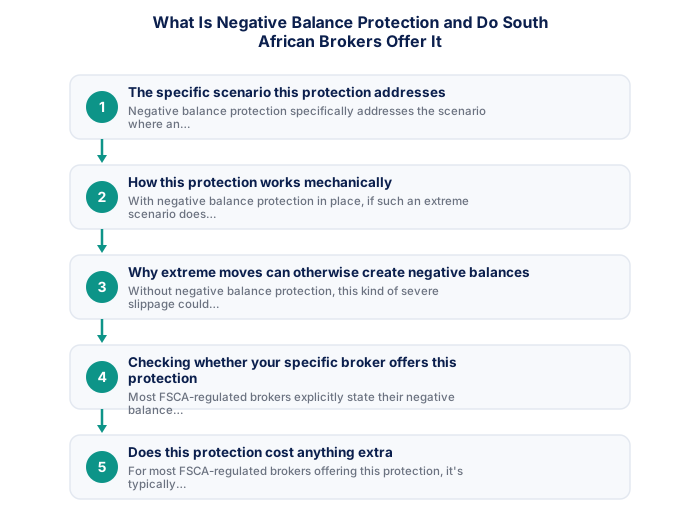
1. The specific scenario this protection addresses
Negative balance protection specifically addresses the scenario where an extreme, rapid market move, causes a position to close at a price so adverse that the resulting loss would exceed your entire account balance, potentially leaving you owing your broker additional money beyond what you originally deposited.
This scenario, while genuinely rare under normal trading conditions, isn't purely theoretical. Sudden, severe currency devaluations, unexpected central bank policy announcements, or major geopolitical shocks have historically produced exactly this kind of extreme, fast-moving price gap in various global markets, which is precisely the situation this protection exists to guard against for retail traders.
2. How this protection works mechanically
With negative balance protection in place, if such an extreme scenario does occur, your broker absorbs the portion of the loss that would otherwise push your account below zero, effectively capping your maximum possible loss at your deposited account balance rather than allowing you to end up owing additional money beyond what you originally placed at risk.
In practice, this means the broker itself absorbs a loss in these rare, extreme circumstances rather than passing it on to the client, an obligation that has real cost implications for the broker's own risk management, which is part of why this protection is now treated as a standard, expected feature among reputable, well-capitalised regulated brokers rather than a burden smaller or less stable operators can easily commit to reliably.
- Search FSP name or number at fsca.co.za
- Confirm licence is current and not suspended
- Check scope covers forex and CFD activity
- Confirm client funds in segregated accounts
- Read FSCA enforcement actions history
- Test customer support before depositing
- Client funds legally segregated
- FSCA complaints process available
- SA consumer protections apply
- ZAR account, no FX conversion costs
- Some offshore brokers offer wider instruments
- Regulatory overhead passed on in spreads
- Stricter position limits for retail clients
- FICA verification required before trading
- Client funds segregated
- Formal FSCA complaints process
- SA consumer protections apply
- ZAR account available
- Fund safety not guaranteed
- Overseas disputes only
- SA law does not apply
- Currency conversion costs
3. Why extreme moves can otherwise create negative balances
It is worth establishing in writing whether a loss can exceed your balance. stop-loss is a term, not a default.
This is worth understanding as a genuine gap between how stop-losses work in theory and how they can behave under truly extreme conditions specifically. A stop-loss reliably closes a position at your specified price under normal market liquidity, but during a severe gap, there may simply be no buyers or sellers available at that exact price, forcing execution at whatever price the market can actually fill, however much worse that turns out to be.
4. Checking whether your specific broker offers this protection
Most FSCA-regulated brokers explicitly state their negative balance protection policy within their terms and conditions. Confirming this explicit statement before depositing significant funds provides important reassurance regarding this specific worst-case risk scenario.
It's worth reading the specific wording used, rather than assuming a broker offers this protection simply because it's become a common industry standard. Some brokers state this protection clearly and unconditionally, while others apply it with specific conditions or exceptions, details worth understanding precisely rather than assuming the most generous possible interpretation applies to your account.
| Protection | FSCA Regulated | Offshore Unregulated |
|---|---|---|
| Client fund segregation | ✓ Required | Varies by broker |
| SA complaints process | ✓ Available | ✗ Not available |
| SA consumer law applies | ✓ Yes | ✗ No |
| ZAR account available | ✓ Typically | Often USD/EUR only |
5. Does this protection cost anything extra
For most FSCA-regulated brokers offering this protection, it's typically included as standard for retail client accounts without any additional explicit cost, reflecting its status as an increasingly common regulatory expectation and competitive standard within the industry, rather than a premium feature requiring separate payment.
This standard inclusion is itself a useful, quick signal worth factoring into broker comparison: a regulated broker that doesn't offer negative balance protection at all, or that charges a separate premium for something competitors provide as standard, is worth questioning more closely as part of your broader due diligence process.
6. What this protection does not prevent
It's worth being clear that negative balance protection caps your maximum loss at your deposited balance, it doesn't prevent the underlying loss itself from occurring, and you can still lose your entire deposited amount through normal trading losses, even with this protection fully in place. The protection specifically addresses the narrower, more extreme scenario of losing more than you deposited, not ordinary trading losses generally.
Without negative balance protection, an extreme market gap can push your account below zero, leaving you owing the broker the shortfall. With protection, the broker absorbs this excess and resets your balance to zero.
★ Why It Matters
Something worth checking for a specific historical reference point: search how your particular broker's negative balance protection actually performed during the well-documented 2015 Swiss Franc event, brokers' own public statements (or absence of any) about that specific episode reveal more than their general marketing claims.
✕ Common mistakes
- Assuming this protection applies unconditionally with every broker. Confirm specifically with your own broker rather than assuming universal coverage.
- Not checking for exclusions during genuinely extreme, historic events. Some policies carve out specific exceptional circumstances.
- Treating this protection as a reason to take on additional risk. It caps your maximum loss; it doesn't make risk-taking free.
- Not researching how your specific broker performed during well-documented past volatility events. A broker's track record during genuine stress reveals more than its marketing claims.
Key Takeaways
- Negative balance protection prevents your account from going below zero after extreme market moves, with most FSCA-regulated brokers offering this safeguard.
- Negative balance protection prevents your trading account from going below zero following extreme, rapid market moves.
- Most FSCA-regulated brokers offer this as standard, capping your maximum possible loss at your deposited balance.
- The specific scenario this protection addresses.
- How this protection works mechanically.
Frequently asked follow-up questions
Is negative balance protection required by FSCA regulation?
This has become an increasingly standard feature and expectation within the industry; checking your specific broker's explicit policy confirms their particular position.
Does this protection apply to all account types?
Some brokers may apply this protection specifically to retail client accounts, with different terms potentially applying to professional client classifications.
Has negative balance protection ever actually been tested by extreme market events?
Yes, various historical extreme market events have tested this protection across the industry, generally reinforcing why most brokers now offer this as a standard, important safeguard.
