i Short answer
Start with FSCA licensing as a non-negotiable first filter, never deposit with an unlicensed broker regardless of how attractive their other terms appear, and note the FSCA has shown genuine willingness to enforce against violators at real scale.
Once regulatory status is confirmed, the meaningful comparison points become spreads and fees, ZAR account support, withdrawal speed, platform quality, and customer support.
📋 ON THIS PAGE
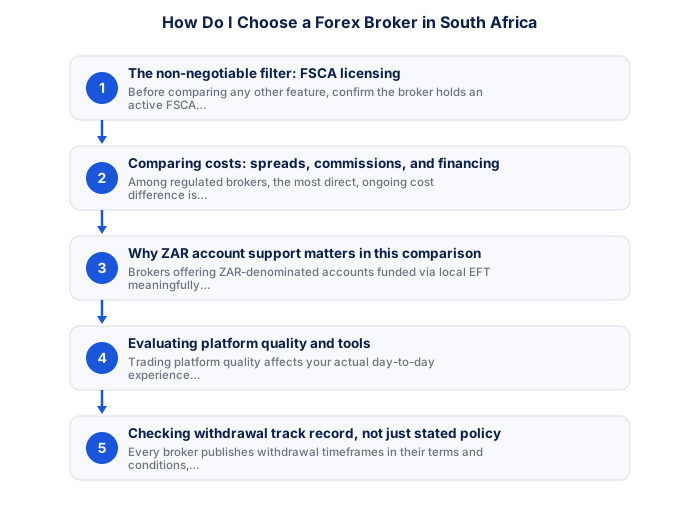
1. The non-negotiable filter: FSCA licensing
Before comparing any other feature, confirm the broker holds an active FSCA Financial Services Provider licence covering derivative instruments, by searching the broker's name or FSP number directly on the FSCA's public register at fsca.co.za. This single check eliminates the most serious risk category entirely, outright fraud or complete absence of regulatory recourse, and should never be skipped regardless of how compelling a broker's marketing, bonus offers, or reviews appear elsewhere.
If a broker fails this check, no other comparison point matters; move on to a different provider. If multiple candidate brokers all pass this check, that's the point where the more nuanced comparisons below become genuinely useful in differentiating between otherwise legitimate options.
It's worth checking not just that a licence exists, but that its status shows as active and that its category genuinely covers the specific products you intend to trade. A licence can technically exist while being suspended, or while covering a different category of financial service entirely, both details the register makes visible if you look beyond simply confirming a name appears in the search results.
| Factor | What to Check |
|---|---|
| FSCA licensing | Verify FSP number on the official register |
| Costs | Spreads, commissions, overnight financing |
| ZAR account support | Local EFT deposits, ZAR-denominated accounts |
| Platform quality | Charting tools, execution speed, mobile app |
| Withdrawal track record | Independent reviews, actual processing times |
| Customer support | Response time, local support hours |
2. Comparing costs: spreads, commissions, and financing
Among regulated brokers, the most direct, ongoing cost difference is typically the spread charged on instruments you intend to trade most frequently. Comparing typical spreads on a handful of your most-likely-to-trade instruments (for example, a couple of major forex pairs and USD/ZAR specifically, if that's relevant to your trading plan) across two or three candidate brokers gives a concrete, comparable cost figure rather than relying on vague marketing claims about being "low-cost" or "competitive."
Beyond spreads, compare any explicit commission structures (some brokers charge a separate commission on top of a tighter spread, rather than building all cost into a wider spread), overnight financing rates for positions you might hold longer-term, and any account maintenance or inactivity fees, together these form the realistic ongoing cost structure you'll actually experience, which can differ meaningfully from a broker's headline marketing about low costs.
- Search FSP name or number at fsca.co.za
- Confirm licence is current and not suspended
- Check scope covers forex and CFD activity
- Confirm client funds in segregated accounts
- Read FSCA enforcement actions history
- Test customer support before depositing
- Client funds legally segregated
- FSCA complaints process available
- SA consumer protections apply
- ZAR account, no FX conversion costs
- Some offshore brokers offer wider instruments
- Regulatory overhead passed on in spreads
- Stricter position limits for retail clients
- FICA verification required before trading
- Client funds segregated
- Formal FSCA complaints process
- SA consumer protections apply
- ZAR account available
- Fund safety not guaranteed
- Overseas disputes only
- SA law does not apply
- Currency conversion costs
It helps to compare these figures at a similar time of day and market condition across candidate brokers, rather than checking one broker's spread during quiet overnight trading and another's during a busy session, since spreads widen and narrow with liquidity and comparing mismatched conditions can make an otherwise competitive broker look worse than it actually is.
3. Why ZAR account support matters in this comparison
Brokers offering ZAR-denominated accounts funded via local EFT meaningfully simplify the practical experience of being a South African client, avoiding currency conversion friction on every deposit and withdrawal, and sidestepping SARB exchange control considerations that apply when funding an offshore-currency account. If a broker doesn't support this, factor in the added complexity and potential conversion costs of operating a USD or other foreign-currency account as a genuine, ongoing cost consideration, not just a minor inconvenience.
For most South African retail traders without a specific reason to hold a foreign-currency-denominated account deliberately, ZAR support is a meaningful practical advantage worth weighing seriously in broker selection, even when comparing brokers that are otherwise similarly regulated and similarly priced.
This advantage compounds over time in a way that's easy to underestimate when comparing brokers only on headline spread figures. Currency conversion costs on every single deposit and withdrawal, even if individually modest, add up across a full trading history in a way a one-off comparison of spreads alone won't capture.
4. Evaluating platform quality and tools
Trading platform quality affects your actual day-to-day experience significantly: reliable order execution without excessive slippage or rejected orders, intuitive charting tools with the technical indicators you intend to use, stable mobile app functionality if you plan to monitor or manage positions away from a desktop, and clear, accessible account statements and trade history. Most brokers let you explore platform quality firsthand through a free demo account before committing any real funds, which is genuinely the most reliable way to assess this dimension rather than relying solely on marketing screenshots or third-party reviews.
Testing the same demo strategy or simply managing the platform's core features across two or three candidate brokers' demo accounts gives a direct, personal basis for comparison that's considerably more reliable than secondhand opinions about which platform is "better," since platform preference can be subjective depending on your specific trading style and personal interface preferences.
| Protection | FSCA Regulated | Offshore Unregulated |
|---|---|---|
| Client fund segregation | ✓ Required | Varies by broker |
| SA complaints process | ✓ Available | ✗ Not available |
| SA consumer law applies | ✓ Yes | ✗ No |
| ZAR account available | ✓ Typically | Often USD/EUR only |
Pay particular attention to how the platform performs specifically around the times you're most likely to actually trade. A platform that feels smooth during a quiet demo session can behave quite differently under the load of a fast-moving market during your preferred trading window, which is part of why testing across a few different sessions, rather than just once, gives a more representative picture.
5. Checking withdrawal track record, not just stated policy
Every broker publishes withdrawal timeframes in their terms and conditions, but actual real-world experience can sometimes differ from stated policy. Searching for recent, specific trader experiences and reviews discussing withdrawal speed and reliability with your specific candidate brokers, looking for patterns across multiple independent sources rather than relying on a single review, gives a more grounded sense of how a broker actually performs in practice, beyond what their own marketing claims.
Be appropriately skeptical of both overwhelmingly positive and overwhelmingly negative review patterns that seem disproportionate or potentially manipulated, and weight more heavily specific, detailed accounts (clear timelines, specific amounts, specific circumstances) over vague, emotionally-charged complaints or praise that provide little concrete, verifiable detail.
Forums and independent review platforms tend to be more useful for this specific check than a broker's own testimonials page, precisely because dissatisfied clients are more likely to post detailed, specific accounts of a withdrawal problem than satisfied clients are to publicly confirm that a routine withdrawal simply worked as expected.
6. Customer support and broader reputation checks
Testing a broker's customer support responsiveness before committing significant funds, sending a genuine question through their support channel and observing response time and quality, gives you direct insight into how that broker is likely to handle you if a genuine issue or dispute arises later. This is a low-cost, low-effort due diligence step many traders skip but that can reveal meaningful differences between otherwise similar regulated brokers.
Beyond direct testing, checking how long the broker has operated in the South African market specifically, whether they maintain active local representation or support, and their broader international regulatory footprint, including additional licences in other jurisdictions, all contribute to a fuller picture of the broker's overall institutional stability and track record beyond simply meeting the minimum FSCA licensing bar.
Check the agreement for what happens when a loss exceeds the deposit. negative balance protection is offered by some brokers and not others.
It's worth testing support through more than one channel if the broker offers several, live chat, email, and phone support don't always deliver the same quality of response from the same provider, and knowing which channel actually works well for a given broker is useful information to have before you need it during a genuine issue.
Confirming an active FSCA licence comes before comparing any other feature. Spread costs, ZAR account convenience, and tested support responsiveness matter, but only after that foundation.
★ Why It Matters
A check we think is underused: ask a prospective broker's support team a moderately technical question (how exactly is overnight financing calculated, for instance) before opening an account, the quality and speed of that single response often previews your actual support experience better than any review site.
✕ Common mistakes
- Choosing a broker based on marketing alone, without checking FSCA status. This is the single most important and most skippable check.
- Ignoring withdrawal speed until you actually need a withdrawal. Stated policies and lived experience sometimes differ.
- Overweighting bonus offers in the comparison. Bonus terms often carry conditions that reduce their real value.
- Not testing customer support responsiveness before depositing. A single test question often reveals more than reviews do.
How long does verification take?
Typically under two business days. The common cause of a longer wait is a document that does not match the account name. Switching brokers covers it in full.
Key Takeaways
- Check FSCA licensing first, then compare spreads, ZAR account support, withdrawal speed, and platform quality. A practical checklist for South African traders.
- Start with FSCA licensing as a non-negotiable first filter, never deposit with an unlicensed broker regardless of how attractive their other terms appear.
- Once regulatory status is confirmed, the meaningful comparison points become spreads and fees, ZAR account support, withdrawal speed, platform quality, and customer support.
- The non-negotiable filter: FSCA licensing.
- Comparing costs: spreads, commissions, and financing.
Frequently asked follow-up questions
Is the broker with the lowest spreads always the best choice?
Not necessarily, lowest spreads matter most for active, frequent traders where this cost accumulates significantly; for less frequent traders, other factors like platform reliability and withdrawal experience may matter more in the overall decision.
Should I open accounts with multiple brokers?
Some experienced traders do use multiple regulated brokers for different purposes (testing different platforms, accessing different specific instruments), though for beginners, starting with one well-vetted broker while learning is generally simpler to manage.
Does broker size or popularity guarantee a better experience?
Not automatically, a larger, more well-known broker isn't inherently better for your specific needs than a smaller but still properly regulated one; the specific comparison points discussed above matter more than size or brand recognition alone.
