What this page covers
Several acts sit behind a South African trading account trading account. Knowing which one covers what makes it clear who to approach when something goes wrong, and why a broker asks for the documents it asks for.
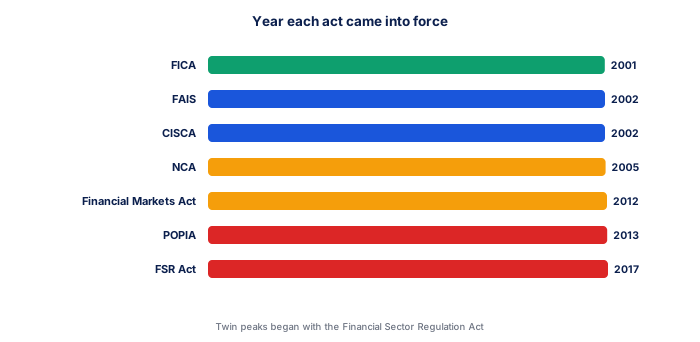
| Act | What it governs | Regulator |
|---|---|---|
| FAIS, 2002 | Licensing and conduct of financial services providers | FSCA |
| FICA, 2001 | Identity verification and reporting of suspicious transactions | FIC |
| Financial Sector Regulation Act, 2017 | The twin peaks structure itself | FSCA and Prudential Authority |
| Financial Markets Act, 2012 | Exchanges, clearing houses and market conduct | FSCA |
| CISCA, 2002 | Collective investment schemes, unit trusts | FSCA |
| POPIA, 2013 | How your personal data may be used | Information Regulator |
| National Credit Act, 2005 | Credit agreements and maximum rates | NCR |
| Income Tax Act, 1962 | How trading profit is taxed | SARS |
| Situation | Act |
|---|---|
| A broker will not release your funds | FAIS, complain to the FAIS Ombud |
| You are asked for proof of address | FICA |
| A broker shares your data without consent | POPIA |
| A unit trust misprices your units | CISCA |
| A margin facility charges above the cap | National Credit Act |
| Problem | Act | Where to go |
|---|---|---|
| Broker will not release funds | FAIS | FAIS Ombud |
| Misleading advice | FAIS | FAIS Ombud |
| Personal data misused | POPIA | Information Regulator |
| Credit charged above the cap | NCA | National Credit Regulator |
| Unit trust mispricing | CISCA | FSCA |
| Market manipulation | Financial Markets Act | FSCA |

Download this data
Every table on this page as a spreadsheet, with the source and the date it was checked in the header rows.
⬇ Download CSVHow these figures work
South Africa uses a twin peaks model. The Prudential Authority, inside the Reserve Bank, watches whether an institution is financially sound. The FSCA watches how it behaves toward customers. Both were created by the Financial Sector Regulation Act, which sits above the older acts rather than replacing them.
For a trader, the practical question is which act covers the problem at hand, because that determines which body to approach and what remedy exists.
★ A worked example
A trader's withdrawal has been pending for three weeks and the broker will not explain why.
This is conduct, not solvency, so it falls under FAIS and the FSCA. The route is a written complaint to the provider, six weeks to resolve it, then the FAIS Ombud.
If the same broker had also shared the trader's identity documents with a third party without consent, that is a separate matter under POPIA and goes to the Information Regulator. The two complaints run in parallel, to different bodies, from the same set of facts.
✕ Common mistakes
- Complaining to the wrong regulator. The FSCA handles conduct, the Information Regulator handles data, the NCR handles credit. A misdirected complaint loses weeks.
- Assuming FICA is the broker being difficult. The obligation sits on the firm by law. Refusing the documents means the account cannot be opened.
- Expecting a regulator to recover losses. The FSCA supervises and sanctions. Compensation comes through the Ombud or the courts.
- Treating an offshore broker as covered. None of these acts reach a firm with no South African licence, which is the practical cost of using one.
Notes on reading these figures
- Twin peaks means two regulators with different jobs. The Prudential Authority watches whether an institution is financially sound; the FSCA watches how it treats you.
- FICA obligations sit on the broker, not on you. The documents are collected because the law requires the firm to collect them, and refusing means the account cannot be opened.
- An offshore broker with no South African licence is outside all of this. That is the practical consequence of using one, rather than any question of legality.
To put these figures to work, the FSCA FSP Licence Categories runs the arithmetic on your own numbers, and FAIS Ombud Complaint Process covers the same ground in ordinary language. Documents needed to open an account and How POPIA protects your data go into the detail this table only summarises.
Terms used on this page
Put this table on your own site
The table below can sit on your own page and stays current without you editing anything.
- Preview the embeddable table as it will appear on your site
Place this snippet on your page and the table is embedded live, rather than copied and left to age.
<iframe src="https://www.tradeanswers.co.za/embed/ref-south-african-financial-laws-reference.html" width="100%" height="620" style="border:0" title="South African Financial Laws Reference"></iframe>Free to use with attribution. The link back to this page is built into the embed.
Frequently asked questions
What is twin peaks?
Two regulators with different jobs: the Prudential Authority for financial soundness, the FSCA for conduct. Both established under the Financial Sector Regulation Act.
Why does my broker need my documents?
FICA requires the firm to verify your identity and address before it may transact for you. The obligation is on the firm.
What does POPIA give me?
Control over how your personal information is used, with a right to complain to the Information Regulator if it is misused.
Which act covers unit trusts?
CISCA, the Collective Investment Schemes Control Act, supervised by the FSCA.
Is there a cap on margin interest?
The National Credit Act caps credit agreements using a formula based on the repo rate. Whether a specific margin facility falls under it depends on how it is structured.
Where are these acts published?
On the government gazette and on each regulator's site. The FSCA and FIC both publish guidance notes that are more readable than the acts themselves.