i Short answer
Most FSCA-regulated brokers allow withdrawing excess deposited funds at any time, unless this conflicts with bonus terms or pending volume requirements.
Depositing more than intended generally isn't a problem requiring urgent action.
📋 ON THIS PAGE
- The straightforward case: no bonus involved
- How bonus terms can complicate this specific situation
- The withdrawal process for excess funds generally
- Considering whether to actually withdraw or simply keep it allocated
- Avoiding this situation in future deposits
- When to contact your broker directly about this
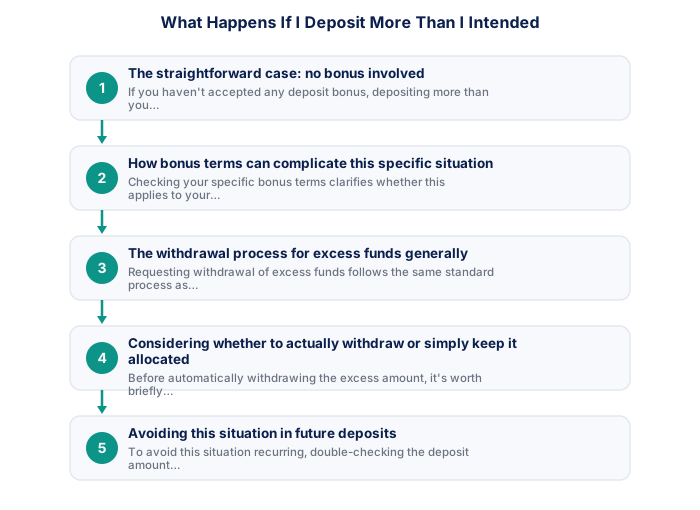
1. The straightforward case: no bonus involved
If you haven't accepted any deposit bonus, depositing more than you originally intended is generally a straightforward, low-stakes situation. The excess funds simply sit in your account as additional available balance, which you can either use for trading according to your own deliberate risk management decisions, or withdraw back out at your convenience.
It's worth actually pausing on this decision rather than acting on autopilot in either direction. An unintended excess deposit is a reasonable moment to briefly revisit your discretionary capital figure and risk percentage calculations, since your effective account size has just changed, even if only because of an input error rather than a deliberate choice.
2. How bonus terms can complicate this specific situation
If you have accepted a broker bonus tied to a specific trading volume requirement, your ability to withdraw your full deposited amount, including any unintended excess, may be temporarily restricted until that volume requirement is met. Checking your specific bonus terms clarifies whether this applies to your situation before assuming unrestricted access to the full deposited amount.
This is worth checking before you even attempt a withdrawal request, rather than discovering the restriction only once a request is unexpectedly declined or delayed. A quick review of your specific bonus terms, or a direct question to support, saves the frustration of an unanticipated restriction surfacing at the exact moment you wanted quick access to those funds.
- South African ID or valid passport
- Proof of residential address dated within 3 months
- Proof of bank account ownership
- Selfie or photo for biometric verification (some brokers)
- Source of funds declaration if depositing above threshold
- Full charting and analysis
- Best for trade entry
- Multi-monitor support
- More order types available
- Monitor and manage on the go
- Load shedding backup use
- Push price alerts
- Limited charting tools
3. The withdrawal process for excess funds generally
Requesting withdrawal of excess funds follows the same standard withdrawal process as any other request, submitting the request through your platform, undergoing any standard verification, and waiting for the typical processing timeline, rather than requiring any special, separate process simply because the deposit happened to exceed your original intention.
This is worth being reassured by if the situation feels stressful in the moment, an accidental over-deposit, absent any bonus complication, is a genuinely routine, low-risk situation from the broker's perspective, handled through exactly the same reliable process as any other withdrawal request you might make.
4. Considering whether to actually withdraw or simply keep it allocated
Before automatically withdrawing the excess amount, it's worth briefly reconsidering whether keeping this additional capital allocated to trading, provided it still genuinely meets your discretionary capital standard, might actually be a reasonable adjustment to your trading plan, rather than assuming the excess must necessarily be removed simply because it wasn't part of your original specific figure.
If you do decide to keep the excess allocated, it's worth deliberately updating your written trading plan and risk calculations to reflect the new, larger account figure, rather than continuing to calculate position sizes based on your original, smaller intended amount out of habit.
| Rejection reason | Fix |
|---|---|
| Address proof older than 3 months | Get a recent utility bill or bank statement |
| Name mismatch between documents | Use documents with exactly matching full name |
| Poor quality scan | Retake with good lighting, all corners visible |
| PO Box address | Brokers require physical residential address only |
5. Avoiding this situation in future deposits
To avoid this situation recurring, double-checking the deposit amount carefully before confirming any transfer, particularly when using methods that involve manual entry of figures, and keeping a clear record of your intended deposit amounts as part of your broader trading plan documentation, helps prevent this kind of unintended discrepancy going forward.
A simple additional safeguard worth adopting: confirming the exact deposit amount displayed on the final confirmation screen before submitting, rather than only checking the figure you initially typed. Many platforms display a clear summary at this final step specifically to catch this kind of entry error before it actually processes.
6. When to contact your broker directly about this
If you're at all uncertain about whether bonus terms or other account-specific factors might restrict your ability to withdraw an unintended excess deposit, contacting your broker's support team directly for clarification resolves any uncertainty before you make a final decision about how to handle the situation.
Local EFT deposits and withdrawals run through the infrastructure overseen by PASA (the Payments Association of South Africa), which is part of why Rand-denominated transfers between South African bank accounts tend to clear faster than international wire transfers.
An unintended deposit is recovered through a standard withdrawal request. The funds return to the originating account, usually within 1-5 business days, though any bonus funds attached may have conditions.
★ Why It Matters
Worth confirming directly with your broker rather than assuming: whether withdrawing an accidental over-deposit shortly after triggers the same processing time as a normal withdrawal, or whether same-day reversals are sometimes handled faster as a goodwill exception. This varies by broker.
✕ Common mistakes
- Leaving accidentally over-deposited funds at risk in the account. Funds sitting in a trading account remain exposed unless explicitly withdrawn.
- Not double-checking deposit amounts before confirming a transfer. A quick second look prevents this situation entirely.
- Assuming this kind of error is rare enough to not warrant a process for it. Knowing the correction process in advance saves time if it happens.
Key Takeaways
- Most brokers allow withdrawing excess deposited funds at any time, provided this doesn't conflict with bonus terms or pending volume requirements.
- Most FSCA-regulated brokers allow withdrawing excess deposited funds at any time, unless this conflicts with bonus terms or pending volume requirements.
- Depositing more than intended generally isn't a problem requiring urgent action.
- The straightforward case: no bonus involved.
- How bonus terms can complicate this specific situation.
Frequently asked follow-up questions
Will my broker automatically refund an accidental overdeposit?
Generally no automatic refund occurs; you would need to actively request withdrawal of the excess amount through the standard process.
Does this affect my FICA verification status?
No, this is unrelated to your identity verification status, which remains valid regardless of deposit amount discrepancies.
Can I use the excess for a completely different trading strategy?
Yes, there's no restriction preventing you from allocating excess funds toward a different approach, provided this still reflects deliberate, considered decision-making rather than impulsive reallocation.
