i Short answer
A genuine stop-loss order, whether fixed or trailing, executes automatically at a predetermined level regardless of in-the-moment emotion.
A mental stop relies purely on willpower to manually close the position, carrying considerably more risk of being ignored.
📋 ON THIS PAGE
- How a genuine stop-loss order works mechanically
- What a mental stop actually involves instead
- Why mental stops fail so often in practice
- The sunk cost and hope dynamic specific to mental stops
- Are there any legitimate reasons to use mental stops
- Why automated stops are almost always the better default choice
1. How a genuine stop-loss order works mechanically
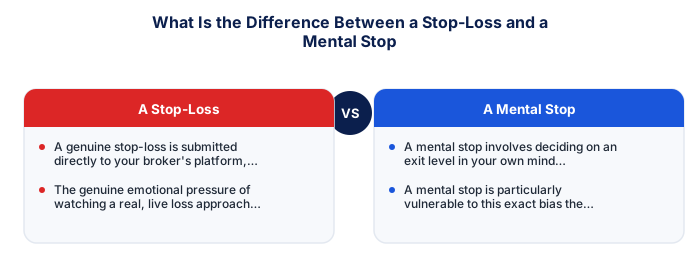
A genuine stop-loss is submitted directly to your broker's platform, executing automatically once price reaches your predetermined level, without requiring any further action, decision, or emotional willpower from you at the actual moment of execution.
It's worth appreciating why this automated execution matters so fundamentally, discussed elsewhere on this site regarding stop-loss orders generally, the broker's system, not your own in-the-moment willpower, is what actually closes the position, removing the dependency on your own psychological state at exactly the moment discipline matters most.
2. What a mental stop actually involves instead
A mental stop involves deciding on an exit level in your own mind without actually placing the corresponding order on your platform, intending to manually close the position yourself once price reaches that level, this approach depends entirely on you noticing the price reaching that level and then actually following through with the planned action in real time.
It's worth being honest with yourself about how genuinely reliable this intention actually is, given everything discussed throughout this site regarding loss aversion and the psychological pressure of live, real losses, a mental stop asks you to execute discipline at precisely the moment it's hardest to summon.
- D = Drawdown as decimal (e.g. 0.25 = 25%)
- 25% drawdown = needs 33% to recover
- 50% drawdown = needs 100% to recover
- 75% drawdown = needs 300% to recover
3. Why mental stops fail so often in practice
The mechanism is loss aversion: the two outcomes are not weighted equally, even when the amounts are.
It's worth reviewing your own trading journal honestly for any history of intended mental stops that weren't actually honoured, seeing your own concrete, personal evidence of this pattern tends to be more persuasive than accepting the general principle abstractly.
- Position size calculated before every entry
- Stop-loss defined from chart structure before entry
- Total open risk below 5% of account at any time
- No adding to losing positions under any circumstances
- Trading paused if monthly drawdown reaches 10%
- Stops never moved further away once position is open
| Factor | Placed Stop-Loss Order | Mental Stop |
|---|---|---|
| Execution | Automatic: broker closes at your level | Requires you to act manually |
| Works when you're offline | Yes | No |
| Immune to emotion | Yes: executes regardless of feeling | No: hope and loss aversion intervene |
| Gap risk | May fill at a worse price in a gap | Same gap risk, plus delay risk on top |
| Accountability | Hard record of where your stop was | Easy to redefine retrospectively |
| Suitable for beginners | Yes: strongly recommended | No: requires iron discipline |
| Legitimate use case | All styles and experience levels | Only experienced traders in specific conditions |
4. The sunk cost and hope dynamic specific to mental stops
A mental stop is particularly vulnerable to the sunk cost fallacy. The closer price gets to your mental stop level, the more tempting it can become to mentally move that level further away, hoping for a reversal, precisely the dynamic a genuine, pre-committed automated order is specifically designed to prevent.
It's worth naming this specific psychological trap explicitly whenever you notice it arising, recognising the thought 'it'll probably come back' as the exact hope-driven reasoning that mental stops are particularly vulnerable to helps interrupt this pattern before it leads to holding well past your intended exit.
| Drawdown | Recovery needed | At 20%/yr | At 10%/yr |
|---|---|---|---|
| 10% | 11.1% | 7 months | 14 months |
| 25% | 33.3% | 19 months | 38 months |
| 50% | 100.0% | 4+ years | 7+ years |
| 75% | 300.0% | Never at 10%/yr | Never at 10%/yr |
5. Are there any legitimate reasons to use mental stops
Some very experienced traders occasionally use mental stops deliberately for specific, advanced reasons, perhaps wanting flexibility around a specific technical level that requires nuanced, in-the-moment judgement a fixed automated order can't capture, but this remains a deliberate, advanced exception requiring exceptional, demonstrated discipline, rather than a default approach suitable for most traders, particularly beginners.
It's worth being genuinely rigorous about these specific, narrow exceptions rather than treating them as a general justification, mental stops should remain the exception applied only in genuinely limited circumstances, not a routine substitute for automated protection.
6. Why automated stops are almost always the better default choice
Given the genuine psychological vulnerability mental stops introduce, defaulting to genuine, automated stop-loss orders for the overwhelming majority of trades reflects the same kind of structural safeguard as generally more reliable than depending on in-the-moment willpower alone.
A mental stop relies on self-discipline and is frequently overridden.
A hard stop-loss is set on the platform and executes automatically, independent of your emotional state. A mental stop relies on your discipline at the moment of loss, which research consistently shows is unreliable.
★ Why It Matters
Worth testing on yourself honestly: track your actual follow-through rate on mental stops specifically across a few dozen trades, most traders who try this discover a meaningfully lower adherence rate than they'd have estimated about themselves beforehand.
✕ Common mistakes
- Assuming willpower alone will work as reliably as an automated order. A genuine stop-loss order executes regardless of in-the-moment emotion.
- Moving a mental stop further away as price approaches it. This defeats the entire purpose of having decided on a level in advance.
- Not converting mental stops into actual orders once the pattern of skipping them emerges. This is a direct, available fix once the issue is recognised.
Does a stop-loss guarantee execution at the specified price?
In normal conditions, stop-losses execute at or near the specified price. During gap moves, execution may occur at a worse price. Pre-set stops still provide substantial protection against the vast majority of adverse moves.
Should I adjust my stop-loss once a trade moves into profit?
Moving a stop-loss to break-even once a trade reaches a reasonable profit is standard practice. Trailing stops automate this process. Never move a stop-loss further away from entry to avoid being stopped out - this increases risk beyond your original plan.
Key Takeaways
- A genuine stop-loss order executes automatically at a predetermined level, while a mental stop relies on willpower alone, carrying considerably more risk.
- A genuine stop-loss order executes automatically at a predetermined level regardless of in-the-moment emotion.
- A mental stop relies purely on willpower to manually close the position, carrying considerably more risk of being ignored.
- How a genuine stop-loss order works mechanically.
- What a mental stop actually involves instead.
See also: What Is the 2% Rule and Should I Follow It Strictly?.
Frequently asked follow-up questions
Do experienced traders ever recommend mental stops for beginners?
Generally no. Most experienced traders and educators specifically recommend genuine, automated orders for beginners given the psychological vulnerability involved.
Can a mental stop ever be more precise than an automated order?
In theory it allows for in-the-moment judgement, though this flexibility is exactly what introduces the discipline risk that generally outweighs any precision benefit for most traders.
Does slippage affect automated stops more than mental stops?
Both can be affected by slippage during fast-moving conditions, though this is a separate consideration from the discipline and execution reliability issue specific to mental stops.
