i Short answer
Most FSCA-regulated brokers require proof of identity (ID or passport), proof of residential address (a recent utility bill or bank statement), and sometimes proof of income.
📋 ON THIS PAGE
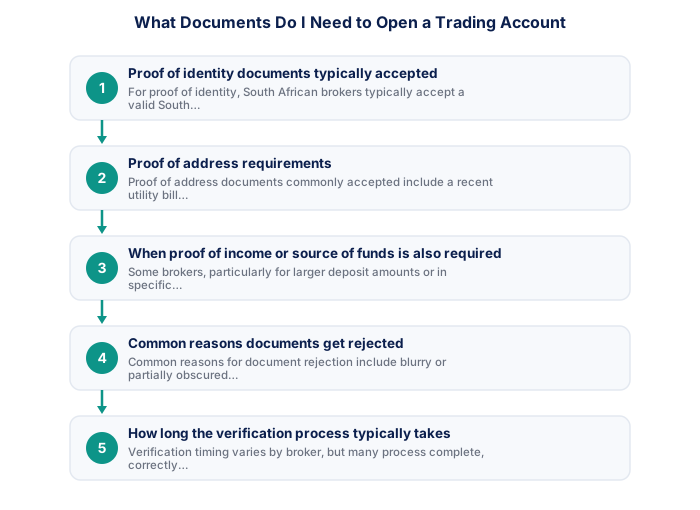
1. Proof of identity documents typically accepted
For proof of identity, South African brokers typically accept a valid South African ID document, an ID card, or a valid passport, all requiring the photograph, full name, and identity number to be clearly legible. The document should generally be current and not expired, since an expired document typically won't satisfy the verification requirement even if all other details remain visible.
It's worth photographing or scanning these documents in good, even lighting against a plain background, rather than relying on a quick snapshot taken in a rush. Glare across a laminated ID card or a shadow obscuring part of the identity number are among the most common, entirely avoidable reasons a technically valid document still gets rejected on first submission.
| Document Type | Common Examples |
|---|---|
| Proof of identity | ID book, smart ID card, passport |
| Proof of address | Utility bill, bank statement, under 3 months old |
| Proof of income or source of funds | Payslip, bank statement (for larger accounts) |
2. Proof of address requirements specifically
Proof of address documents commonly accepted include a recent utility bill (electricity, water, or similar), a bank statement, or sometimes a formal lease agreement, generally required to be dated within the last three months to confirm your address information is genuinely current rather than outdated. The document should clearly show your full name and residential address matching the details provided during account registration.
It's worth checking this specific detail if you've recently moved or if utility accounts are registered in a family member's name rather than your own, since a document showing a different name or an outdated address, even if it's otherwise a perfectly legitimate bill, typically won't satisfy this specific requirement without additional supporting documentation.
- South African ID or valid passport
- Proof of residential address dated within 3 months
- Proof of bank account ownership
- Selfie or photo for biometric verification (some brokers)
- Source of funds declaration if depositing above threshold
Choose FSCA-regulated broker
Verify the FSP number is current at fsca.co.za.
Submit FICA documents
SA ID, proof of address within 3 months, bank account proof.
Fund via EFT
Make the initial deposit from your SA bank account in ZAR.
Open demo account first
Practice on demo before activating your live account.
Start with minimum capital
Begin with an amount you can afford to lose while learning.
3. When proof of income or source of funds is also required
Some brokers, particularly for larger deposit amounts or in specific risk-assessment circumstances, may also request proof of income or source of funds documentation, such as a recent payslip or bank statement showing the origin of deposited funds. This additional requirement connects to the broader anti-money-laundering purpose underlying FICA, rather than being an arbitrary additional hurdle.
This is worth anticipating in advance if you know you're planning a larger initial deposit, rather than being caught off guard by an unexpected request partway through account opening. Having a recent payslip or clear bank statement readily available from the outset can meaningfully speed up verification for larger deposit amounts specifically.
4. Common reasons documents get rejected
Common reasons for document rejection include blurry or partially obscured images where key details aren't clearly legible, documents that have expired or fall outside the required recency window for proof of address specifically, and mismatches between the name on submitted documents and the name used during account registration, making careful attention to these details before submission worthwhile.
It's worth double-checking that the name format matches exactly, including middle names or initials, between your submitted documents and your account registration details, since even a minor, seemingly trivial discrepancy, a missing middle initial, for example, can trigger a rejection that a more careful initial submission would have avoided entirely.
| Rejection reason | Fix |
|---|---|
| Address proof older than 3 months | Get a recent utility bill or bank statement |
| Name mismatch between documents | Use documents with exactly matching full name |
| Poor quality scan | Retake with good lighting, all corners visible |
| PO Box address | Brokers require physical residential address only |
5. How long the verification process typically takes
Verification timing varies by broker, but many process complete, correctly submitted documentation within one to a few business days, though this can extend longer if documents require resubmission due to the rejection issues discussed above, or during periods of particularly high application volume for that specific broker.
It's worth submitting your documentation as early as possible in the account opening process, well before you actually need to deposit or withdraw funds urgently, rather than treating verification as a final step to handle only once it becomes an active blocker to something you're trying to do.
6. Preparing documents in advance to speed up account opening
Preparing clear, current, correctly-named copies of your required documents before beginning the account opening process, rather than scrambling to locate or photograph documents partway through, helps avoid unnecessary delays and the frustration of repeated resubmission attempts due to easily avoidable document quality issues.
Opening a trading account with an FSCA-regulated broker involves a FICA verification process that provides meaningful protection for the broader financial system as well as the individual trader. The documentation requirements under the Financial Intelligence Centre Act require financial services providers to verify client identity and source of funds as part of South Africa's anti-money-laundering framework. Most brokers complete this process within one to three business days for straightforward applications. The most common source of delays is submitting proof of address documents that are older than three months or that do not exactly match the name on the identity document. Reviewing your documentation for these potential issues before submission typically produces a smoother process and faster account activation, allowing you to move more quickly from application to live trading.
Opening a trading account requires an identity document and proof of residence not older than 3 months. Some brokers additionally request source of funds information or a tax reference number.
★ Why It Matters
Worth preparing in advance to avoid delays: ensure your proof of address document is genuinely recent, most brokers require it dated within 3 months, an otherwise complete application held up purely by an outdated utility bill is a surprisingly common, easily avoidable delay.
✕ Common mistakes
- Assuming all brokers require identical documentation. Specific requirements can vary slightly between providers.
- Not preparing documents in advance of starting the application. This is a common, easily avoidable source of onboarding delay.
- Submitting documents with mismatched personal details. Discrepancies between documents can stall verification unnecessarily.
Key Takeaways
- Most brokers require proof of identity, proof of residential address, and sometimes proof of income or source of funds, consistent with FICA requirements.
- Most FSCA-regulated brokers require proof of identity (ID or passport), proof of residential address (a recent utility bill or bank statement), and sometimes proof of income.
- Proof of identity documents typically accepted.
- Proof of address requirements specifically.
- When proof of income or source of funds is also required.
See also: How Do I Start Forex Trading in South Africa? and What Happens If I Deposit More Than I Intended? and What Is a Joint Trading Account and Can I Open One in South Africa?.
Frequently asked follow-up questions
Can I use a digital copy of my ID document?
Yes, most brokers accept a clear photograph or scan, provided all details remain clearly legible and the full document is visible without cropping important information.
What if my proof of address is in a family member's name?
This can complicate verification; checking your specific broker's policy on this situation, or providing alternative proof of address in your own name, is generally advisable.
Do I need to resubmit documents periodically after my account is open?
Some brokers may request periodic re-verification, particularly for proof of address given its time-sensitive nature, though this varies by broker policy.
