i Short answer
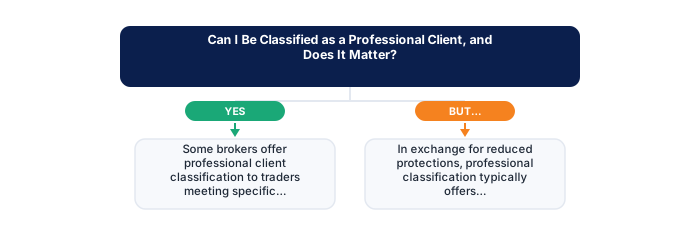
Some brokers offer professional client classification to traders who meet specific criteria, demonstrated experience, sufficient account size, or relevant financial sector employment, usually. It trades away certain retail protections for potentially higher leverage, and that trade-off is worth taking seriously before you make it.
📋 ON THIS PAGE
1. The typical qualifying criteria for this classification
Brokers usually set the bar around a minimum account size or trading volume over a recent period, a meaningful transaction history, or relevant professional experience or qualifications in financial markets. The FSCA's framework mirrors approaches used in other regulated jurisdictions: clients must genuinely demonstrate knowledge and experience proportionate to the reduced protections they're accepting.
It's worth being clear that meeting the letter of these criteria, a large enough account balance, for instance, doesn't automatically mean you actually possess the trading knowledge and experience the classification implies. Brokers are expected to assess substance, not just documentation, and a diligent provider will probe your actual experience rather than simply processing your paperwork.
The specific criteria vary by broker, and some providers are more rigorous in their assessment than others. Reading the exact qualifying criteria in your broker's terms, rather than relying on a general description, tells you what that specific provider requires and what their process actually involves.
South African retail traders considering this classification should also verify that their broker is conducting the assessment in compliance with FSCA requirements rather than simply mirroring a parent company's process from another jurisdiction. Regulatory obligations here are specific to South Africa's framework, and what a European broker does for its clients under MiFID II doesn't automatically translate to local compliance requirements.
| Feature | Retail Client | Professional Client |
|---|---|---|
| Leverage limits | FSCA capped | Typically higher |
| Negative balance protection | Usually guaranteed | May not apply |
| Risk warnings | Standardised, prominent | Reduced |
| Complaints process access | Full access | Often limited |
| Qualifying criteria | None required | Account size, experience, or volume |
2. What retail protections you might give up
One clause worth locating is the treatment of a balance that goes below zero. negative balance protection is where that sits.
This is worth sitting with specifically because these protections tend to matter most in exactly the scenarios you're least likely to be thinking about when markets are calm and your positions are performing well. A flash crash, a gap open, or a sudden illiquid market can produce losses that wipe a retail account entirely in a way that negative balance protection contains.
- FSCA-regulated broker verified at fsca.co.za
- Demo account tested for minimum 60 days
- Trading plan written: entry, exits, position sizing
- Risk per trade defined (1-2% of account)
- Backup internet connection tested for load shedding
- Tax implications understood
The complaint and dispute resolution differences are less dramatic in normal trading circumstances but can matter if you encounter a dispute with your broker over trade execution, platform issues, or account management. Retail clients generally have clearer and more accessible pathways for formal complaints under FSCA oversight.
Understanding exactly which protections apply to your specific account type, not just the general category, requires reading your broker's terms for professional clients carefully. The differences aren't always as large as the summary descriptions suggest, but the ones that are meaningful, negative balance protection in particular, deserve careful consideration before you agree to waive them.
3. The leverage and other benefits typically offered
In exchange for reduced protections, you typically get access to higher maximum leverage than retail accounts can access, sometimes different margin requirements, and occasionally access to products that aren't available to retail clients. Higher leverage is usually the primary motivation traders cite when pursuing professional classification.
It's worth being honest that higher leverage, on its own, doesn't improve your actual trading results, it simply changes how much of a given price movement affects your account balance. A trader who consistently loses with 1:30 leverage will lose faster, not less, with 1:200 leverage. The edge, if there is one, comes from the strategy and execution, not from the multiplier.
Access to lower margin requirements can be genuinely useful for traders who are managing a portfolio of positions across multiple instruments and need capital efficiency. But this is an operational benefit for sophisticated, well-capitalised traders, not a performance benefit for developing ones.
Some professional accounts also offer access to direct market access execution or specific institutional-grade data that can reduce execution friction at higher volumes. These benefits have genuine value at a certain scale and sophistication level, they're just not what most traders who pursue professional classification are actually seeking.
4. How this classification process generally works
This isn't a box you tick and move on. You apply formally, submit evidence backing your claimed qualification, and the broker reviews it before reclassifying your account. The evidence typically includes documentation of your trading history, account statements, professional background, or formal financial qualifications depending on which qualifying criteria you're relying on.
Brokers generally aren't especially motivated to make this process effortless, since the FSCA expects them to genuinely verify qualification rather than simply accept self-certification. A broker that reclassifies clients on the basis of minimal documentary evidence is creating regulatory risk for itself.
| Item | Detail |
|---|---|
| Regulator | FSCA, fsca.co.za |
| Exchange control | SARB, resbank.co.za |
| Tax authority | SARS, sars.gov.za |
| JSE hours | 09:00-17:00 SAST Mon-Fri |
| Best forex session | 15:00-17:00 SAST |
| CGT annual exclusion | R50,000 (individuals) |
The timeline varies considerably by broker and is rarely instant. Budget for a process that might take days to weeks depending on the broker's internal review procedures and how quickly you can supply the required documentation.
One practical implication worth noting: once you're reclassified, the treatment of your account under the broker's systems changes in ways that extend beyond just the leverage limits. Communications, risk disclosures, and certain account features may differ from the retail experience, and understanding those differences before you start trading in that classification reduces unexpected friction.
5. Who this classification genuinely suits
This suits traders with genuine, demonstrated market experience who've specifically identified a need for higher leverage or capabilities beyond the retail tier, and who've weighed the trade-off of reduced protections with clear eyes. The ideal candidate understands exactly which retail protections they're giving up and has a specific operational reason for accepting that trade-off.
A useful question to ask yourself honestly before applying: if you were explaining your specific reason for wanting this classification to someone else, someone who understood the trade-offs, would the explanation hold up? If the honest answer is that you want more leverage because you think it will make you more profitable, that's worth examining carefully before proceeding.
The classification tends to be most appropriate for traders who are managing their trading as a structured business activity, have substantial and verifiable trading experience, and are specifically constrained by retail leverage limits in a way that affects their actual trading operations rather than their aspirations.
It's also worth considering whether the specific operational need that's driving the interest in professional classification can be addressed through other means, different instruments, different markets, or a higher account balance, without accepting the reduced regulatory protections that come with the professional tier.
6. Reversing this classification if you change your mind
Most brokers technically allow you to revert to retail status if you change your mind. In practice, the process tends to be less smooth than the initial reclassification, and some brokers are notably more reluctant to revert than to upgrade. Check your specific broker's process and any conditions for reverting before you reclassify, not after.
Worth knowing too: any FSCA-regulated broker is bound by POPIA, the Protection of Personal Information Act, which governs how your personal and financial information is handled throughout this process. This applies equally to professional and retail clients.
Professional classification is in practice difficult to reverse once the relationship has developed in that direction. Once you've waived retail protections and traded for a period under professional terms, brokers get understandably cautious about the circumstances under which they should restore protections that have been legitimately waived.
This practical irreversibility reinforces the case for treating the initial decision with appropriate deliberation rather than testing professional status to see how it feels. The asymmetry between ease of reclassifying upward and difficulty of reverting downward is worth factoring into the timing of your application.
✕ Common mistakes
- Requesting professional status purely for higher leverage. Higher leverage without matching risk discipline substantially raises leverage risk.
- Not understanding which protections get waived. Professional classification removes specific regulatory safeguards, not just the leverage cap.
- Assuming you can always reclassify back to retail. Brokers are often reluctant to reverse this status once granted.
- Overestimating your own experience relative to the criteria. These requirements are specific and objective, not a subjective self-assessment.
Key Takeaways
- Some brokers offer professional client classification with fewer protections but potentially higher leverage, requiring you to meet specific qualifying criteria.
- Some brokers offer professional client classification to traders who meet specific criteria, demonstrated experience, sufficient account size, or relevant financial sector employment, usually.
- It trades away certain retail protections for potentially higher leverage, and that trade-off is worth taking seriously before you make it.
- The typical qualifying criteria for this classification.
- What retail protections you might give up.
Frequently asked follow-up questions
Is professional client classification available through all brokers?
No, this varies by broker, not all FSCA-regulated brokers offer this classification, so it's worth checking directly with yours if you're interested.
Does this classification affect my tax treatment?
Not directly, no, though your trading frequency and activity level, covered elsewhere on tax treatment, remain the relevant factors for tax purposes regardless of which classification you hold.
Can beginners apply for professional client status?
Generally not, the qualifying criteria specifically require demonstrated experience or relevant background that beginners, almost by definition, haven't had time to accumulate yet.
Does professional classification ever happen automatically without applying?
No, this takes a deliberate application and supporting evidence. Brokers don't typically reclassify a retail account to professional status without you specifically requesting it and providing qualifying documentation.
Can my professional classification be revoked by the broker without my consent?
It can happen, particularly if the ongoing qualifying criteria are no longer met or the broker reassesses its own policies. Checking your specific broker's terms clarifies exactly what would trigger it.
