i Short answer
Execution speed measures how quickly an order processes after submission, mattering most for short-term strategies like scalping.
📋 ON THIS PAGE
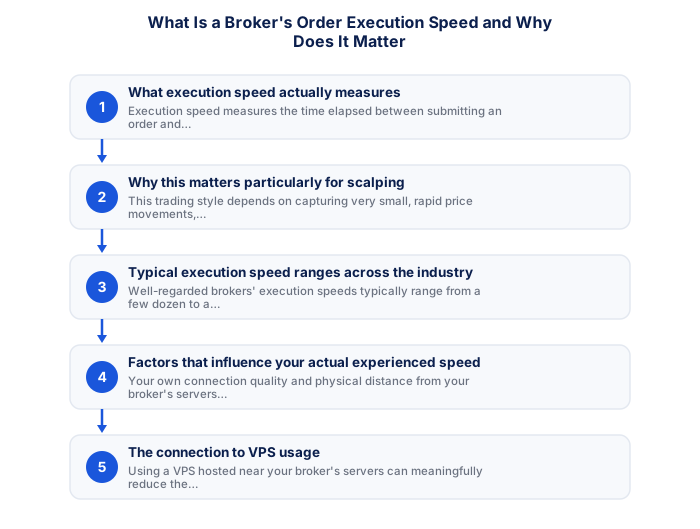
1. What execution speed actually measures
Execution speed measures the time elapsed between submitting an order and that order actually processing and confirming, typically measured in milliseconds for electronic trading platforms, reflecting the combined speed of your own connection, the broker's systems, and the underlying liquidity provider infrastructure.
It's worth understanding this as a chain of several sequential steps, your device, your internet connection, the broker's own order processing systems, and finally the liquidity provider actually filling the order, rather than a single measurement. A delay at any one link in that chain adds to your total experienced execution time, which is exactly why improving just one factor, like your broker's infrastructure, doesn't guarantee a proportionally faster overall experience if another link remains slow.
2. Why this matters particularly for scalping
Scalping depends on capturing very small, rapid price movements, meaning even modest execution delays can meaningfully affect whether a specific trade's intended entry or exit price is actually achieved.
For most other trading styles, holding positions for hours, days, or longer, this same delay is genuinely negligible in proportion to the trade's overall intended timeframe. It's specifically the compressed timeframe and narrow profit targets central to scalping that make execution speed matter as much as it does, rather than execution speed being universally critical for every possible trading approach.
- Search FSP name or number at fsca.co.za
- Confirm licence is current and not suspended
- Check scope covers forex and CFD activity
- Confirm client funds in segregated accounts
- Read FSCA enforcement actions history
- Test customer support before depositing
- Client funds legally segregated
- FSCA complaints process available
- SA consumer protections apply
- ZAR account, no FX conversion costs
- Some offshore brokers offer wider instruments
- Regulatory overhead passed on in spreads
- Stricter position limits for retail clients
- FICA verification required before trading
- Client funds segregated
- Formal FSCA complaints process
- SA consumer protections apply
- ZAR account available
- Fund safety not guaranteed
- Overseas disputes only
- SA law does not apply
- Currency conversion costs
3. Typical execution speed ranges across the industry
Well-regarded brokers' execution speeds typically range from a few dozen to a few hundred milliseconds under normal conditions, though this can vary considerably by specific broker infrastructure, your own connection quality, and current market volatility conditions.
These figures are worth treating as a general reference point rather than a precise benchmark to hold every broker to rigidly, since actual, moment-to-moment execution speed can vary meaningfully even for the same broker depending on current market conditions, time of day, and which specific instrument is being traded.
4. Factors that influence your actual experienced speed
Your own connection quality and physical distance from your broker's servers both genuinely affect your actual experienced execution speed, independent of the broker's own underlying infrastructure quality.
This is worth testing directly rather than assuming, running a simple connection speed and latency test from your own actual trading location gives concrete data about your own baseline, which is useful context for interpreting any execution speed figures a broker or independent review reports, since those figures were measured under their own specific conditions, not necessarily yours.
| Protection | FSCA Regulated | Offshore Unregulated |
|---|---|---|
| Client fund segregation | ✓ Required | Varies by broker |
| SA complaints process | ✓ Available | ✗ Not available |
| SA consumer law applies | ✓ Yes | ✗ No |
| ZAR account available | ✓ Typically | Often USD/EUR only |
5. The connection to VPS usage
Using a VPS hosted near your broker's servers can meaningfully reduce the connection-related portion of execution delay, which is particularly relevant for execution-sensitive strategies like scalping.
It's worth being realistic about when this investment genuinely pays off. For a trader whose strategy holds positions for hours or longer, the marginal execution speed improvement a VPS provides is unlikely to meaningfully affect actual trading outcomes, making this a consideration primarily relevant to scalpers and other execution-sensitive, high-frequency trading styles specifically.
6. How to assess this for your specific broker
Checking independent reviews specifically discussing execution speed, testing your own experience on a demo account first, and asking your broker directly about their typical execution speed statistics all help assess this factor.
Establish before you deposit whether a loss can run past your balance. negative balance protection is a contractual term and differs by broker.
For most swing or position traders, adequate execution is widely available.
Execution speed matters most for scalpers and news traders where milliseconds of slippage can compound. For most swing or position traders, adequate execution quality is widely available from regulated brokers.
★ Why It Matters
Worth testing yourself rather than trusting marketing claims: place a series of small market orders during a calm period and note the time-stamped fill details your platform provides. This gives you real, personal execution speed data for your specific broker and connection.
✕ Common mistakes
- Trusting a broker's advertised average execution speed without personal testing. Real execution speed often varies by time of day and market condition.
- Assuming execution speed matters equally for every trading style. It matters far more for scalping than for swing or position trading.
- Not logging your own time-stamped fill data to verify claims. Personal, measured data is more reliable than marketing figures.
- Ignoring execution speed entirely when comparing brokers for a fast-paced style. This factor deserves real weight for short-term strategies specifically.
Key Takeaways
- Execution speed measures how quickly an order processes after submission, mattering most for short-term strategies sensitive to rapid price movement.
- Execution speed measures how quickly an order processes after submission, mattering most for short-term strategies like scalping.
- What execution speed actually measures.
- Why this matters particularly for scalping.
- Typical execution speed ranges across the industry.
For what execution speed is and whether it matters for your style, see does execution speed actually matter.
Frequently asked follow-up questions
Does execution speed matter for longer-term position trading?
This matters considerably less for longer-timeframe strategies, where minor execution delays have negligible effect on overall position outcomes compared to scalping specifically.
Can I test my broker's execution speed myself before committing real capital?
Yes, using a demo account gives some indication, though genuine execution speed differences can sometimes only become fully apparent with live trading under real market conditions.
Does mobile trading typically have slower execution than desktop?
This can vary by specific app and connection type rather than following a fixed universal pattern. Testing your own mobile setup gives the most relevant information for your situation.
Is execution speed the same as the broker's stated order processing time?
These terms are often used interchangeably, though specific brokers may define and measure this slightly differently. Checking your broker's specific documentation clarifies their particular terminology.
Do all instruments execute at the same speed through the same broker?
Execution speed can vary somewhat by instrument and current liquidity conditions, rather than being perfectly uniform across every single instrument a broker offers.
