i Short answer
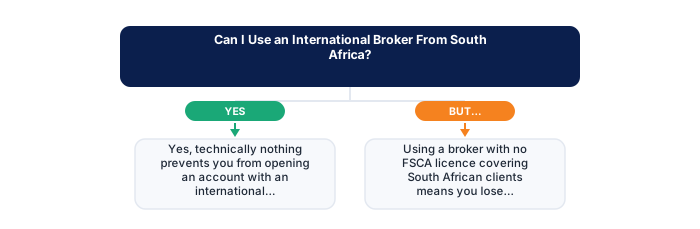
Yes, technically nothing prevents you from opening an account with an international broker that isn't FSCA-licensed for South African clients.
However, doing so means forfeiting FSCA-backed protection and the formal complaints process, and you must still manage SARB exchange control rules to legally move money to that offshore entity.
📋 ON THIS PAGE
1. What you give up by going offshore
A broker without an FSCA licence covering South African clients means no FSCA complaints process if things go wrong: the structured dispute resolution pathway that the FSCA provides to clients of licensed providers simply doesn't exist. It also means no FSCA-mandated client fund protections, no FSCA-monitored capital adequacy requirements for your specific account relationship, and no recourse to the Financial Services Tribunal.
You might have recourse through whatever regulator oversees the broker in its home jurisdiction, if any reputable regulator genuinely does. But chasing complaints through a foreign regulatory process, in a foreign jurisdiction, under foreign law: often with limited practical authority over a broker that doesn't have South African assets, is a materially different protection level from the FSCA pathway.
It's worth listing these protections explicitly for yourself before making this decision rather than accepting the trade-off vaguely. The specific protections you lose are concrete: FSCA oversight, domestic complaints process, local regulatory requirements around segregated client funds and capital adequacy. Making the decision with a clear inventory of what you're forgoing is more informed than a general sense that there's 'less regulation'.
Client fund segregation: the requirement to hold client money separately from the broker's operating capital, is an FSCA requirement for licensed providers. Without it, your deposited funds are potentially exposed to the broker's own business risks in a way that a properly licensed, regulated broker is structurally prevented from creating.
| Feature | Local FSCA-Regulated Broker | Offshore Broker |
|---|---|---|
| FSCA recourse | Yes | No |
| FAIS Ombud access | Yes | No |
| SARB allowance rules apply | Simplified | Full exchange control process |
| Negative balance protection | Common | Varies, verify directly |
| Ease of dispute resolution | Higher | Lower, foreign jurisdiction |
2. The legal status of trading with an offshore broker
Trading with an offshore broker isn't illegal for you as the individual client, in the same way dealing with a non-licensed provider in other categories of consumer services isn't automatically illegal for the consumer. The licensing obligation sits with the provider, not the individual trading their own capital.
The practical risk to you stays real regardless of the legal permissibility. Without FSCA oversight, you have far less recourse if the broker mishandles funds, misquotes prices, prevents withdrawals, or becomes insolvent. The absence of legal prohibition on using them doesn't translate to the presence of practical protection.
- Search FSP name or number at fsca.co.za
- Confirm licence is current and not suspended
- Check scope covers forex and CFD activity
- Confirm client funds in segregated accounts
- Read FSCA enforcement actions history
- Test customer support before depositing
- Client funds legally segregated
- FSCA complaints process available
- SA consumer protections apply
- ZAR account, no FX conversion costs
- Some offshore brokers offer wider instruments
- Regulatory overhead passed on in spreads
- Stricter position limits for retail clients
- FICA verification required before trading
- Client funds segregated
- Formal complaints process
- FSCA dispute resolution
- SA consumer law applies
- ZAR account available
- Fund safety not guaranteed
- Disputes overseas only
- SA law does not apply
- Currency conversion costs
- Tax reporting more complex
This distinction between legal permissibility and practical risk is worth keeping clearly separate in your thinking, since 'not illegal' is often treated as endorsement in informal discussions about offshore brokers. What's permissible and what's sensible are different questions. Using the FSCA register to check whether a broker has bothered to obtain South African authorisation is the most direct way to assess their commitment to the local regulatory framework.
SARB exchange control rules apply regardless of the broker's regulatory status. Transferring funds offshore to a trading account: whether the broker is FSCA-licensed or not, requires using your allowances and following the applicable rules. The broker's regulatory status doesn't affect those obligations.
3. SARB considerations specific to funding an offshore account
Funding an offshore account still runs through South Africa's exchange control framework: your single discretionary allowance of R2 million per year (subject to current SARB rules, which can change), or the foreign investment allowance for larger amounts with SARS tax clearance. These apply to all offshore broker funding regardless of the broker's regulatory status.
Some traders assume going offshore somehow sidesteps these rules. It doesn't. SARB's concern is the cross-border nature of the transaction: whether your capital is leaving South Africa, not what it's going into. An unlicensed offshore broker receives the same SARB scrutiny as any other foreign payment destination.
It's worth tracking cumulative transfers carefully if you're funding offshore accounts, particularly if you're using multiple brokers and the sums add up across the year. Exceeding your allowance without the appropriate approval creates a SARB compliance issue that affects you personally, not your broker.
For larger offshore transfers using the foreign investment allowance, the required SARS tax clearance process is an additional administrative step that takes time and requires being current with your SARS obligations. Planning this lead time into any decision to make larger offshore broker deposits prevents delays at the point you want to transfer.
4. Why some traders consider this option anyway
Traders reach for offshore, unlicensed brokers for a few recurring reasons: access to instruments FSCA-regulated brokers don't offer, higher maximum leverage than local retail limits allow, promotional bonuses that regulated brokers aren't permitted to advertise in the same way, or the belief that a specific foreign broker has better technology or execution.
Some of those reasons have genuine weight. FSCA-regulated brokers do have retail leverage caps that some traders find limiting. The instrument sets do differ between brokers. These are real factors to weigh, but they should be weighed explicitly against the real protection you're forgoing, not assumed to automatically justify the trade-off.
| Protection | FSCA Regulated | Offshore Unregulated |
|---|---|---|
| Client fund segregation | ✓ Required | Varies by broker |
| SA complaints process | ✓ Available | ✗ Not available |
| SA consumer law applies | ✓ Yes | ✗ No |
| ZAR account available | ✓ Typically | Often USD/EUR only |
It's worth actually doing this comparison concretely rather than assuming the benefit based on general impressions. List the specific instruments or leverage levels you're seeking that local regulated brokers don't offer. Then check whether any FSCA-regulated broker with strong international standing actually does offer them: the overlap between 'regulated in South Africa' and 'broad instrument and feature set' is larger than many traders assume.
The marketing appeal of offshore brokers often involves features or terms that aren't as differentiated in practice as they appear in the marketing. A bonus that can't be withdrawn in reasonable conditions, leverage that creates risk beyond the leverage benefit, or instruments that are available at locally regulated brokers with more checking: these are common patterns worth verifying before treating them as genuine advantages.
5. Red flags specific to offshore broker selection
If you do proceed with an offshore broker, apply more scrutiny than you'd give an FSCA-regulated provider. Verify genuine, checkable licensing from a reputable regulator: the FCA, ASIC, CySEC, MAS, or equivalent tier-1 authorities, by looking up the broker's registration number on the relevant regulator's public database directly, not by trusting claims on the broker's own website.
The same due diligence principles that matter for domestic brokers apply here with higher stakes: verify regulatory claims independently, be sceptical of guaranteed-profit marketing, check for verifiable physical presence and ownership, and look for independent user reviews over multiple years rather than curated testimonials.
It's worth applying a significantly higher bar of scepticism here than for a domestic broker precisely because the usual safety nets are absent. A domestic FSCA-regulated broker faces ongoing regulatory scrutiny and compliance costs that incentivise legitimate operation. An offshore broker without a South African presence faces those incentives only from its home jurisdiction, which you'd need to understand and verify independently.
The absence of easily verifiable regulatory information is itself a red flag. Legitimate tier-1 regulated brokers can be verified on their regulator's public register in under five minutes. A broker whose regulatory claims can't be verified in that way is telling you something about their legitimacy before you've deposited any capital.
6. A more balanced alternative worth considering first
Before committing to a non-FSCA broker, check whether an FSCA-regulated broker with strong international standing: one that also holds licences from the FCA, ASIC, or similar tier-1 regulators for its international operations, can already provide the instruments or features you're seeking. Many of the larger global brokers have FSCA-licensed South African entities that provide a domestically protected relationship without sacrificing international breadth.
Choosing a broker with genuine global scale but a properly licensed South African offering typically provides most of the benefit people seek from offshore brokers: broader instrument access, competitive pricing, advanced platforms, with the FSCA protections intact. This combination is more available than traders who default to offshore brokers typically realise.
Before trusting any broker with real capital, verify their FSP licence number on the FSCA's public register at fsca.co.za. An FSP number that appears on that register: with the correct company name and licence category, confirms the broker has met FSCA authorisation requirements. One that doesn't appear, or appears with different details than advertised, is a broker worth avoiding regardless of any other marketing claims.
The FSCA complaints process doesn't exist for an offshore, unlicensed entity. The practical consequence: that 'I'll sort it out if something goes wrong' is not a viable fallback strategy, should be the starting point for any consideration of an unlicensed provider, not an afterthought when a problem actually arises.
✕ Common mistakes
- Assuming reputation substitutes for regulatory protection. A well-known offshore brand still lacks FSCA recourse for South African clients.
- Skipping SARB exchange control requirements for offshore transfers. This step is still required even when the broker itself isn't locally regulated.
- Not checking the broker's actual regulatory status in its home jurisdiction. Some entities operate with weaker oversight than their marketing suggests.
- Assuming a complaint process exists if something goes wrong. The FSCA process simply isn't available for unlicensed offshore entities.
How long does verification take?
Expect same day to two days with complete documents. Submitting a document the broker has to query is what turns that into a week. Switching brokers covers it in full.
Key Takeaways
- Yes, but you lose FSCA protection and must manage SARB exchange control rules for funding. Learn the real trade-offs before choosing an offshore broker.
- Yes, technically nothing prevents you from opening an account with an international broker that isn't FSCA-licensed for South African clients.
- However, doing so means forfeiting FSCA-backed protection and the formal complaints process, and you must still manage SARB exchange control rules to legally move money to that offshore entity.
- What you give up by going offshore.
- The legal status of trading with an offshore broker.
Frequently asked follow-up questions
Is it illegal for me personally to use an unlicensed offshore broker?
The act of using such a broker isn't typically criminal for the individual client, though you take on substantially greater practical risk and reduced recourse compared to using a locally licensed alternative.
Can the FSCA help me if I have a dispute with an offshore broker?
Generally no, since the FSCA's authority and complaints process applies specifically to entities licensed under its framework; an unlicensed offshore broker falls outside this specific jurisdiction and recourse mechanism.
Does AvaTrade's South African entity count as an offshore broker?
No, AvaTrade's South African entity holds an FSCA licence (FSP 45984) for South African clients, meaning clients onboarded under this entity retain full FSCA protection despite AvaTrade's broader international presence.
