i Short answer
Slippage occurs when a trade executes at a different price than expected, typically during fast-moving market conditions or reduced liquidity.
It can work in your favour (positive slippage) or against you (negative slippage), depending on which way the market moves, a related but distinct cost from the bid-ask spread you pay on every trade regardless of market movement.
📋 ON THIS PAGE
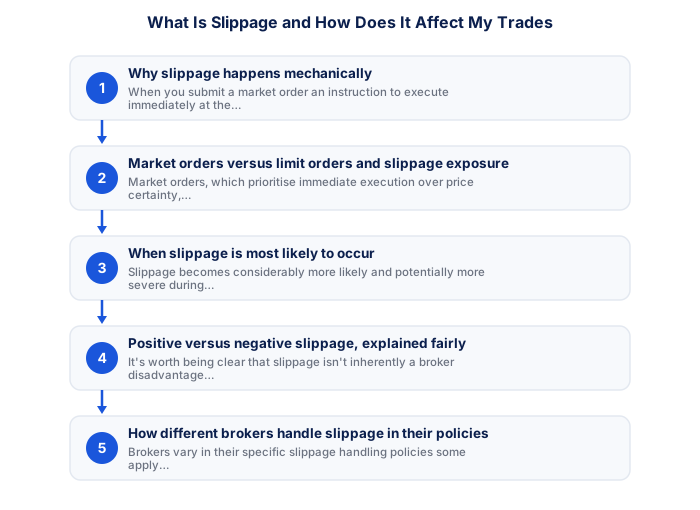
1. Why slippage happens mechanically
When you submit a market order, an instruction to execute immediately at the best available price, there's a brief, genuine time delay between your order being submitted and it actually being matched and executed against available liquidity in the market. During this brief window, if the price moves, your order executes at the new, current price rather than the price you saw at the moment you clicked to place the trade, and this difference is what constitutes slippage.
This isn't a flaw or manipulation specific to any particular broker, it's a genuine, mechanical feature of how real-time markets function, since prices are constantly updating based on ongoing buying and selling activity, and no execution system can guarantee a price that's already become stale by the time the order actually reaches the market.
It helps to think of the price you see on screen as a snapshot that's already slightly out of date the moment you view it, rather than a live, guaranteed number. Even under normal, calm conditions, this gap is typically tiny, fractions of a second and often a fraction of a pip, but it's never literally zero, which is exactly why the concept exists as a genuine feature of trading rather than an occasional glitch.
2. Market orders versus limit orders and slippage exposure
Market orders, which prioritise immediate execution over price certainty, carry genuine slippage exposure by design, since you're instructing the system to execute at whatever the best currently available price happens to be rather than insisting on a specific price. Limit orders, by contrast, specify an exact price (or better) at which you're willing to execute, meaning they generally don't experience negative slippage in the same way, though they carry the trade-off of potentially not executing at all if the market never reaches your specified limit price.
Understanding this trade-off between execution certainty (market orders) and price certainty (limit orders) helps clarify which order type genuinely suits your specific situation, if avoiding negative slippage matters more to you than guaranteed execution, limit orders address this directly, though at the cost of potentially missing a trade entirely if price moves away before reaching your specified level.
- FSCA-regulated broker verified at fsca.co.za
- Demo account tested for minimum 60 days
- Trading plan written: entry, exits, position sizing
- Risk per trade defined (1-2% of account)
- Backup internet connection tested for load shedding
- Tax implications understood
- Predictable cost per trade
- Widens less during news
- Better for news traders
- Slightly wider average
- Very low in calm markets
- Widens during high-impact news
- Lower average cost
- Better for swing traders
Neither order type is objectively 'better,' the right choice depends on what actually matters more for a specific trade. A trader entering a fast-moving breakout, where being in the position at all matters more than the exact entry price, typically favours a market order despite the slippage risk, while a trader with a specific, carefully calculated entry level in mind often prefers the price certainty a limit order provides.
3. When slippage is most likely to occur
Slippage becomes considerably more likely and potentially more severe during periods of reduced market liquidity, such as off-peak trading hours for a given instrument, and around major scheduled news announcements or unexpected events that trigger rapid, significant price movement. During these specific conditions, the normal, orderly price discovery process that usually keeps slippage minimal can break down temporarily, sometimes producing meaningfully larger price gaps between expected and actual execution price.
This is precisely why traders specifically avoid opening new positions immediately before major scheduled announcements, Beyond the general volatility risk, the elevated slippage risk during these specific windows is itself a distinct, additional consideration worth factoring into this broader avoidance practice.
South African traders should note that this liquidity pattern applies to local market hours too: activity around the JSE's open and close, and around scheduled SARB announcements specifically, can produce the same kind of temporarily reduced liquidity and elevated slippage risk that major global news events create for international pairs.
4. Positive versus negative slippage, explained fairly
It's worth being clear that slippage isn't inherently a broker disadvantage working against clients, it's a neutral, mechanical phenomenon that can favour either party depending on which direction price happens to move during the brief execution window. A well-functioning, properly regulated broker passes through both positive and negative slippage fairly and symmetrically, rather than somehow only ever applying negative slippage to client orders while keeping positive slippage for itself.
If you notice a pattern where your specific broker seems to consistently apply only negative slippage and never positive slippage in your favour, this asymmetry is worth investigating and raising directly with the broker, and potentially escalating through your broker's formal complaints process if you believe this represents genuinely unfair treatment rather than simple, normal market randomness.
| Item | Detail |
|---|---|
| Regulator | FSCA, fsca.co.za |
| Exchange control | SARB, resbank.co.za |
| Tax authority | SARS, sars.gov.za |
| JSE hours | 09:00-17:00 SAST Mon-Fri |
| Best forex session | 15:00-17:00 SAST |
| CGT annual exclusion | R50,000 (individuals) |
Reviewing your own trade history periodically for the actual balance between positive and negative slippage instances, rather than only remembering the negative ones (which tend to feel more memorable and frustrating), gives a more accurate, evidence-based picture of whether your specific broker is genuinely applying this symmetrically over time.
5. How different brokers handle slippage in their policies
Brokers vary in their specific slippage handling policies, some apply slippage tolerance limits, meaning an order will be rejected and require resubmission if the available execution price has moved beyond a certain threshold from your requested price, rather than executing automatically at a significantly different price. Others execute at whatever the best available price happens to be at the moment of execution, without this kind of rejection threshold, applying slippage transparently in either direction.
Understanding your specific broker's stated slippage policy, typically detailed in their terms or execution policy documentation, helps set accurate expectations for how your orders will actually be handled during fast-moving market conditions specifically.
Neither approach is inherently more favourable to you as a client, a rejection-based policy protects you from executing at a price far worse than intended but can mean missing a trade entirely during fast-moving conditions, while an always-execute policy guarantees your order fills but with less certainty about the exact price, worth understanding as a genuine trade-off rather than assuming one policy is simply superior to the other.
6. Practical steps to manage your exposure to slippage risk
Practical steps for managing slippage exposure include avoiding placing new market orders immediately around major scheduled news events, discussed above; using limit orders specifically when price certainty matters more to you than guaranteed execution; and factoring a small additional buffer into your stop-loss and take-profit planning, particularly for more volatile instruments or trading styles where slippage risk is genuinely elevated, rather than assuming your exact requested price will always be achieved precisely.
These practical adjustments connect to broader risk management discipline: acknowledging slippage as a genuine, normal market mechanism and planning around it accordingly is more productive than being caught off guard by it during an actual fast-moving trading situation.
A well-regulated broker will also keep client funds in segregated accounts, separate from the company's own operating capital, so your deposited funds aren't exposed if the broker itself runs into financial difficulty.
Slippage is the difference between the price you see and the price you actually get. It occurs during fast-moving markets, particularly around news events, and is reduced by using limit orders instead of market orders.
★ Why It Matters
Something worth tracking in your own journal over time: whether your slippage tends to run negative more often than positive across a meaningful sample, if it's consistently one-sided against you , that asymmetry is worth raising directly with your broker rather than assuming it's simply random.
✕ Common mistakes
- Reacting to a single instance of negative slippage as broker misconduct. Isolated instances are usually just normal market behaviour during fast-moving conditions.
- Not tracking slippage direction across many trades to spot genuine patterns. A persistent one-sided pattern is worth raising; a single instance generally isn't.
- Assuming slippage only occurs during scheduled news events. It can occur during any sufficiently fast-moving or illiquid moment.
- Treating all slippage instances as equally significant regardless of size. Small, routine slippage and larger, exceptional slippage warrant different levels of concern.
What causes slippage and how do I minimise it?
Slippage occurs when your order executes at a different price than requested, typically during fast-moving markets. Using limit orders rather than market orders and avoiding order placement immediately around major news releases reduces slippage exposure.
Key Takeaways
- Slippage occurs when a trade executes at a different price than expected, usually during fast-moving markets. Learn why it happens and how to manage it.
- Slippage occurs when a trade executes at a different price than expected, typically during fast-moving market conditions or reduced liquidity.
- It can work in your favour (positive slippage) or against you (negative slippage), depending on which way the market moves.
- Why slippage happens mechanically.
- Market orders versus limit orders and slippage exposure.
Frequently asked follow-up questions
Can slippage cause me to lose more than my stop-loss amount?
In extreme conditions, yes, particularly during significant price gaps, which is precisely why that broader protection mechanism exists as a backstop against this kind of severe slippage scenario.
Do all brokers experience the same level of slippage?
Slippage levels can vary based on a broker's specific liquidity sources and execution model, making this one further factor worth considering in broker comparison.
Is slippage more common on exotic currency pairs than major pairs?
Generally yes, since exotic or less commonly traded pairs typically have lower overall liquidity, making them more susceptible to slippage even outside major news events specifically.
