What this page covers
The FSCA supervises conduct, and where it finds a breach it has a range of tools that stop well short of criminal prosecution. Knowing which one applies tells you how serious a published action actually is.
| Action | Effect | Appealable |
|---|---|---|
| Administrative penalty | A fine, with no cap set in the act | To the Financial Services Tribunal |
| Debarment | Bars a person from financial services | To the Tribunal |
| Licence suspension | Business must stop pending resolution | To the Tribunal |
| Licence withdrawal | The licence is cancelled | To the Tribunal |
| Directive | An order to do or stop doing something | To the Tribunal |
| Public warning | A notice that a firm is unlicensed | Not a sanction as such |
| Period | Penalties imposed | Note |
|---|---|---|
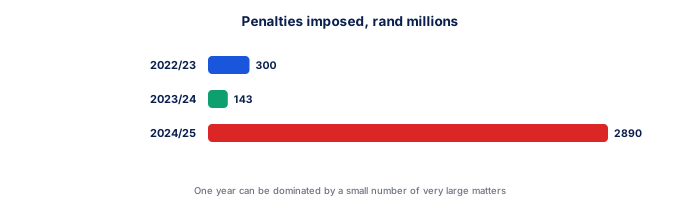
| 2024/25 | R2.89 billion | A record, driven by a small number of very large cases |
| 2023/24 | About R143 million | Closer to the historical norm |
| 2022/23 | About R300 million | Includes several market abuse matters |
| Typical individual case | R50,000 to R5 million | Most published actions sit here |
| Check | Where |
|---|---|
| Is the firm licensed | FSCA FAIS register |
| Has it been warned about | FSCA public warnings list |
| Is a representative debarred | FSCA debarment register |
| Has an action been taken | FSCA enforcement matters page |
| Was it appealed | Financial Services Tribunal decisions |

Download this data
Every table on this page as a spreadsheet, with the source and the date it was checked in the header rows.
⬇ Download CSVHow these figures work
The figures on this page come from published sources and change on a schedule rather than continuously, which is what makes them worth recording in one place. A public warning is not a finding of wrongdoing. It usually means the FSCA has established that a firm is soliciting business without a licence, which is a different and often more urgent problem.
A debarment attaches to the person, not the firm. Someone debarred cannot simply move to another provider, which is why the register is worth searching by name as well as by company.
★ A worked example
Reading the tables together is where the value is. The 2024/25 total is not representative. One or two very large matters can dominate a year's figure, so a trend cannot be read from a single year.
✕ Common mistakes
- A public warning is not a finding of wrongdoing. A public warning is not a finding of wrongdoing. It usually means the FSCA has established that a firm is soliciting business without a licence, which is a different and often more urgent problem.
- A debarment attaches to the person, not the firm. A debarment attaches to the person, not the firm. Someone debarred cannot simply move to another provider, which is why the register is worth searching by name as well as by company.
- The 2024/25 total is not representative. The 2024/25 total is not representative. One or two very large matters can dominate a year's figure, so a trend cannot be read from a single year.
- Taking a figure without its date. A number from a reference page is only as good as when it was last checked, which is why the date sits at the top of this one.
Notes on reading these figures
- A public warning is not a finding of wrongdoing. It usually means the FSCA has established that a firm is soliciting business without a licence, which is a different and often more urgent problem.
- A debarment attaches to the person, not the firm. Someone debarred cannot simply move to another provider, which is why the register is worth searching by name as well as by company.
- The 2024/25 total is not representative. One or two very large matters can dominate a year's figure, so a trend cannot be read from a single year.
To put these figures to work, the How to Verify an FSP Licence runs the arithmetic on your own numbers, and FSCA FSP Licence Categories covers the same ground in ordinary language. The record FSCA fines and FAIS Ombud Complaint Process go into the detail this table only summarises. The The FSCA complaints process covers the part this table leaves out.
Put this table on your own site
The table below can sit on your own page and stays current without you editing anything.
- Preview the embeddable table as it will appear on your site
Place this snippet on your page and the table is embedded live, rather than copied and left to age.
<iframe src="https://www.tradeanswers.co.za/embed/ref-fsca-enforcement-and-penalties.html" width="100%" height="620" style="border:0" title="FSCA Enforcement and Penalties"></iframe>Free to use with attribution. The link back to this page is built into the embed.
Terms used on this page
Frequently asked questions
What can the FSCA actually do?
Impose administrative penalties, debar individuals, suspend or withdraw licences, and issue directives. It does not prosecute criminally.
Is there a cap on penalties?
The act sets no cap. Individual published actions typically run from R50,000 to several million, with occasional very large matters.
What is a debarment?
A bar on an individual acting in financial services. It attaches to the person, so they cannot simply move to another firm.
Is a public warning a finding of wrongdoing?
Not as such. It usually means the FSCA has established that a firm is soliciting business without a licence.
Can an FSCA decision be appealed?
Yes, to the Financial Services Tribunal, which publishes its decisions.
Where do I check whether a firm has been sanctioned?
The FSCA publishes enforcement matters, public warnings and a debarment register, all searchable and free.