i Short answer
Trading psychology matters because even a genuinely sound, well-tested strategy fails to produce good results if a trader can't execute it consistently under real pressure.
Fear, greed, and emotional reactions often cause traders to deviate from their own rules at exactly the moments those rules matter most.
📋 ON THIS PAGE
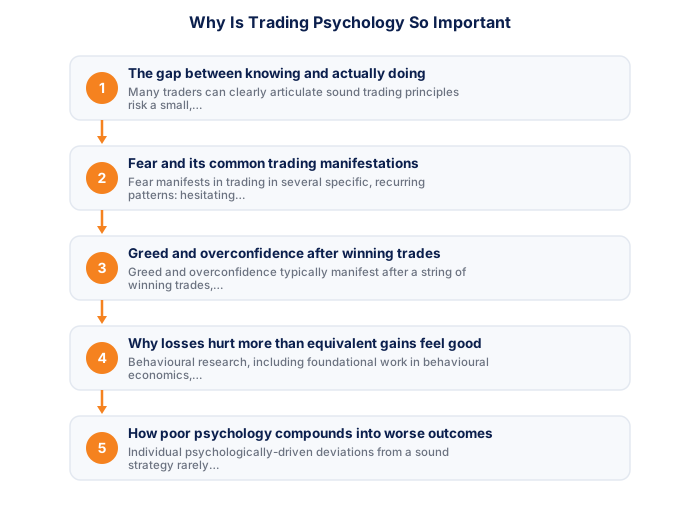
1. The gap between knowing and actually doing
Many traders can clearly articulate sound trading principles, risk a small, fixed percentage per trade, follow your stop-loss without exception, don't chase losses with impulsive revenge trades, while still failing to consistently apply these same principles in actual practice, particularly during emotionally charged moments when real money is genuinely at risk. This gap between intellectual understanding and actual real-time behaviour is precisely what trading psychology specifically addresses.
This isn't a matter of intelligence or theoretical knowledge, many traders who clearly understand sound principles in the abstract still struggle to apply them consistently under genuine pressure, suggesting that the challenge isn't primarily about acquiring more knowledge but about developing the practical emotional discipline to actually execute known, sound principles when it matters most.
See also: What Is Prescribed Assets Policy in SA?
See also: How Do I Manage Trading Notification Volume?
See also: What Is a Heat Map Tool and How Do Traders Use It?
See also: How Do I Open a Trading Account as a South African?
See also: What Is the Gambler's Fallacy in Trading?
See also: My Broker Merges Brands: What Happens to My Account?
See also: What Does the Term Lot Size Mean in Forex Trading?
See also: How Does Emigration Affect My South African Trading Accou
See also: Am I Ready to Start Trading? A Practical Checklist
This gap is worth taking seriously specifically because it means reading more trading education content, on its own, rarely closes it. A trader who has thoroughly studied risk management principles can still watch themselves override a stop-loss in the heat of a losing trade, not from ignorance, but because the emotional pull in that specific moment overpowers the calm, rational understanding that exists clearly enough in a textbook or article.
2. Fear and its common trading manifestations
Fear manifests in trading in several specific, recurring patterns: hesitating to enter a trade that meets your own strategy's valid entry criteria, out of fear the trade might lose; closing a winning position too early out of fear of losing unrealised gains, even when your strategy's rules would suggest holding longer; and, perhaps most damaging, moving a stop-loss further away from entry once a trade moves into loss, specifically to avoid realising the loss your own predetermined rules called for.
Each of these fear-driven deviations undermines the strategic logic and statistical edge a tested strategy is actually designed to capture over a large enough sample of trades, a strategy with genuine positive expectancy can be rendered ineffective, or even turned into a losing approach, if fear consistently causes deviation from its tested entry and exit rules at exactly the critical decision points where discipline matters most.
- Emotional state is neutral
- Yesterday's results not influencing today
- Trading plan is open and reviewed
- Loss limit for today defined and accepted
- Phone notifications silenced
- Backup connectivity confirmed
- Written rules eliminate in-the-moment decisions
- Journalling creates a feedback loop for improvement
- Pre-session checks reduce emotionally-driven entries
- Regular breaks prevent compounding mistakes
- Building discipline requires active daily effort
- Losses immediately test emotional stability
- No external accountability in retail trading
- Social pressure to perform can override rules
Write your trading plan
Entry rules, risk rules, and conditions to NOT trade, all in writing.
Pre-session check
Check your emotional state before opening your platform. Skip if not neutral.
Execute only plan setups
Take only positions that fully match your written criteria.
Journal after each trade
Record rationale, emotion at entry, and outcome immediately after closing.
Weekly rules review
Assess rule adherence weekly. Adjust strategy based on evidence, not emotion.
It's worth noticing that these three patterns share a common thread: each one substitutes an in-the-moment emotional reaction for the predetermined rule your strategy already specified in advance. Recognising this shared structure, rather than treating each manifestation as a separate, unrelated problem, makes it easier to build a single, unified habit of checking 'am I following my rule right now, or reacting to how I feel' across all three situations.
3. Greed and overconfidence after winning trades
Greed and overconfidence typically manifest after a string of winning trades, when accumulated success can create a false sense of having "figured out" the market, leading to increased position size position sizes beyond what disciplined risk management would actually call for, deviation from tested entry criteria in pursuit of additional opportunities that don't actually meet the strategy's defined rules, or abandoning stop-losses on the theory that the current winning streak somehow makes risk management less necessary going forward.
This pattern is particularly dangerous precisely because it emerges during periods that feel successful and validating, making the underlying behavioural drift away from disciplined process harder to recognise and correct compared to fear-driven mistakes, which at least tend to occur during periods that feel uncomfortable enough to prompt some genuine self-reflection.
A useful early-warning sign worth watching for: noticing yourself thinking in terms of 'I' rather than 'the strategy' when a winning streak is underway, 'I'm reading the market well' rather than 'the strategy is performing as tested.' That subtle shift in framing often precedes the more visible behavioural drift, and catching it early gives you a chance to consciously recommit to your tested process before overconfidence fully takes hold.
4. Why losses hurt more than equivalent gains feel good
The mechanism is loss aversion: the two outcomes are not weighted equally, even when the amounts are.
Understanding that this asymmetric emotional response to losses versus gains is a well-documented, broadly shared human tendency, rather than a personal weakness specific to any individual trader, can help normalise the genuine difficulty of managing these emotional responses, while still recognising the practical importance of developing specific strategies and habits to counteract this natural tendency rather than simply accepting it as an unavoidable constraint on trading performance.
This asymmetry is worth keeping in mind specifically when your own emotional reaction to a loss feels disproportionate to its actual financial significance. A modest, well-managed loss that's well within your predetermined risk tolerance can still trigger a surprisingly intense emotional response, precisely because loss aversion operates independently of whether the loss was, objectively, a perfectly normal and expected part of your strategy's statistics.
5. How poor psychology compounds into worse outcomes
Individual psychologically-driven deviations from a sound strategy rarely occur in isolation, they tend to compound and reinforce each other over time. A single instance of moving a stop-loss out of fear, for example, can lead to a larger-than-planned loss, which then increases the emotional pressure and temptation toward revenge trading, which can itself produce an even larger subsequent loss, creating a downward spiral that a single moment of better discipline early in the sequence could have prevented entirely.
Recognising this compounding dynamic specifically, that the cost of a single psychological lapse often extends well beyond that single decision's immediate, direct financial impact, underscores why building sound psychological discipline matters so significantly for overall, longer-term trading outcomes, beyond simply the immediate cost of any one specific undisciplined decision in isolation.
This is worth treating as a genuine argument for intervening as early as possible in any developing sequence, rather than waiting to see how it plays out. The cost of correcting course after a single early deviation is almost always smaller than the cost of correcting course after that deviation has already triggered several more downstream, compounding mistakes.
6. Building genuine psychological resilience over time
Several practical approaches can help build genuine psychological resilience over time: maintaining a detailed trading journal that specifically tracks not just trade outcomes but the emotional state and reasoning behind each decision, enabling honest pattern recognition about your own specific psychological tendencies; predetermining clear rules in calm moments (as discussed regarding strategy development) to reduce the number of real-time decisions that need to be made under emotional pressure; and starting with deliberately small position sizes when transitioning to live trading, to build genuine experience with real psychological pressure while limiting the financial consequences of inevitable early psychological lapses.
This is genuinely ongoing, ongoing work rather than a problem solved once and permanently, even experienced, generally disciplined traders continue actively managing their own psychological responses throughout their trading careers, recognising that psychological discipline is a practised, maintained skill rather than a fixed trait some traders simply have and others simply lack.
A trading strategy provides the edge. Trading psychology determines whether that edge is actually executed consistently or undermined by emotion. Many traders have a genuinely workable strategy but fail to execute it under pressure.
★ Why It Matters
Something worth testing on yourself directly: identify the single rule you violate most often in your own journal, then deliberately track your adherence to just that one rule for the next 20 trades, narrowing focus to one specific psychological weak point tends to produce faster, more measurable improvement than trying to fix everything simultaneously.
✕ Common mistakes
- Assuming a sound strategy alone guarantees good results regardless of execution discipline. Even a well-tested strategy fails to produce good results if it can't be followed consistently under real pressure.
- Treating psychology as a secondary concern compared to strategy development. Both deserve serious, ongoing attention rather than one being treated as an afterthought.
- Deviating from rules at precisely the moments they matter most. Fear and greed tend to surface exactly when discipline is most needed and hardest to maintain.
Is this a mindset problem or a method problem?
The separation is in the record. A journal showing the plan kept points at the method; one showing it abandoned points elsewhere. Telling the two apart covers it in full.
Does taking a break from trading after losses actually help?
Yes. Continued trading under emotional stress often produces further losses as decision quality deteriorates. A planned break to review your journal and identify error patterns typically produces better outcomes than forcing trades through a losing streak.
Key Takeaways
- Psychology often determines whether a sound strategy is actually followed under real pressure. Learn why discipline matters as much as strategy logic.
- Trading psychology matters because even a genuinely sound, well-tested strategy fails to produce good results if a trader can't execute it consistently under real pressure.
- Fear, greed, and emotional reactions often cause traders to deviate from their own rules at exactly the moments those rules matter most.
- The gap between knowing and actually doing.
- Fear and its common trading manifestations.
Frequently asked follow-up questions
Can trading psychology be learned, or is it a fixed personality trait?
Most evidence and trader experience suggests psychological discipline in trading can genuinely be developed and improved through deliberate practice, self-awareness, and structured habits, rather than being a fixed trait some people simply have and others lack.
Does psychological difficulty decrease as account size grows?
Not necessarily, some traders find psychological pressure actually increases with larger account sizes and larger absolute amounts at risk, even if the percentage-based risk per trade remains consistent.
Is it normal to feel anxious before every trade?
Some degree of attentiveness or mild nervousness is common and not necessarily problematic; significant anxiety that consistently disrupts disciplined decision-making is worth addressing directly through the structured approaches discussed above.
