i Short answer
The illusion of control leads traders to overestimate their ability to influence inherently uncertain market outcomes.
This contributes to overtrading and excessive confidence.
📋 ON THIS PAGE
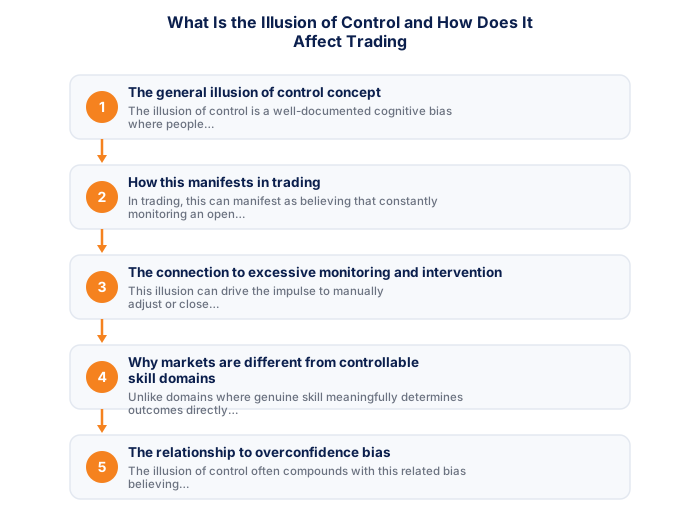
1. The general illusion of control concept
The illusion of control is a well-documented cognitive bias where people overestimate their ability to control or influence outcomes that are actually determined substantially or entirely by chance or factors genuinely outside their influence, sometimes manifesting as believing that taking some specific action, even an objectively irrelevant one, increases the likelihood of a favourable outcome.
It's worth recognising this as a genuinely well-documented psychological pattern studied extensively beyond trading, people across many domains consistently overestimate their genuine influence over outcomes that are actually determined largely by chance or external factors.
2. How this specifically manifests in trading
In trading, this can manifest as believing that constantly monitoring an open position, somehow improves that position's outcome, or believing that taking additional trading action during a difficult period gives you more control over an inherently uncertain market, when in reality the market's actual movement remains entirely independent of these specific behaviours.
It's worth checking your own behaviour honestly for this specific pattern, watching charts intensely during an open position, refreshing repeatedly, feels active and engaged, but genuinely changes nothing about the outcome once your predetermined stop-loss and take-profit are already set.
- FSCA-regulated broker verified at fsca.co.za
- Demo account tested for minimum 60 days
- Trading plan written: entry, exits, position sizing
- Risk per trade defined (1-2% of account)
- Backup internet connection tested for load shedding
- Tax implications understood
3. The connection to excessive monitoring and intervention
This illusion can specifically drive the impulse to manually adjust or close positions reactively, believing this active intervention provides better control than the predetermined, automated orders, even when the evidence generally suggests the opposite, that predetermined, hands-off execution typically outperforms reactive, in-the-moment intervention.
It's worth connecting this directly to the excessive checking behaviour discussed elsewhere on this site, the illusion of control is precisely the underlying psychological driver behind much of that compulsive monitoring, the false sense that watching more closely somehow influences the result.
4. Why markets are genuinely different from controllable skill domains
Unlike domains where genuine skill meaningfully determines outcomes directly and predictably, financial markets involve substantial uncertainty and the aggregated, largely uncontrollable actions of countless other participants, recognising this genuine difference helps calibrate more realistic expectations about how much control any individual trader has over short-term outcomes.
It's worth appreciating this distinction clearly, unlike a genuine skill domain where your ongoing input directly shapes the outcome, once a trade is open with predetermined orders in place, discussed throughout this site's risk management content, your continued attention genuinely doesn't change what happens next.
| Item | Detail |
|---|---|
| Regulator | FSCA, fsca.co.za |
| Exchange control | SARB, resbank.co.za |
| Tax authority | SARS, sars.gov.za |
| JSE hours | 09:00-17:00 SAST Mon-Fri |
| Best forex session | 15:00-17:00 SAST |
| CGT annual exclusion | R50,000 (individuals) |
5. The relationship to overconfidence bias
As, the illusion of control often compounds with this related bias, believing you have more control over outcomes can directly feed into believing your skill is more reliable and predictive than it genuinely is, together producing a particularly strong combined distortion in self-assessment.
It's worth mapping this connection explicitly, the illusion of control specifically feeds broader overconfidence by creating a false sense that your active engagement and skill are driving outcomes that are, in genuine reality, largely determined by market forces outside your direct influence.
6. Practical ways to counter this illusion
Relying on predetermined, automated orders rather than reactive manual intervention, and explicitly acknowledging in your own trading journal which outcomes were genuinely influenced by your decisions versus which reflected factors entirely outside your control, helps build a more accurate, realistic self-assessment over time.
Behavioural research calls this loss aversion, and it explains why holding a losing position feels easier than closing it.
The illusion of control leads traders to add more indicators, more screens, or more analysis as if complexity equals control. Genuine control exists only over risk management and process, not market outcomes.
★ Why It Matters
Something worth noticing specifically: whether you feel different levels of confidence about a trade depending on how much research you personally did, versus an identical setup someone else identified, the illusion of control often shows up as unwarranted extra confidence purely from personal involvement in the analysis.
✕ Common mistakes
- Feeling more confident about a trade simply because you researched it personally. The same setup identified by someone else deserves the same level of confidence.
- Attributing a winning outcome to personal skill rather than possible market luck. This overestimates your actual influence over inherently uncertain outcomes.
- Not recognising overtrading as partly driven by a felt sense of control. This illusion contributes meaningfully to excessive trading frequency.
- Treating confidence level as a reliable indicator of a trade's actual quality. These are genuinely separate things that can easily be confused.
Key Takeaways
- The illusion of control leads traders to overestimate their ability to influence inherently uncertain outcomes, contributing to overtrading and excessive confidence.
- The illusion of control leads traders to overestimate their ability to influence inherently uncertain market outcomes.
- This contributes to overtrading and excessive confidence.
- The general illusion of control concept.
- How this specifically manifests in trading.
See also: What Is the Difference Between a Stop-Loss and a Mental Stop?.
Frequently asked follow-up questions
Is the illusion of control the same as overconfidence bias?
They're closely related but distinct; the illusion of control specifically concerns overestimating influence over outcomes, while overconfidence bias, concerns overestimating one's own skill and accuracy more broadly.
Does experience reduce susceptibility to this illusion?
Some traders develop better calibrated awareness over time through honest, accumulated experience, though this bias affects people across experience levels rather than being automatically eliminated.
Can this illusion ever motivate genuinely useful trading behaviour?
The underlying desire for some sense of agency is understandable, but channeling this toward sound process and predetermined planning is more constructive than believing direct, reactive control over market outcomes is achievable.
