i Short answer
Accepting that no strategy wins every trade, and measuring success by disciplined process adherence rather than flawless outcomes, helps manage perfectionism.
📋 ON THIS PAGE
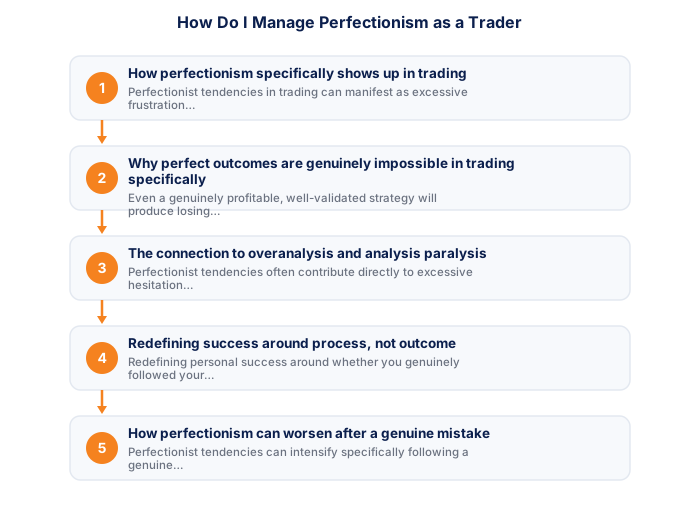
- How perfectionism specifically shows up in trading
- Why perfect outcomes are genuinely impossible in trading specifically
- The connection to overanalysis and analysis paralysis
- Redefining success around process, not outcome
- How perfectionism can worsen after a genuine mistake
- Practical reframes for managing this tendency
1. How perfectionism specifically shows up in trading
Perfectionist tendencies in trading can manifest as excessive frustration over any losing trade regardless of whether your process was genuinely sound, an inability to accept that a reasonable, well-analysed decision can still result in a loss given trading's inherent uncertainty, or persistent dissatisfaction even during genuinely successful periods because results weren't flawless.
It's worth recognising these patterns as a coherent, connected cluster rather than isolated quirks, each one traces back to the same underlying belief, that a genuinely skilled trader should somehow avoid losses or mistakes entirely, worth naming this core belief explicitly since it's what actually needs addressing rather than each individual symptom separately.
2. Why perfect outcomes are genuinely impossible in trading specifically
Even a genuinely profitable, well-validated strategy will produce losing trades as a normal, expected part of its overall statistical performance, demanding flawless, win-every-time outcomes from yourself sets an impossible standard that no trading approach, however sound, can actually achieve.
It's worth internalising this mathematically, not just as an abstract idea, actually looking at your own strategy's backtested or forward-tested win rate confirms concretely that losses are a built-in, expected feature of even your best-performing approach, not evidence that something went wrong.
- FSCA-regulated broker verified at fsca.co.za
- Demo account tested for minimum 60 days
- Trading plan written: entry, exits, position sizing
- Risk per trade defined (1-2% of account)
- Backup internet connection tested for load shedding
- Tax implications understood
3. The connection to overanalysis and analysis paralysis
Perfectionist tendencies often contribute directly to excessive hesitation and overanalysis, since a perfectionist mindset can resist committing to any decision without impossible, complete certainty that the outcome will be favourable, which trading's inherent uncertainty can never actually provide.
It's worth noticing this pattern specifically when you find yourself repeatedly re-checking a setup that already meets your criteria, searching for additional confirmation beyond what your predetermined rules actually require is often perfectionism seeking an impossible certainty rather than genuinely improving your analysis.
4. Redefining success around process, not outcome
Redefining personal success around whether you genuinely followed your predetermined strategy criteria and risk management rules, rather than whether each individual trade happened to win, provides a more achievable, genuinely controllable standard than outcome-based perfectionism.
It's worth practising this redefinition explicitly in your trading journal, actively writing 'this was a successful trade' next to a losing trade that followed your criteria correctly reinforces this reframe considerably more effectively than simply understanding the concept intellectually.
| Item | Detail |
|---|---|
| Regulator | FSCA, fsca.co.za |
| Exchange control | SARB, resbank.co.za |
| Tax authority | SARS, sars.gov.za |
| JSE hours | 09:00-17:00 SAST Mon-Fri |
| Best forex session | 15:00-17:00 SAST |
| CGT annual exclusion | R50,000 (individuals) |
5. How perfectionism can worsen after a genuine mistake
Perfectionist tendencies can intensify specifically following a genuine error, sometimes producing excessive self-criticism, that goes beyond constructive learning into unproductive, harsh self-judgement disconnected from a realistic, balanced assessment of the situation.
It's worth watching for this intensification specifically after a genuine error, since perfectionist self-criticism following an actual mistake can spiral considerably further than the mistake itself warrants, worth catching this escalation early and redirecting toward the constructive review process discussed elsewhere on this site rather than allowing it to continue unchecked.
6. Practical reframes for managing this tendency
Practical reframes include explicitly reminding yourself that a losing trade following sound, disciplined process represents successful execution of your strategy, not personal failure; tracking your process-adherence rate alongside financial results, to provide a more complete, balanced picture of genuine performance; and recognising that demanding perfection from yourself in an inherently uncertain activity is itself the actual problem, not your individual trading results.
Behavioural research calls this loss aversion, and it explains why holding a losing position feels easier than closing it.
Redefining personal success around whether you genuinely followed your predetermined strategy criteria, rather than the outcome alone, directly addresses perfectionist tendencies.
★ Why It Matters
Something that tends to help concretely: deliberately reviewing a trade you executed flawlessly by your own rules but that still lost money, and labelling it explicitly as a 'good trade, bad outcome' in your journal, separating process quality from result is the practical antidote to perfectionism, not just a nice idea.
✕ Common mistakes
- Judging every trade purely by its outcome. A well-executed trade can still lose money without being a mistake.
- Treating any deviation from an ideal entry as a failure. No strategy achieves perfect entries on every single trade.
- Avoiding trades altogether to avoid the risk of imperfection. This trades one problem (mistakes) for another (missed opportunities).
Key Takeaways
- Accepting that no strategy wins every trade, and measuring success by disciplined process adherence rather than flawless outcomes, helps manage perfectionism.
- How perfectionism specifically shows up in trading.
- Why perfect outcomes are genuinely impossible in trading specifically.
- The connection to overanalysis and analysis paralysis.
- Redefining success around process, not outcome.
See also: How Do I Build Resilience After a String of Trading Mistakes?.
Frequently asked follow-up questions
Is some attention to detail in trading the same as harmful perfectionism?
No, careful, disciplined analysis is valuable. The concern is specifically demanding flawless, guaranteed outcomes, which differs from sound, careful process.
Can perfectionism ever improve trading discipline?
Some attention to detail can support discipline, though the all-or-nothing, outcome-focused version tends to undermine rather than support sustainable, realistic trading practice.
Should I seek professional support if perfectionism feels significantly distressing?
If this tendency causes significant distress beyond trading specifically, discussing this with a mental health professional alongside the trading-specific reframes above is a reasonable, sensible step.
