i Short answer
You're emotionally ready to trade live when you consistently follow your trading plan on a demo account, hold realistic expectations, and can afford to risk only discretionary capital without emotional stress.
📋 ON THIS PAGE
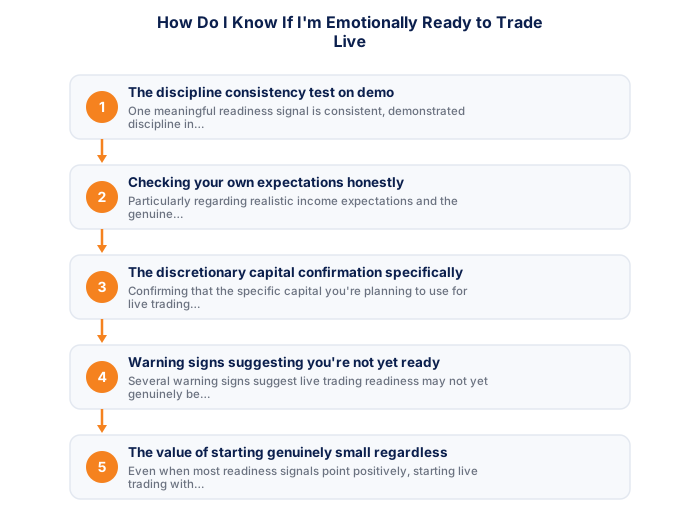
1. The discipline consistency test on demo
One meaningful readiness signal is consistent, demonstrated discipline in following your own predetermined strategy rules across a decent sample of demo trades, not just profitability, which can reflect favourable conditions or chance, but specifically rule adherence, since that's the dimension demo trading can genuinely help you practise and evaluate honestly.
If your demo trading shows frequent, significant deviation from your own stated rules, that's useful information: more demo practice, or a more honest look at your actual strategy and discipline, would serve you better than moving to live trading right now, however eager you feel to start with real capital.
It's worth being genuinely rigorous about what counts as a decent sample here, a handful of demo trades over a few days tells you very little, while a larger, more sustained period of demo trading across varied market conditions gives you considerably more reliable evidence of your own actual, demonstrated consistency.
2. Checking your own expectations honestly
Honestly checking whether your own expectations for live trading line up with the realistic statistics on typical retail outcomes, rather than the more optimistic narratives sometimes pushed in trading marketing, is an important readiness check.
If you're going into live trading expecting rapid, substantial profits that don't match realistic timelines, that expectation gap is itself a real risk. The inevitable gap between those expectations and more modest or mixed actual results can trigger exactly the kind of frustrated, undisciplined behaviour behind revenge trading and overtrading.
- 100+ demo trades completed with consistent rules
- Positive expectancy over full demo sample
- Every demo trade documented in journal
- Written trading plan: entry, exit, position sizing
- FSCA-regulated broker chosen and FSP verified
- Starting capital is genuinely disposable
- Backup connectivity tested
Open a demo
Choose an FSCA-regulated broker. Start with R50,000-R100,000 virtual capital.
Write trading rules
Define entry criteria, stop-loss method, and position sizing in writing.
Trade 2-3 months
Complete at least 50-100 trades across varied market conditions.
Journal everything
Record rationale, emotion, and outcome for every trade.
Evaluate objectively
Move to live only when consistent rule-following meets your benchmark.
It's worth writing your specific expectations down explicitly and comparing them directly against the realistic statistics discussed elsewhere on this site, seeing your own written expectations alongside the honest data makes any gap considerably harder to overlook or rationalise away than a vague, unexamined sense of what you're hoping for.
3. The discretionary capital confirmation specifically
Confirming that the capital you plan to use for live trading genuinely meets the discretionary standard, money you could afford to lose entirely without hurting your essential financial stability or causing real emotional distress, is a concrete, checkable readiness criterion, distinct from the more abstract psychological signals covered elsewhere here.
If you can't honestly identify capital meeting that standard, that's a clear, practical signal you're not yet ready to trade live in any meaningful amount, whatever your demo performance or strategy confidence looks like. This capital check is, in some ways, the most objectively verifiable of all the readiness signals in this piece.
It's worth applying this standard with genuine rigour rather than stretching the definition to justify capital you're eager to start trading with, if you find yourself constructing reasons why money that doesn't quite meet this standard is 'probably fine anyway,' that rationalisation itself is worth treating as a signal worth heeding.
4. Warning signs suggesting you're not yet ready
A few warning signs suggest you may not be ready yet: feeling real anxiety about starting live trading that goes beyond normal, reasonable caution; having only a handful of demo trades behind you rather than a meaningful sample; planning to use capital that doesn't actually meet the discretionary standard above; or carrying expectations well out of step with realistic statistics and timelines.
Recognising any of these honestly in your own situation, rather than brushing them aside in your eagerness to start live trading, reflects the same self-awareness that supports sustainable, sound trading practice over time.
It's worth reviewing this list honestly and specifically against your own current situation, rather than reading it in the abstract and assuming it doesn't apply to you, genuine self-assessment here requires actually checking each sign against your own real feelings and circumstances, not simply agreeing with the general principle.
5. The value of starting genuinely small regardless
Even when most of the signals above point positively, starting live trading with a deliberately small position size and capital amount remains a sound approach, given the unavoidable demo-to-live psychological gap that no amount of demo preparation can fully close in advance.
That's not a sign of inadequate confidence or readiness, it's a recognition that live trading's psychological dimension can only really be tested through actual live experience, which makes a small, controlled first exposure the more prudent approach whatever your other readiness signals look like beforehand.
It's worth embracing this approach even if every other readiness signal points strongly positive, since no amount of demo practice or careful self-assessment can fully substitute for the genuine, lived experience of real financial stakes, starting small remains the sensible bridge regardless of how ready you otherwise feel.
6. Readiness as an ongoing, rather than one-time, assessment
Emotional readiness for live trading isn't a single threshold you cross once and leave behind, it's worth reassessing honestly as you gain actual live experience, since live trading itself can reveal psychological challenges that weren't visible during your pre-live assessment, and may call for scaling back, pausing, or developing specific skills even after you've technically started.
Treating readiness as an ongoing, continuously reassessed state rather than a fixed achievement reflects the same honest, adaptive self-awareness that matters throughout your entire trading journey, not just at the outset.
Genuine readiness involves several distinct signals checked together.
Demo profitability alone doesn't measure psychological readiness for live trading. Genuine readiness involves several distinct signals, including realistic expectations and confirmed discretionary capital.
★ Why It Matters
After reviewing common behavioural patterns among retail traders, one recurring mistake is confusing confidence after a short winning streak with genuine readiness. Measuring consistency over dozens of trades is far more informative than focusing on a handful of recent outcomes.
✕ Common mistakes
- Going live after only a few winning trades. A short hot streak on demo doesn't yet prove a real edge, see demo trading limitations for why a small sample is misleading.
- Increasing position size too quickly. Scaling up before position sizing has been proven consistent at a smaller size usually means scaling up unverified confidence, not unverified skill.
- Trading with money you can't actually afford to lose. This single factor changes your psychology more than any strategy detail.
- Ignoring emotional patterns instead of journaling them. Traders who skip a trading journal tend to repeat the same emotional mistakes without ever noticing the pattern.
How do I know if my problem is psychological or strategy-related?
If you follow rules consistently on demo but deviate on live accounts, the issue is primarily psychological. If you lose money even when following your rules exactly, the issue is more likely the strategy itself. Most traders experience elements of both.
Is it normal to feel anxious about this?
Some is ordinary and some is a signal the position is too large for your tolerance. Fear before entry covers where the line sits.
Key Takeaways
- Signs of readiness include consistent demo discipline, realistic expectations, and using genuinely discretionary capital. Learn the honest signs to look for.
- You're emotionally ready to trade live when you consistently follow your trading plan on a demo account, hold realistic expectations, and can afford to risk only discretionary capital without emotional stress.
- The discipline consistency test on demo.
- Checking your own expectations honestly.
- The discretionary capital confirmation specifically.
Frequently asked follow-up questions
Is some nervousness before starting live trading normal?
Yes. Mild nervousness reflecting reasonable caution is common and isn't itself a sign of inadequate readiness. The concern is significant, overwhelming anxiety well beyond that normal range.
How many demo trades constitute enough evidence of readiness?
There's no single universal number, though many sources suggest at least 50-100 trades following a consistent strategy as a reasonable benchmark before considering yourself ready.
Can I be financially ready but not emotionally ready, or vice versa?
Yes. These are genuinely distinct dimensions, and both deserve honest, separate assessment rather than assuming one implies the other.
