i Short answer
Loss aversion means losses feel psychologically more painful than equivalent-sized gains feel pleasurable.
This typically leads to holding losing positions too long and closing winning positions too early, working against favourable risk-reward ratios.
📋 ON THIS PAGE
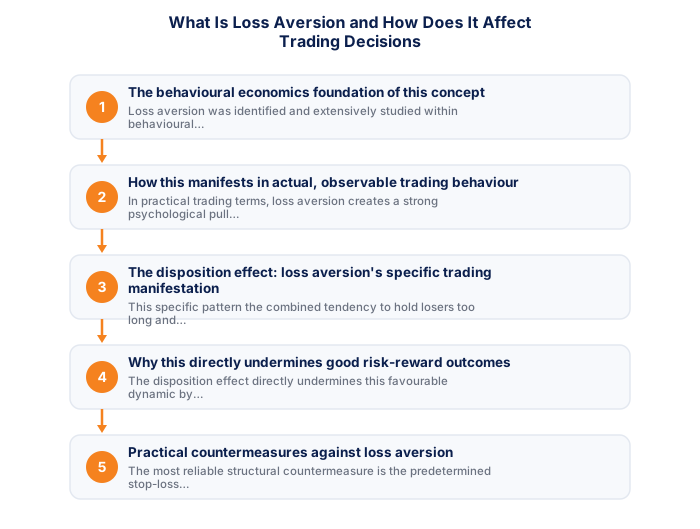
- The behavioural economics foundation of this concept
- How this manifests in actual, observable trading behaviour
- The disposition effect: loss aversion's specific trading manifestation
- Why this directly undermines good risk-reward outcomes
- Practical countermeasures against loss aversion
- Reframing losses to reduce their disproportionate psychological weight
1. The behavioural economics foundation of this concept
Loss aversion has been studied extensively in behavioural economics, showing across many contexts and experiments that people generally feel the pain of losing a given amount more intensely than the pleasure of gaining the same amount. Various studies commonly put losses at roughly twice the psychological weight of equivalent gains, though the exact ratio varies by study and context.
This isn't a trading-specific quirk but a broadly documented human tendency, so it affects nearly all traders to some degree, regardless of style, experience, or whether they're aware of the concept. Knowing about it intellectually doesn't automatically stop it from shaping your behaviour, which is exactly why the practical countermeasures later in this piece matter.
What makes this particular bias so persistent is that it operates below the level of deliberate reasoning, it's closer to a reflex than a conscious calculation. A trader can hold a fully accurate intellectual understanding of the statistics involved and still feel the pull to avoid realising a loss, simply because the underlying psychological wiring doesn't update just because the concept has been understood.
2. How this manifests in actual, observable trading behaviour
In practical terms, loss aversion creates a strong pull to avoid the painful moment of "realising" a loss by closing a losing position, even when the sound decision would be to close it. As long as a position stays open, the loss remains "unrealised" and psychologically deferred, even though your actual financial position is identical whether or not you've formally closed the trade.
The same asymmetric psychology pulls the opposite way on winning positions. Fear of a current unrealised gain disappearing creates pressure to close winners quickly and "lock in" the profit, even when your strategy's own logic would suggest holding longer for a bigger gain in line with your original analysis.
- FSCA-regulated broker verified at fsca.co.za
- Demo account tested for minimum 60 days
- Trading plan written: entry, exits, position sizing
- Risk per trade defined (1-2% of account)
- Backup internet connection tested for load shedding
- Tax implications understood
This is worth sitting with directly: an open, unrealised loss and a closed, realised loss of the identical size represent exactly the same reduction in your account equity. The only thing that changes when you close the position is your own psychological relationship to that number, not the number itself, which is precisely why treating them as meaningfully different tends to lead to worse decisions.
3. The disposition effect: loss aversion's specific trading manifestation
This specific pattern, holding losers too long and selling winners too early, has been studied directly in trading and investment contexts under the name "disposition effect." Considerable research across both professional and retail populations consistently documents how prevalent it is and its generally negative effect on trading and investment performance.
That research backing matters: the disposition effect isn't just a theoretical concern but a well-evidenced pattern that genuinely affects outcomes, which makes the countermeasures below a response to documented, real risk rather than a hypothetical one.
note that this pattern shows up even among traders who would readily describe themselves as disciplined and rules-based, which is part of why it's worth actively checking your own trading history for evidence of it rather than assuming self-awareness alone is sufficient protection. The bias operates quietly enough that many traders genuinely don't notice it in their own behaviour until they look for it systematically.
4. Why this directly undermines good risk-reward outcomes
Profitability often depends on letting winning trades develop into meaningfully bigger gains than typical losses, since a favourable risk-reward ratio can sustain profitability even with a win rate below 50%. The disposition effect undermines exactly that dynamic by systematically cutting winners short while letting losers run, inverting the risk-reward relationship your strategy may have been built around.
Behavioural research calls this trading strategy, and it explains why holding a losing position feels easier than closing it.
| Item | Detail |
|---|---|
| Regulator | FSCA, fsca.co.za |
| Exchange control | SARB, resbank.co.za |
| Tax authority | SARS, sars.gov.za |
| JSE hours | 09:00-17:00 SAST Mon-Fri |
| Best forex session | 15:00-17:00 SAST |
| CGT annual exclusion | R50,000 (individuals) |
Put concretely: a strategy built around a 1:2 risk-reward ratio, needing to win only roughly a third of its trades to be profitable, can quietly become a losing strategy in practice if the disposition effect is consistently cutting winners at 1:1 while losers are allowed to run to 1:3 or worse. The strategy's rules never changed on paper; only their actual execution did.
5. Practical countermeasures against loss aversion
The most reliable structural countermeasure is a predetermined stop-loss and take-profit order. Deciding your exit points before emotional pressure builds removes the need to make the hard realisation decision in the moment, since the order fires automatically based on your calmer, earlier planning rather than your in-the-moment state of mind.
It also helps to review your trading journal specifically for signs of the disposition effect, trades closed noticeably earlier than your target, or losers held well past your stop-loss level, to build honest, evidence-based awareness of your own susceptibility over time.
It also helps to remove yourself from actively watching a position once your stop-loss and take-profit are set, where your trading style allows it. Continuous, real-time observation of an open position's fluctuating profit and loss tends to intensify the emotional pull in both directions, precisely the conditions under which loss aversion exerts the strongest influence over impulsive, in-the-moment decisions.
6. Reframing losses to reduce their disproportionate psychological weight
Some traders find it helps to deliberately reframe individual losses, not as personal failures but as a normal, already-budgeted cost of running a strategy with real statistical edge over a large sample. This reframe doesn't remove the underlying bias, but it can shrink its outsized emotional weight by putting each loss in that broader statistical context.
Pairing this reframe with the structural safeguards above, rather than relying on either alone, tends to be the most sound practical defence against loss aversion's steady pull toward exactly the behaviours that undermine long-term profitability.
Symmetric risk management treats gains and losses with equal discipline.
Loss aversion makes losses feel around twice as painful as equivalent gains feel pleasurable. This leads traders to hold losing positions too long and cut winners too early, the opposite of what works.
★ Why It Matters
Worth testing on your own data: calculate your average holding time for losing trades versus winning trades. A meaningfully longer average hold on losses than wins is one of the clearest, most measurable personal signatures of loss aversion actually showing up in your results.
✕ Common mistakes
- Not comparing your own average holding time for winners versus losers. This specific comparison in your journal often reveals the bias directly.
- Closing winning trades prematurely to lock in a felt sense of safety. This works against the favourable risk-reward ratios sound trading generally requires.
- Treating the discomfort of a loss as a signal to avoid taking it. This avoidance is precisely the behaviour pattern worth recognising and addressing.
Will my stop fill at the price I set?
No. A gap straight through the level is exactly when the stop matters and exactly when it fills worst. stop-loss against mental stop covers it in full.
Should I move my stop to breakeven?
Moving to breakeven is a decision about volatility rather than about discipline, and it should be tested rather than assumed. Stop-loss against mental stop covers it in full.
Key Takeaways
- Loss aversion means losses feel psychologically worse than equivalent gains feel good, leading to holding losers too long and cutting winners too short.
- Loss aversion means losses feel psychologically more painful than equivalent-sized gains feel pleasurable.
- This typically leads to holding losing positions too long and closing winning positions too early, working against favourable risk-reward ratios.
- The behavioural economics foundation of this concept.
- How this manifests in actual, observable trading behaviour.
Frequently asked follow-up questions
Does understanding loss aversion intellectually help reduce its effect?
Not on its own. Structural countermeasures, predetermined orders especially, are more reliable than awareness alone at counteracting a bias this deeply ingrained.
Is loss aversion the same as fear of losing money in general?
Related, but not identical. Loss aversion specifically refers to the asymmetric psychological weighting of losses versus equivalent gains, a more precise concept than general fear or risk aversion.
Can loss aversion ever be helpful in trading?
In moderation, a healthy respect for losses supports prudent risk management. The problem is when it becomes strong enough to consistently override sound, predetermined strategy rules.
