i Short answer
Screen recording active trading sessions provides a richer review resource than memory or written notes alone.
This captures your actual real-time decision process, adding a visual dimension to your journaling.
📋 ON THIS PAGE
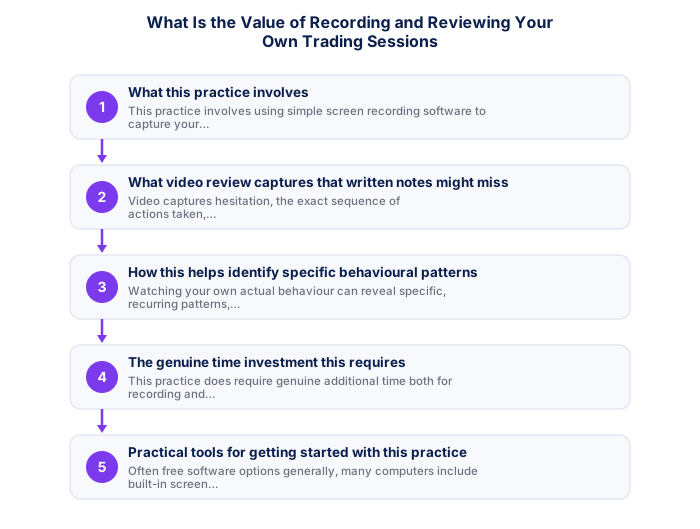
1. What this practice specifically involves
Recording your trading sessions involves using screen capture software to create a video record of your platform while you're actively trading, price action, order entries and exits, and ideally your own audio commentary narrating your thinking in real time. The review involves watching that video back, typically a day or more later, and analysing your decision-making process with the benefit of distance from the emotional context of the live session.
The practice extends standard journaling in an important way: where a journal records what you decided to do and sometimes why, a session recording captures everything, including hesitation, corrections, second-guessing, the exact timing of decisions relative to price action, and the gap between your planned approach and what you actually did.
See also: What Is a Good Framework for Analysing USD/ZAR?
See also: How Does Load Shedding Affect My Trading Day?
See also: The JSE All Share Index vs the Top 40
See also: How Do I Evaluate Trading Podcasts and Audio Content?
This gap between intention and execution is often the most valuable thing session recordings reveal. Many traders find that their journal notes portray a more rational, disciplined process than the recorded video actually shows, because journal entries are written retrospectively, with the outcome already known, in a less emotionally charged state than the live session.
2. What video review captures that written notes might miss
Video captures the sequential reality of what happened in a way written notes rarely do. You can see exactly how long you hesitated before entering, whether you placed the order before or after the key level broke, how you reacted in the moments immediately after entry, and whether your exit decision came at a point when price action supported it or when anxiety drove it.
Verbal commentary recorded during live trading is particularly revealing. Many traders find that the reasons they articulate out loud while trading differ from the reasons they'd write in a journal entry afterward, the real-time narration is less curated, more honest about uncertainty, and often captures the emotional state that influenced the decision in ways a written retrospective doesn't.
- FSCA-regulated broker verified at fsca.co.za
- Demo account tested for minimum 60 days
- Trading plan written: entry, exits, position sizing
- Risk per trade defined (1-2% of account)
- Backup internet connection tested for load shedding
- Tax implications understood
Video review also allows precise timing comparison: you can measure how long after a setup trigger you entered, whether you held through the expected noise range, and whether your exit coincided with your predetermined criteria or with a moment of emotional response to short-term price movement. This precision isn't possible with written records.
3. How this helps identify specific behavioural patterns
Watching multiple recorded sessions over time reveals recurring behavioural patterns that a journal may obscure by presenting individual decisions in isolation. You might notice that you consistently enter slightly late on a specific setup type, always after confirmation that's technically already a reduced-quality entry. Or that you exit positions within a predictable number of candles after entry regardless of how the setup is developing, reflecting impatience rather than strategic exit criteria.
Patterns visible in session recordings often don't show up clearly in P&L statistics. An entry timing problem might produce slightly worse outcomes on average without creating an obvious statistical signal until you have a large sample. But watching yourself enter consistently late on ten recorded sessions makes the pattern undeniable and specific enough to address directly.
The distance from the emotional context of the live session is important for the review to be honest. Reviewing a recording immediately after the session, when the emotional residue is still fresh, tends to produce defensive interpretation. Waiting a day or two and reviewing with fresh eyes produces more objective assessment of what actually happened.
4. The genuine time investment this requires
Session recording and review requires meaningful additional time. Recording is passive, the software runs in the background, but review requires as much time as the session itself, plus additional reflection time. For a trader doing daily sessions, this could represent several hours per week dedicated purely to review.
This time investment is worth treating as selective rather than universal. Recording every session indefinitely is neither necessary nor the most productive use of review time. Recording focused on specific things you're trying to improve, your entry timing on a particular setup, your exit discipline during trending conditions, produces more actionable insight than complete recording for its own sake.
| Item | Detail |
|---|---|
| Regulator | FSCA, fsca.co.za |
| Exchange control | SARB, resbank.co.za |
| Tax authority | SARS, sars.gov.za |
| JSE hours | 09:00-17:00 SAST Mon-Fri |
| Best forex session | 15:00-17:00 SAST |
| CGT annual exclusion | R50,000 (individuals) |
Recording selectively around periods of performance change, when you're entering a drawdown, after a run of good results, or when you're trying to implement a specific process change, tends to produce the most useful material, since these are the moments when reviewing actual behaviour against intended behaviour reveals the most.
5. Practical tools for getting started with this practice
Most computers include built-in screen recording capability: QuickTime on Mac, the Xbox Game Bar or a built-in screen capture utility on Windows. These free options are sufficient for the purpose and require no additional software installation. For traders who want to add audio commentary, a simple microphone, many laptops have adequate built-in microphones, is all that's needed.
Dedicated recording software like OBS (free and open-source) offers more control over recording quality, file size management, and annotation features. For most purposes the built-in options are adequate, but OBS becomes useful if you're recording long sessions and need smaller file sizes or want to add timestamps and annotations during review.
File management is a practical consideration worth thinking through before starting. Session recordings can be several gigabytes for a full trading session, and accumulating months of recordings requires either significant local storage or a systematic deletion policy once each session's review is complete.
6. Combining this with your existing journaling practice
Session recording works best as a supplement to written journaling rather than a replacement for it. The journal provides a searchable, easily referenced written record; the recording provides the raw video evidence that the journal summarises. Using both means you can cross-reference a journal note with the recorded evidence of the decision it describes.
A practical workflow: record the session, take brief notes in your journal immediately after while the session is fresh, then review the recording a day or two later and add more detailed observations to those journal notes. This two-stage process combines the advantages of immediate recall (the immediate notes) with the objectivity of distance (the delayed recording review).
Worth trying as a specific exercise: record yourself narrating your reasoning out loud during a live session, then watch it back several days later without first reviewing your journal entry for that session. Comparing what you said in real time to what you later wrote in your journal often surfaces the specific ways retrospective framing changes your account of what actually happened, and that gap is itself a useful thing to understand about your own process.
✕ Common mistakes
- Reviewing a recorded session immediately rather than after some genuine distance. A few days' gap tends to reveal differences between in-the-moment reasoning and clearer hindsight assessment.
- Not narrating your reasoning out loud while recording. Without this, the recording captures actions but not the thinking behind them.
- Treating recordings as useful only for catching technical or platform errors. Their real value often lies in revealing gaps in real-time decision quality.
- Recording sessions without ever actually reviewing the footage afterward. The value comes specifically from the review process, not the recording itself.
Key Takeaways
- Screen recording active trading sessions provides a richer review resource than memory or notes alone, capturing your actual real-time decision process.
- Screen recording active trading sessions provides a richer review resource than memory or written notes alone.
- This captures your actual real-time decision process, adding a visual dimension to your journaling.
- What this practice specifically involves.
- What video review captures that written notes might miss.
See also: How Do I Build Discipline as a New Trader?.
Frequently asked follow-up questions
How often should I record and review my trading sessions?
Many traders find periodic application, perhaps weekly or monthly, or specifically after notable wins or losses, provides good value without requiring excessive ongoing time investment.
Should I narrate my thinking out loud while recording?
Some traders find this valuable, since verbal commentary captures reasoning that pure screen capture alone might not reveal, though this is a personal preference.
Does this practice work for day trading as well as longer-term styles?
Yes, though day trading's faster pace, may make session recordings particularly information-dense and valuable for detailed review.
Can I share recorded sessions with a mentor for additional feedback?
Yes, sharing specific recorded sessions can provide a mentor with richer context than verbal description alone might convey.
Is there a risk of becoming overly self-critical when reviewing my own recordings?
This is worth being mindful of, approaching review with curiosity rather than excessive self-judgment.
