i Short answer
A trading coach typically focuses on improving execution of an existing strategy and discipline over a defined period.
A trading mentor often provides broader, longer-term strategic guidance spanning strategy development and trading philosophy.
📋 ON THIS PAGE
1. The general coaching relationship explained
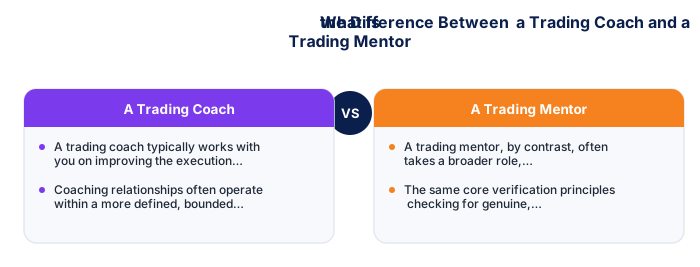
A trading coach typically works with you on improving the execution and discipline around a strategy you already have, focusing on identifying specific behavioural patterns, that might be undermining your results, and providing structured feedback over a defined coaching period, similar in spirit to coaching relationships in other skill-based domains.
It's worth appreciating why this narrower, skill-focused structure suits certain specific needs particularly well, if you have a genuinely well-defined gap, execution discipline, a specific technical skill, a coaching relationship can address that particular issue efficiently without requiring a broader, more open-ended commitment.
2. The general mentoring relationship explained
A trading mentor, by contrast, often takes a broader role, potentially helping you develop your underlying strategy itself, sharing broader market philosophy and experience accumulated over their own trading career, and providing more open-ended, longer-term guidance rather than focusing narrowly on execution of an already-established approach.
See also: Are Free Trading Tools as Good as Paid Ones?
It's worth recognising why this broader relationship genuinely suits earlier-stage development particularly well, when you're still forming your overall approach and understanding, discussed elsewhere on this site regarding building a personal trading curriculum, a mentor's wider perspective often provides more value than narrowly-focused coaching alone.
- FSCA-regulated broker verified at fsca.co.za
- Demo account tested for minimum 60 days
- Trading plan written: entry, exits, position sizing
- Risk per trade defined (1-2% of account)
- Backup internet connection tested for load shedding
- Tax implications understood
| Aspect | Trading Coach | Trading Mentor |
|---|---|---|
| Focus | Specific skill improvement, process | Broader career and mindset development |
| Time frame | Short to medium: goal-oriented | Longer: ongoing relationship |
| Structure | Formal sessions, defined outcomes | Often informal, experience-sharing |
| Payment | Usually paid service | Often unpaid: genuine relationship |
| FSCA licensing required | Not for general coaching | Not for mentoring |
| Best for | Addressing a specific weakness | Learning from an experienced practitioner |
| Red flag to watch for | Guarantees of profit improvement | Claims to share trades for copying |
3. How the typical time horizon differs between these roles
Coaching relationships often operate within a more defined, bounded timeframe, perhaps weeks or a few months, with specific, measurable goals around discipline and execution improvement, while mentoring relationships can be more open-ended and longer-term, sometimes continuing informally for years as the relationship and trust develops.
It's worth being explicit with any prospective coach or mentor about which specific timeframe and structure you're actually looking for, rather than assuming the relationship's scope, a clear, upfront conversation about expectations helps ensure both parties share the same understanding.
4. Which relationship suits which specific need
If you already have a reasonably developed strategy but struggle specifically with disciplined execution, a coaching relationship focused narrowly on this specific challenge may be more directly suited to your need than broader mentorship. If you're still developing your fundamental approach and philosophy, broader mentorship may offer more relevant value.
It's worth being honest with yourself about which category genuinely describes your current need, someone still building fundamental understanding likely benefits more from mentoring, while someone with solid fundamentals struggling with a specific, identifiable issue may find coaching more efficient and targeted.
| Item | Detail |
|---|---|
| Regulator | FSCA, fsca.co.za |
| Exchange control | SARB, resbank.co.za |
| Tax authority | SARS, sars.gov.za |
| JSE hours | 09:00-17:00 SAST Mon-Fri |
| Best forex session | 15:00-17:00 SAST |
| CGT annual exclusion | R50,000 (individuals) |
5. The same verification principles apply to both roles
As, the same core verification principles, checking for genuine, verifiable track record, watching for guaranteed-result red flags, and confirming a genuine focus on building your own skill rather than dependence, apply equally whether you're considering a coach or a mentor specifically, regardless of which particular terminology is being used.
It's worth applying the exact same evaluation rigour discussed elsewhere on this site regarding evaluating trading mentors generally, verifiable track record, transparent process over signal-selling, balanced risk discussion, to either type of relationship, regardless of which specific label is used.
6. Can the same person fill both roles
Yes, some experienced trading educators offer both coaching and mentoring services, sometimes within the same overall relationship, blending narrow execution-focused coaching with broader strategic guidance, the specific terminology used by any individual educator matters less than clearly understanding what kind of guidance and relationship you're genuinely entering into.
A mentor offers ongoing broader guidance without fixed structure.
A trading coach provides structured, often paid sessions focused on specific skills or issues. A mentor offers ongoing, broader guidance on your development as a trader, which can be a less formal, sometimes unpaid relationship.
★ Why It Matters
Something worth clarifying explicitly before paying either: ask directly what specific, measurable outcome they're working toward with you over a defined period, vague engagements without a stated target tend to drift longer and cost more than ones with clear, agreed milestones from the outset.
✕ Common mistakes
- Assuming a coach and mentor serve identical functions. One typically focuses on execution discipline, the other on broader strategic guidance.
- Not checking which specific role you actually need before engaging either. Mismatched expectations reduce the value of paid guidance.
- Continuing an engagement without periodically reassessing whether goals are being met. Regular check-ins keep the arrangement genuinely useful.
Key Takeaways
- A coach typically focuses on improving execution of an existing strategy and discipline, while a mentor often provides broader, longer-term strategic guidance.
- A trading coach typically focuses on improving execution of an existing strategy and discipline over a defined period.
- A trading mentor often provides broader, longer-term strategic guidance spanning strategy development and trading philosophy.
- The general coaching relationship explained.
- The general mentoring relationship explained.
See also: How Do I Build Discipline as a New Trader? and Should I Join a Paid Trading Discord or Telegram Group? and What Is the Value of Paper Trading Competitions?.
Frequently asked follow-up questions
Is a coach generally cheaper than a mentor?
Pricing varies considerably by individual provider rather than following a consistent pattern based on terminology alone; independent verification matters more than the specific title used.
Should beginners start with a coach or a mentor?
This depends on your specific need; beginners still developing foundational strategy understanding, might benefit more from broader mentorship initially.
Can I have both a coach and a mentor simultaneously?
Yes, some traders work with different people serving these distinct purposes simultaneously, provided both relationships are genuinely valuable and properly verified.
