i Short answer
Broker research reports can offer genuine analytical value, but warrant awareness of the underlying incentive structure connecting broker revenue to client trading activity.
📋 ON THIS PAGE
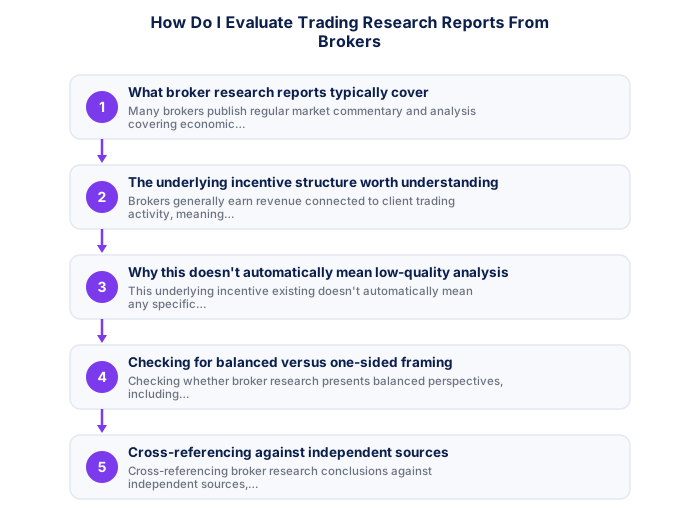
1. What broker research reports typically cover
Many brokers publish regular market commentary and analysis covering economic developments, technical chart analysis, and sometimes specific trading idea suggestions for particular instruments their platform offers.
It's worth checking how frequently and consistently a specific broker actually publishes this content before relying on it heavily, since the depth and reliability of broker research varies considerably, some providers offer genuinely substantive, regularly updated analysis, while others provide only sporadic, thin content that adds little real value.
| Signal | Worth Weighing More | Worth Cross-Checking |
|---|---|---|
| Balanced framing | Presents both bull and bear cases | One-sided, only bullish or bearish |
| Sourcing | Cites specific data and reasoning | Vague, unsupported assertions |
| Independent confirmation | Aligns with other credible sources | Contradicts broader consensus without explanation |
2. The underlying incentive structure worth understanding
Brokers generally earn revenue connected to client trading activity, meaning research content encouraging more frequent trading or specific instrument focus could theoretically align with this broader revenue interest, independent of whether any specific analysis is genuinely sound.
It's worth keeping this incentive in mind specifically when broker research consistently suggests trading opportunities requiring frequent activity, rather than occasionally concluding that patience or inaction is the more sensible response, a research feed that never suggests waiting is worth noticing as a pattern.
- Search FSP name or number at fsca.co.za
- Confirm licence is current and not suspended
- Check scope covers forex and CFD activity
- Confirm client funds in segregated accounts
- Read FSCA enforcement actions history
- Test customer support before depositing
- Client funds legally segregated
- FSCA complaints process available
- SA consumer protections apply
- ZAR account, no FX conversion costs
- Some offshore brokers offer wider instruments
- Regulatory overhead passed on in spreads
- Stricter position limits for retail clients
- FICA verification required before trading
- Client funds segregated
- Formal FSCA complaints process
- SA consumer protections apply
- ZAR account available
- Fund safety not guaranteed
- Overseas disputes only
- SA law does not apply
- Currency conversion costs
3. Why this doesn't automatically mean low-quality analysis
This underlying incentive existing doesn't automatically mean any specific broker's research is poor quality or dishonest, many brokers genuinely employ qualified analysts producing substantively useful content, similar to how the underlying revenue incentives.
It's worth evaluating each specific broker's research on its own actual merits rather than dismissing broker-produced content categorically, some of the most substantively useful, well-reasoned market commentary genuinely does come from broker research desks staffed by qualified analysts with real expertise.
4. Checking for balanced versus one-sided framing
Checking whether broker research presents balanced perspectives, including genuine risk discussion and acknowledgment of uncertainty, rather than consistently one-sided, bullish framing toward more frequent trading, helps assess genuine analytical quality.
It's worth tracking this pattern over several weeks or months of a specific broker's research rather than judging based on a single report, a consistent, sustained pattern of one-sided, activity-encouraging framing tells you considerably more than any individual piece of content viewed in isolation.
| Protection | FSCA Regulated | Offshore Unregulated |
|---|---|---|
| Client fund segregation | ✓ Required | Varies by broker |
| SA complaints process | ✓ Available | ✗ Not available |
| SA consumer law applies | ✓ Yes | ✗ No |
| ZAR account available | ✓ Typically | Often USD/EUR only |
5. Cross-referencing against independent sources
Cross-referencing broker research conclusions against independent sources, including reputable financial news, provides additional verification beyond relying solely on any single source, including your own specific broker.
It's worth doing this cross-referencing specifically before acting on any broker research suggestion that would meaningfully affect your trading, rather than treating this verification step as optional, the small additional time investment is modest compared to the cost of acting on a conclusion that turns out to be unusually skewed.
6. A practical approach to using this content
Treating broker research as one input within your broader analytical framework, applying your own independent judgement and the verification techniques, rather than executing trades purely based on broker-suggested ideas without this kind of independent evaluation, supports more genuinely sound, autonomous decision-making.
The FSCA regulatory framework provides South African retail traders with meaningful protection that extends beyond simply verifying a broker's licence number. The requirement for FSCA-regulated brokers to maintain segregated client accounts means your deposited funds are legally separated from the broker's operating funds. In the event of broker insolvency, this segregation protects client money from creditor claims against the company. FSCA-regulated brokers must also maintain adequate financial resources, submit to regulatory oversight, and adhere to disclosure requirements covering fees, risks, and conflicts of interest. For traders considering offshore brokers outside FSCA supervision, the loss of these domestic protections is a material risk consideration, particularly for larger account balances where the downside of unregulated broker failure would be financially significant.
That doesn't automatically mean any specific research is poor.
Brokers generally earn revenue connected to client trading activity, a real incentive worth noting, but that doesn't automatically mean any specific broker's research is poor quality.
★ Why It Matters
A useful cross-check: compare a broker's published research call against the same instrument's coverage from an independent source with no execution-revenue incentive, persistent, systematic divergence in one direction is worth noticing.
✕ Common mistakes
- Treating broker research as fully independent analysis. Broker revenue connects to client trading activity, an incentive worth keeping in mind.
- Assuming research quality is uniform across all brokers. Depth and rigour vary meaningfully between providers.
- Acting on research conclusions without your own independent verification. Treat broker research as one input, not a standalone basis for trades.
When evaluating whether a broker is appropriate for South African retail trading, the FSCA public register provides the starting point, but the quality of regulatory compliance goes beyond simply holding a licence. Checking how long the broker has been licensed, whether there are any enforcement actions in their history, and what the FSCA inspection record shows, if available, provides a more complete picture than the licence alone. South African financial consumer bodies periodically publish guidance on broker evaluation that supplements the FSCA register as a due diligence resource.
Evaluating trading educational content requires applying the same critical standards you would apply to any financial information source. The most valuable resources are those that focus on process, risk management, and psychological frameworks rather than those that primarily promise profits or specific returns. South African traders should additionally prioritise content that addresses SA-specific regulatory, tax, and market context, since most international trading education was produced without South African exchange control, SARS tax treatment, or ZAR-specific market conditions in mind.
Key Takeaways
- Broker research reports can offer genuine analytical value but warrant awareness of the underlying incentive structure connecting broker revenue to trading activity.
- Broker research reports can offer genuine analytical value, but warrant awareness of the underlying incentive structure connecting broker revenue to client trading activity.
- What broker research reports typically cover.
- The underlying incentive structure worth understanding.
- Why this doesn't automatically mean low-quality analysis.
Frequently asked follow-up questions
Should I avoid reading my own broker's research entirely?
Not necessarily; treating it as one useful input alongside independent verification, rather than avoiding it entirely or relying on it exclusively, reflects a balanced approach.
Do larger, more established brokers generally produce better research?
Not necessarily by size alone. Quality and balance matter more than the specific broker's overall size or prominence.
Can I trust broker research more if it sometimes recommends against trading?
Research occasionally suggesting caution or non-action can suggest more genuinely balanced framing than content consistently encouraging trading activity.
