i Short answer
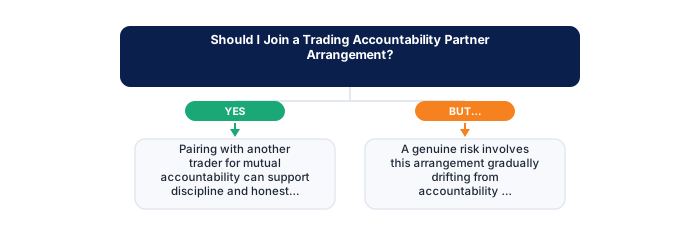
Pairing with another trader for mutual accountability can support discipline and honest journaling, provided both parties maintain independent decision-making.
📋 ON THIS PAGE
- What an accountability partner arrangement typically involves
- The genuine benefits this structure can provide
- The risk of drifting into shared, rather than independent, decision-making
- Setting clear boundaries from the outset
- What makes a good accountability partner
- Alternatives if you can't find a suitable partner
1. What an accountability partner arrangement typically involves
An accountability partner arrangement typically involves two traders agreeing to regularly share their trading journal entries, discuss their adherence to predetermined strategy criteria, and provide mutual encouragement and honest feedback, similar in spirit to accountability structures used in other disciplines like fitness or habit-building generally.
It's worth agreeing on a specific, regular schedule for this sharing from the outset, rather than an informal, whenever-convenient arrangement, a concrete rhythm, weekly journal review, for example, keeps the relationship genuinely functional rather than gradually fading into infrequent, inconsistent contact.
2. The genuine benefits this structure can provide
Having someone else genuinely reviewing your stated reasoning and discipline can surface patterns or rationalisations you might overlook reviewing your own journal in isolation, providing a valuable, complementary perspective on your own trading behaviour.
It's worth appreciating why an outside perspective genuinely helps here, patterns in your own decision-making can be genuinely difficult to spot from inside your own thinking, someone reviewing your reasoning from outside brings a fresh, less biased vantage point that pure self-review often can't fully replicate.
- South African ID or valid passport
- Proof of residential address dated within 3 months
- Proof of bank account ownership
- Selfie or photo for biometric verification (some brokers)
- Source of funds declaration if depositing above threshold
Choose FSCA-regulated broker
Verify the FSP number is current at fsca.co.za.
Submit FICA documents
SA ID, proof of address within 3 months, bank account proof.
Fund via EFT
Make the initial deposit from your SA bank account in ZAR.
Open demo account first
Practice on demo before activating your live account.
Start with minimum capital
Begin with an amount you can afford to lose while learning.
4. Setting clear boundaries from the outset
Establishing clear boundaries from the outset, agreeing explicitly that the arrangement involves reviewing already-made decisions for honest feedback and discipline-checking, rather than jointly deciding on trades together in real time, helps maintain the genuine accountability benefit while avoiding the herd-behaviour risk this same closeness could otherwise introduce.
| Rejection reason | Fix |
|---|---|
| Address proof older than 3 months | Get a recent utility bill or bank statement |
| Name mismatch between documents | Use documents with exactly matching full name |
| Poor quality scan | Retake with good lighting, all corners visible |
| PO Box address | Brokers require physical residential address only |
5. What makes a genuinely good accountability partner
A good accountability partner demonstrates their own consistent discipline and honest self-reflection, is willing to provide honest, sometimes uncomfortable feedback rather than purely encouraging validation, and ideally maintains their own independent strategy and analysis rather than simply mirroring yours.
It's worth being honest with yourself about whether a prospective partner genuinely meets these criteria, rather than choosing based purely on convenience or existing friendship, a partner who consistently avoids honest critique, however pleasant the relationship otherwise, doesn't actually provide the accountability function this arrangement is meant to serve.
6. Alternatives if you can't find a suitable partner
If a suitable individual partner isn't available, the broader trading communities can sometimes provide a similar accountability function at a group level, or simply maintaining rigorous self-accountability through your own detailed journal and predetermined review schedule, can achieve much of this same discipline-supporting benefit independently.
Building consistent trading psychology in South Africa requires confronting the full range of emotional pressures that leveraged trading produces. The combination of rand volatility around political events, load shedding operational stress, and the standard emotional challenges of trading losses and gains creates a uniquely demanding psychological environment for South African retail traders. Developing a pre-session checklist that includes both an operational check (connectivity, stops) and a brief psychological check (emotional state, recent performance, current stress level) is a practical structure that many experienced SA traders have found effective.
An accountability partner arrangement works best when it focuses on process adherence, journal sharing, and honest discussion of mistakes, not just comparing profit and loss figures.
★ Why It Matters
Worth establishing explicitly at the outset: what specifically gets shared (entries only, or full reasoning and emotional state too), and how directly you'll each call out rule violations, vague accountability arrangements without these specifics tend to quietly fade within a few weeks.
✕ Common mistakes
- Letting the partner influence your independent trading decisions. Accountability should support discipline, not replace your own judgement.
- Choosing a partner with a very different risk tolerance or style. Mismatched approaches can create unhelpful pressure rather than useful accountability.
- Not setting a regular, scheduled check-in cadence. Without structure, the arrangement tends to lose momentum.
Trading psychology research consistently shows that the management of positive emotions, overconfidence after winning streaks, euphoria after large gains, is as important as managing negative emotions like fear and frustration. South African traders who maintain a consistent daily routine, fixed position sizing rules, and a written trading plan regardless of recent performance are better protected against both the positive and negative emotional extremes that undermine decision quality. Treating exceptional results with the same analytical discipline as disappointing ones is one of the most reliable markers of a developing trader's maturity.
Key Takeaways
- Pairing with another trader for mutual accountability can support discipline and honest journaling, provided both parties maintain independent decision-making.
- What an accountability partner arrangement typically involves.
- The genuine benefits this structure can provide.
- The risk of drifting into shared, rather than independent, decision-making.
- Setting clear boundaries from the outset.
Frequently asked follow-up questions
Should my accountability partner trade the same strategy as me?
Not necessarily; a partner with their own genuinely independent approach can sometimes provide more valuable, less biased perspective than someone trading identically to you.
How often should accountability partners check in with each other?
This varies by personal preference; weekly or bi-weekly check-ins are common, balancing meaningful engagement against excessive, potentially distracting frequency.
Can an accountability partnership work well between traders at very different experience levels?
It can, provided both parties respect the arrangement's purpose, though some prefer partnering with someone at a broadly similar stage for more mutually relevant discussion.
