i Short answer
A trading thesis articulates your specific reasoning for a trade in writing before entering.
This supports clearer analysis at the time and more honest, evidence-based post-trade review.
📋 ON THIS PAGE
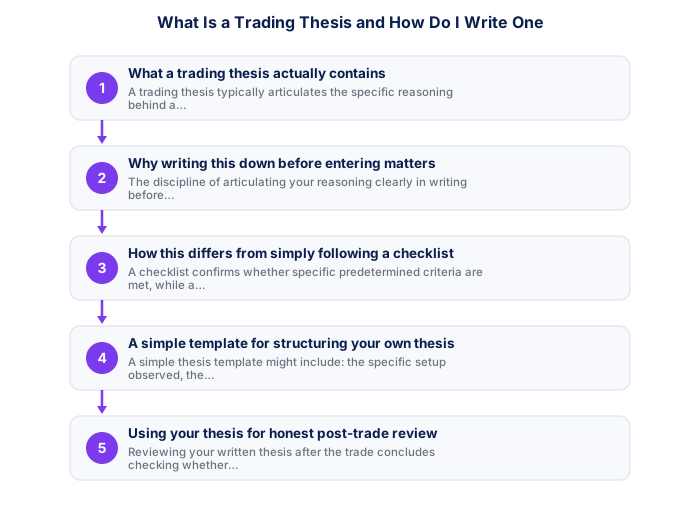
1. What a trading thesis actually contains
A trading thesis typically articulates the specific reasoning behind a particular trade, what technical or fundamental evidence supports this decision, what would invalidate the thesis, and what outcome you genuinely expect if your reasoning proves correct, written clearly enough that someone else could understand your reasoning.
It's worth writing this in genuinely plain, specific language, rather than vague generalities, a thesis stating 'price is likely to fall because resistance has held twice and momentum is weakening' gives you something concrete to later evaluate, unlike a vaguer 'this looks bearish' impression.
2. Why writing this down before entering matters
The discipline of articulating your reasoning clearly in writing before entering often reveals whether your thinking is genuinely sound and evidence-based, or whether it's actually vague, intuitive, or based on incomplete analysis you hadn't fully examined.
See also: What Is a Good Framework for Analysing USD/ZAR?
It's worth noticing how the act of writing itself changes your thinking, articulating your reasoning in complete, specific sentences often reveals gaps or weaknesses in analysis that felt solid while it remained only a vague, unexamined feeling in your head.
- FSCA-regulated broker verified at fsca.co.za
- Demo account tested for minimum 60 days
- Trading plan written: entry, exits, position sizing
- Risk per trade defined (1-2% of account)
- Backup internet connection tested for load shedding
- Tax implications understood
3. How this differs from simply following a checklist
A trading checklist confirms whether specific predetermined criteria are met, while a thesis goes further, articulating the actual underlying reasoning and broader market context in your own words, providing richer documentation than a simple criteria checklist alone.
It's worth using both tools together rather than choosing one, a checklist confirms your predetermined criteria are genuinely met, while a thesis captures the specific reasoning behind this particular trade, complementary rather than redundant practices.
4. A simple template for structuring your own thesis
A simple thesis template might include: the specific setup observed, the supporting evidence, what would prove this thesis wrong, your specific target and stop-loss reasoning, and your genuine confidence level in this particular trade relative to your typical setups.
It's worth keeping this template genuinely brief and quick to complete, a thesis that takes so long to write that it becomes a burden tends to get skipped during busier trading periods, worth designing your own version specifically for genuine, consistent sustainability.
| Item | Detail |
|---|---|
| Regulator | FSCA, fsca.co.za |
| Exchange control | SARB, resbank.co.za |
| Tax authority | SARS, sars.gov.za |
| JSE hours | 09:00-17:00 SAST Mon-Fri |
| Best forex session | 15:00-17:00 SAST |
| CGT annual exclusion | R50,000 (individuals) |
5. Using your thesis for honest post-trade review
Reviewing your written thesis after the trade concludes as part of honest journaling, checking whether your reasoning actually proved sound regardless of whether the trade itself won or lost, provides considerably richer learning than simply noting the financial outcome alone.
It's worth comparing your original thesis against the actual outcome specifically, rather than only noting whether the trade won or lost, a trade can lose despite a genuinely sound thesis, or win despite a flawed one, this comparison reveals which scenario actually occurred.
6. When this practice is particularly valuable
This practice is particularly valuable for traders specifically working to develop more discretionary, judgement-based skill, where the quality of reasoning itself, beyond simple rule-following, genuinely matters for ongoing skill development.
A trading thesis captures the market context driving an instrument and the specific trigger that confirms entry. Writing it down before entering also forces you to define the conditions that would invalidate it.
The difference between traders who improve systematically and those who plateau for extended periods is typically not natural talent or market insight but the quality of their record-keeping and review process. Traders who maintain a detailed journal, review every trade against their original rationale, and update their trading plan based on accumulated evidence rather than gut feeling develop a feedback loop that continuously improves their decision quality. This structured approach is available to every trader regardless of experience level and costs nothing except the discipline to apply it consistently.
★ Why It Matters
Worth including in every thesis you write: the exact condition that would prove you wrong, not just the reasoning supporting the trade. Theses that only state supporting evidence tend to make it psychologically harder to exit cleanly once that invalidating condition actually shows up.
✕ Common mistakes
- Skipping the thesis-writing step for trades that feel obviously good. This is exactly when unexamined assumptions are most likely to slip through.
- Not reviewing past theses against actual outcomes. This comparison reveals patterns in your own reasoning worth noticing.
- Writing theses too vaguely to actually test or falsify later. A specific, falsifiable thesis is far more useful for review.
Key Takeaways
- A trading thesis articulates your specific reasoning for a trade in writing, supporting clearer analysis and more honest post-trade review of your decisions.
- A trading thesis articulates your specific reasoning for a trade in writing before entering.
- This supports clearer analysis at the time and more honest, evidence-based post-trade review.
- What a trading thesis actually contains.
- Why writing this down before entering matters.
See also: How Do I Build Discipline as a New Trader? and What Is a Trading Playbook and How Do I Build One?.
Frequently asked follow-up questions
Is writing a full thesis necessary for every single trade?
Some traders reserve this more detailed practice for higher-conviction or more discretionary trades, while using simpler checklist confirmation for more routine, systematic setups.
Does this practice take too much time for active day trading?
This can be adapted into a brief, efficient format for faster-paced trading, rather than requiring lengthy, time-consuming documentation for every trade.
Can I use voice notes instead of written text for my thesis?
Some traders do use voice recordings as an alternative, though written text generally supports easier later review and comparison across multiple trades.
Should my thesis include emotional state at the time of the trade?
Many traders do find this valuable, since emotional context can provide additional useful insight during later honest review.
Does a sound thesis guarantee a winning trade?
No, even genuinely sound reasoning can still result in a losing trade given trading's fundamentally probabilistic nature.
