i Short answer
Bitcoin CFDs let you speculate on price movement with leverage without ever owning the underlying asset.
This differs from directly purchasing and holding actual Bitcoin, which involves genuine ownership through a crypto wallet and different security considerations.
📋 ON THIS PAGE
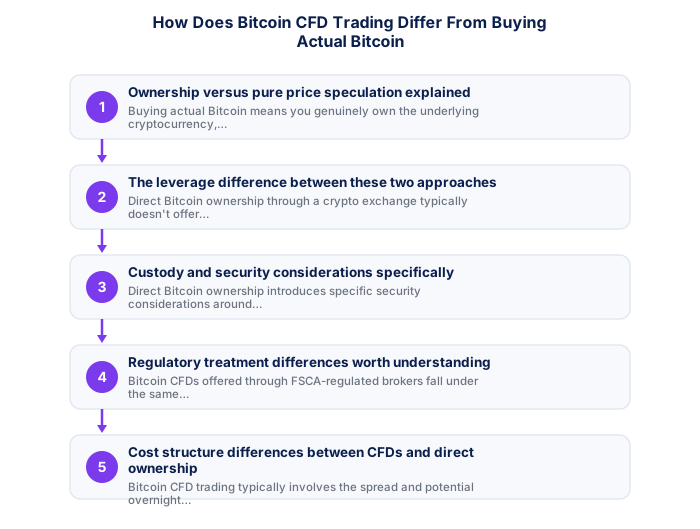
- Ownership versus pure price speculation explained
- The leverage difference between these two approaches
- Custody and security considerations specifically
- Regulatory treatment differences worth understanding
- Cost structure differences between CFDs and direct ownership
- Which approach suits which specific goals
1. Ownership versus pure price speculation explained
Buying actual Bitcoin means you genuinely own the underlying cryptocurrency, holding it in a crypto wallet and able to transfer, spend, or hold it independently of any specific trading platform. A Bitcoin CFD, by contrast, is purely a derivative contract tracking Bitcoin's price movement, similar in structure to other CFD instruments, without granting any actual cryptocurrency ownership whatsoever.
It's worth applying a simple test to clarify your own genuine motivation here: would you want to actually spend, transfer, or hold Bitcoin independently of any trading purpose, or are you purely interested in whether its price goes up or down over your intended holding period? The honest answer to that question points fairly clearly toward one approach over the other.
| Feature | Bitcoin CFD | Actual Bitcoin |
|---|---|---|
| Ownership of the asset | No | Yes |
| Leverage available | Yes | No, unless margin trading on an exchange |
| Can go short | Yes | Not directly |
| Custody responsibility | Broker | You, or the exchange |
| Regulatory framework | Standard CFD rules | Crypto-specific, evolving |
2. The leverage difference between these two approaches
Bitcoin CFDs typically allow leveraged exposure, meaning you can control a larger notional position than your deposited margin alone would otherwise allow. Direct Bitcoin ownership through a crypto exchange typically doesn't offer this same leverage mechanism in the same way, generally requiring you to pay the full purchase price for the actual cryptocurrency amount you're buying.
See also: How Does SARS Tax Cryptocurrency Gains in South Africa?
This leverage availability cuts both ways and is worth weighing carefully given how volatile Bitcoin already is on an unleveraged basis, discussed elsewhere on this site regarding crypto CFDs generally. Applying additional leverage on top of an already highly volatile underlying asset amplifies both potential gains and potential losses considerably more than the same leverage would on a calmer, more stable instrument.
| Lot type | Size | USD/ZAR pip value | Min recommended account |
|---|---|---|---|
| Standard | 100,000 units | ~R1.00 | R100,000+ |
| Mini | 10,000 units | ~R0.10 | R10,000+ |
| Micro | 1,000 units | ~R0.01 | R1,000+ |
| Nano | 100 units | ~R0.001 | R100+ |
- V = Pip value in account currency
- E = Current exchange rate of quote vs account currency
- L = Lot size (100,000 standard / 10,000 mini / 1,000 micro)
- USD/ZAR example = 1 pip = R1 per standard lot
- Leveraged instrument
- Long and short available
- Overnight financing applies
- No ownership of asset
- Typically unleveraged
- Physical currency received
- No daily financing
- Currency ownership
3. Custody and security considerations specifically
Direct Bitcoin ownership introduces specific security considerations around wallet custody, protecting your private keys, choosing between custodial exchange wallets versus self-custody options, and the genuine risk of permanent loss if access credentials are lost or compromised. CFD trading avoids these custody considerations entirely, since you never hold the actual underlying asset requiring this kind of direct security management.
It's worth researching wallet security and self-custody practices thoroughly before pursuing direct ownership specifically, since this genuinely represents a distinct skill set from trading itself, understanding private key management, backup practices, and the real, permanent consequences of losing access credentials matters as much for direct ownership as understanding CFD mechanics matters for CFD trading.
4. Regulatory treatment differences worth understanding
Bitcoin CFDs offered through FSCA-regulated brokers fall under the same broader CFD regulatory framework as other CFD instruments, while direct cryptocurrency purchase and custody involves a somewhat different, still-evolving regulatory environment specific to crypto assets themselves, worth understanding separately if considering direct ownership.
It's worth checking current sources for the latest regulatory position specifically if you're considering direct ownership, since this area has continued developing in South Africa, and confirming you're working from current information matters more here than for more settled areas of financial regulation.
5. Cost structure differences between CFDs and direct ownership
Bitcoin CFD trading typically involves the spread and potential overnight financing costs, similar to other CFD instruments, while direct cryptocurrency purchase typically involves exchange trading fees and potentially network transaction fees when moving cryptocurrency between wallets, a genuinely different cost structure worth comparing for your intended use case.
It's worth calculating your genuinely expected total cost under each approach for your specific intended holding period and trade frequency, rather than assuming one structure is simply cheaper in the abstract, since the relative cost comparison can shift considerably depending on how actively you plan to trade versus simply hold.
6. Which approach suits which specific goals
Bitcoin CFDs generally suit traders interested in short-to-medium-term price speculation with leverage flexibility, consistent with the broader CFD trading approach, while direct ownership suits those specifically wanting genuine, long-term cryptocurrency holding or who have a specific use case requiring actual possession of the underlying asset rather than purely derivative price exposure.
A Bitcoin CFD position can face a margin call since it involves leveraged exposure with no wallet. Owned Bitcoin in a wallet cannot face a margin call, but requires its own wallet security.
★ Why It Matters
A distinction worth being precise about: a Bitcoin CFD position can be subject to a margin call during a sharp drop, actual owned Bitcoin in a wallet cannot, since there's no leverage or broker counterparty involved. These are genuinely different risk profiles despite tracking the same underlying price.
✕ Common mistakes
- Treating leveraged crypto exposure the same as unleveraged ownership. The risk profiles differ substantially despite tracking the same price.
- Not understanding the counterparty risk involved in a CFD position. This is a structurally different risk than self-custody of actual coins.
- Confusing crypto CFD volatility with actual cryptocurrency market dynamics. The instrument's leverage can amplify moves beyond the underlying asset's own volatility.
Key Takeaways
- Bitcoin CFDs let you speculate on price movement with leverage without owning the underlying asset, unlike directly purchasing and holding actual Bitcoin.
- Bitcoin CFDs let you speculate on price movement with leverage without ever owning the underlying asset.
- This differs from directly purchasing and holding actual Bitcoin, which involves genuine ownership through a crypto wallet and different security considerations.
- Ownership versus pure price speculation explained.
- The leverage difference between these two approaches.
See also: Why Is SAA Accepting Bitcoin for Flights, and What It Means.
Frequently asked follow-up questions
Can I take delivery of actual Bitcoin from a CFD position?
No, as with other CFD instruments, Bitcoin CFDs are cash-settled and never involve actual delivery of the underlying cryptocurrency.
Is direct Bitcoin ownership riskier than CFD trading?
They carry different risk profiles. Direct ownership carries custody and security risk, while CFD trading carries leverage-amplified price risk.
Do both approaches require the same broker or platform?
Generally no, Bitcoin CFDs are typically offered through FSCA-regulated CFD brokers, while direct ownership requires a separate cryptocurrency exchange account.
