i Short answer
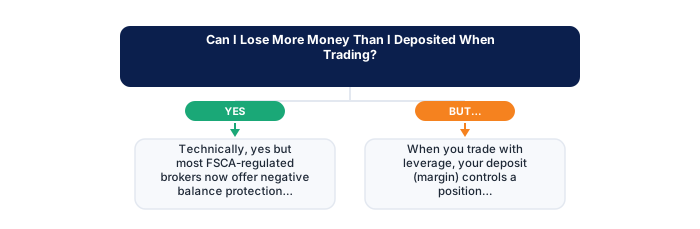
Technically, yes, but most FSCA-regulated brokers now offer negative balance protection as standard, preventing your balance from falling below zero.
Always confirm this feature is in place before depositing with any broker.
📋 ON THIS PAGE
1. How losses can technically exceed your deposit
With leverage, your deposit acts as margin that controls a position far larger than the deposit itself. If the market moves sharply against you and price gaps past your stop-loss before it can be executed, as happens in fast-moving markets or around major news events, your losses can exceed the capital you initially deposited.
This isn't a routine risk for most retail traders. It surfaces most prominently around extreme events: unexpected central bank announcements, geopolitical shocks, sudden currency devaluations, or market opens after significant weekend news. In normal market conditions, automated risk controls typically close positions before losses reach the account balance.
See also: How Do Sovereign Credit Rating Reviews Affect the Rand?
The mechanism is worth understanding concretely. A stop-loss order is an instruction to close your position if price reaches a specified level, it's not a guarantee of execution at that exact price. In a fast market or at a gap open, the first available execution price may be considerably worse than your stop level, leaving a loss larger than your margin on that position.
For South African traders, the rand's known sensitivity to risk-off events, sovereign credit actions, political developments, commodity price shocks, means that ZAR-involving positions can be particularly susceptible to gap risk around specific events that affect South Africa's economic outlook disproportionately relative to global market benchmarks.
2. What negative balance protection actually does
Negative balance protection resets your account balance to zero rather than allowing it to go negative, with the broker absorbing any excess loss beyond your account balance. It's a specific policy choice by the broker, not a mechanical feature of leverage itself, without it, a client would technically owe the broker the difference.
Most FSCA-regulated brokers now offer this protection as standard for retail accounts, partly from competitive pressure and partly from the broader global regulatory direction that followed European regulators making it mandatory. Verifying that your specific broker provides it, in writing, for your specific account type is still worth doing rather than assuming.
- South African ID or valid passport
- Proof of residential address dated within 3 months
- Proof of bank account ownership
- Selfie or photo for biometric verification (some brokers)
- Source of funds declaration if depositing above threshold
Choose an FSCA-regulated broker
Verify the FSP number is current at fsca.co.za.
Submit FICA documents
SA ID or passport, recent proof of address, and bank account proof.
Fund via EFT
Make the initial deposit from your South African bank account in ZAR.
Open demo first
Practice on demo until you are confident in the platform and strategy.
Start with minimum capital
Begin with an amount you can afford to lose while building experience.
It is worth establishing in writing whether a loss can exceed your balance. drawdown is a term, not a default.
The policy is most relevant as a backstop for genuinely extreme scenarios, the kind of market events that happen rarely but create losses that outpace risk controls. Treating it as a reason to be less careful about position sizing or stop-loss placement would be a significant misreading of its purpose.
| Scenario | With NBP | Without NBP |
|---|---|---|
| Account balance after extreme loss | Reset to zero | Can go negative |
| Who absorbs excess loss | The broker | You |
| Common in South Africa | Yes, among FSCA-regulated brokers | Uncommon among regulated brokers |
| Where to confirm | Product disclosure or terms document | Same |
3. When this protection actually gets tested
This protection rarely activates in day-to-day trading because margin calls and automated stop-outs are specifically designed to close losing positions well before account equity reaches zero. The sequence of controls, margin call warning, then automatic stop-out, exists precisely to prevent the scenario that negative balance protection addresses.
The historical event most frequently cited in this context is the Swiss franc's sudden 30% revaluation in January 2015, when the Swiss National Bank unexpectedly removed its cap on the franc's exchange rate against the euro. Positions that looked controllable seconds before the announcement became catastrophically loss-making in the fraction of a second it took for prices to reprice to the new equilibrium, and many accounts went deeply negative before any risk controls could execute.
What makes this event useful to understand isn't just its scale but its suddenness. It happened in seconds during an active market session, not during a weekend or an illiquid period, demonstrating that gap risk can emerge even in highly liquid, normally traded instruments when a genuinely unexpected policy decision is announced without prior warning.
South African traders should also note that the rand's historical volatility around credit rating reviews, elections, and commodity cycle shifts creates elevated gap risk on ZAR-denominated positions and ZAR-sensitive instrument pairs at predictable points in the political and economic calendar. Being aware of upcoming scheduled risk events and reducing exposure ahead of them is a practical risk management habit.
4. How to confirm a broker offers this protection
Look for negative balance protection explicitly stated in a broker's product disclosure documents, terms and conditions, or risk disclosure statement, not just mentioned in a marketing FAQ. The formal terms are what matter legally; a marketing page statement without the corresponding term in the client agreement has limited protective value.
Be specific when you confirm: check that the protection covers your actual account type and the instruments you intend to trade. Some brokers apply negative balance protection to their standard retail CFD accounts but not to accounts with professional client classification, and some exclude specific instrument types. The general statement that protection is available is less useful than confirmation that it applies to your specific setup.
| Rejection reason | Fix |
|---|---|
| Address proof older than 3 months | Get a recent utility bill or bank statement |
| Name mismatch between documents | Use documents with exactly matching full name |
| Poor quality scan | Retake with good lighting, all corners visible |
| PO Box address | Brokers require physical residential address only |
Getting this confirmation in writing, through a broker support ticket rather than a verbal chat, creates a record that has practical value if the question ever becomes relevant. The documentation standard matters more than it might seem when you're in the middle of a normal trading period and the scenarios that activate this protection feel remote.
As part of your broader broker due diligence, checking whether a broker is FSCA-licensed and confirming their specific client money protections alongside negative balance protection gives you a clearer picture of the full protection structure your account operates within.
5. Margin calls and stop-outs: the earlier safety net
Before negative balance protection ever becomes relevant, earlier risk controls handle most loss-management work. When your equity falls below a set percentage of your required margin, the margin call level, which varies by broker but is commonly 100% or below, the broker issues a margin call warning, alerting you that your account needs additional funds or position reductions to stay within permitted exposure.
If the account continues deteriorating without intervention, an automated stop-out triggers at a lower margin level, commonly between 50% and 20% of required margin, force-closing positions to prevent further loss. This automated closure is designed to cut exposure before account equity is exhausted, and it runs whether you're watching the account or not.
Thinking of these as three layered safeguards, your own stop-loss orders, the margin call system, and ultimately negative balance protection, gives a more accurate picture of how trading account risk controls actually work. Each layer is a defence against a failure of the previous layer, not a replacement for careful risk management at the front end.
The practical implication is that good position sizing and consistent stop-loss discipline make the margin call and stop-out systems largely irrelevant in normal trading, they're reserves for when things go wrong, not the intended mechanism for managing routine risk. Relying on automated stop-outs rather than deliberate exit management is a symptom of oversized positions rather than a risk management strategy.
6. The regulatory context behind this protection
Negative balance protection has become near-standard in the retail CFD industry partly because European regulators under ESMA made it mandatory for CFD providers serving EU retail clients from 2018. That regulatory change prompted brokers operating globally to extend similar protections to their clients in other markets, including South Africa, even where it wasn't locally mandated.
It's a useful example of how major market regulation can shape industry norms beyond its direct jurisdiction. The FSCA's own framework for retail client protection has also developed in a direction consistent with this standard, encouraging its adoption among FSCA-regulated providers as a baseline retail protection even without it being mandated in identical terms.
A subtlety worth understanding: negative balance protection typically applies per account rather than per trader. A trader running multiple accounts, at the same broker or different ones, may have protection on each individual account while their overall financial exposure across all accounts isn't similarly capped by any single protective mechanism. Managing aggregate exposure across multiple accounts is your responsibility, not the protection's.
Confirming negative balance protection is one component of a broader due diligence checklist that any trader should run before opening a live account: FSCA registration, client fund segregation, clear fee disclosure, and the specific terms governing your account type are all equally important. Protection from extreme loss scenarios is valuable, but it sits alongside, not above, the more routine protections that govern your trading experience day to day.
✕ Common mistakes
- Assuming negative balance protection applies automatically everywhere. Confirm this specifically with your own broker rather than assuming.
- Not checking for exceptions during extreme market events. Some policies exclude genuinely exceptional, historic volatility events.
- Running excessive leverage without understanding the downside. See how leverage amplifies losses beyond what feels intuitive.
- Treating protection as a reason to take on more risk. Protection limits catastrophic loss, it doesn't make risk-taking free.
Key Takeaways
- With leverage, technically yes, unless your broker offers negative balance protection. Learn how this works and what to check before depositing.
- Technically, yes, but most FSCA-regulated brokers now offer negative balance protection as standard, preventing your balance from falling below zero.
- Always confirm this feature is in place before depositing with any broker.
- How losses can technically exceed your deposit.
- What negative balance protection actually does.
Frequently asked follow-up questions
Does negative balance protection cost extra?
No, it's typically offered as a standard account feature by brokers that provide it, rather than a paid add-on, though it's always worth confirming this directly with your specific broker.
Does negative balance protection apply to all instruments equally?
Generally yes for standard retail accounts, though it's worth checking whether any specific high-volatility instruments or account types carry different terms with your particular broker.
What's the difference between a margin call and a stop-out?
A margin call is typically a warning notification as your margin level approaches a risk threshold; a stop-out is the actual automated closure of positions once margin falls to a more critical level, designed to limit further losses.
Can extreme market gaps over a weekend still cause a negative balance?
In rare, extreme circumstances even protected accounts can theoretically see brief negative balances before the broker's systems correct this, though proper negative balance protection should reset this back to zero afterward.
Should I still use stop-losses if I have negative balance protection?
Yes, this protection is a safety net for worst-case scenarios, not a substitute for disciplined risk management that should genuinely limit losses before they ever approach that point.
