i Short answer
An order book lists current buy and sell orders at various price levels for a specific instrument, showing market depth and liquidity at that moment.
Most retail CFD traders don't directly interact with this structure, given the OTC nature of typical retail forex trading.
📋 ON THIS PAGE
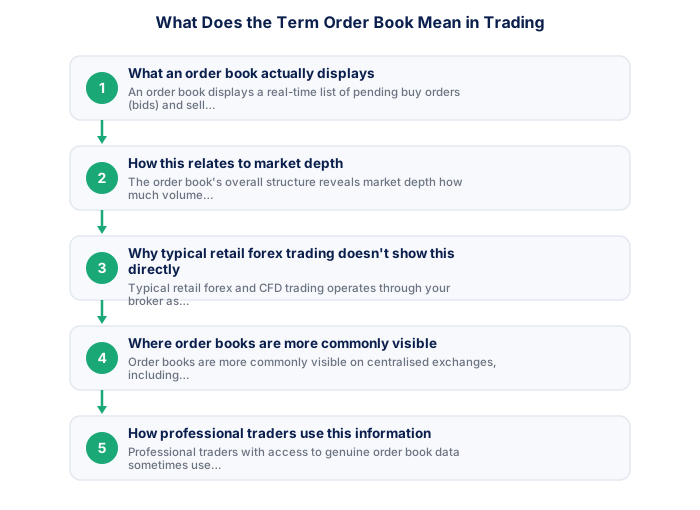
1. What an order book actually displays
An order book displays a real-time list of pending buy orders (bids) and sell orders (asks) at various specific price levels for a particular instrument, typically organised with the highest bids and lowest asks displayed most prominently, since these represent the prices closest to actually executing.
It's worth picturing this as a genuine, real-time snapshot of collective trader intention at a given moment, rather than an abstract concept, every visible order represents a real participant's specific, current willingness to transact at that particular price level.
2. How this relates to market depth specifically
The order book's overall structure reveals market depth, how much volume exists at each specific price level, with a "deeper" book at any given level suggesting more liquidity, available without significantly moving price.
It's worth connecting this concept directly to the liquidity discussion elsewhere on this site, market depth is essentially a visual, granular expression of liquidity, showing not just that liquidity exists broadly, but precisely how much is available at each specific price increment.
- FSCA-regulated broker verified at fsca.co.za
- Demo account tested for minimum 60 days
- Trading plan written: entry, exits, position sizing
- Risk per trade defined (1-2% of account)
- Backup internet connection tested for load shedding
- Tax implications understood
3. Why typical retail forex trading doesn't show this directly
Typical retail forex and CFD trading operates through your broker as counterparty or intermediary, rather than through a centralised exchange order book structure, meaning most retail platforms don't display this kind of detailed order book view.
It's worth understanding this as a structural feature of the OTC market discussed elsewhere on this site, rather than something your specific broker is withholding, the decentralised, dealer-based nature of forex trading simply doesn't produce the same kind of unified, visible order book a centralised exchange does.
4. Where order books are more commonly visible
Order books are more commonly visible on centralised exchanges, including some share trading platforms and certain cryptocurrency exchanges, where trading genuinely occurs through this centralised, transparent order-matching structure.
It's worth exploring your specific platform's available data for any exchange-traded instruments you trade, some retail platforms do surface simplified order book or market depth information for shares and certain other exchange-listed instruments, worth checking rather than assuming it's unavailable.
| Item | Detail |
|---|---|
| Regulator | FSCA, fsca.co.za |
| Exchange control | SARB, resbank.co.za |
| Tax authority | SARS, sars.gov.za |
| JSE hours | 09:00-17:00 SAST Mon-Fri |
| Best forex session | 15:00-17:00 SAST |
| CGT annual exclusion | R50,000 (individuals) |
5. How professional traders use this information
Professional traders with access to genuine order book data sometimes use this information to gauge immediate supply and demand imbalances or identify significant pending orders at specific levels, representing a more advanced analytical approach beyond what typical retail CFD trading platforms make available.
It's worth appreciating that this kind of order flow analysis represents a genuinely specialised skill set, requiring considerable dedicated study and experience to apply effectively, worth being realistic that this isn't something to casually adopt without substantial additional, focused learning.
6. Why understanding this concept still helps retail traders
Even without direct order book access, understanding this underlying concept helps retail traders better grasp why liquidity and broader market structure genuinely matter for understanding how prices actually form and move.
The quality of trading education available to South African traders has improved substantially with the growth of FSCA-regulated broker educational content and global online resources. The critical evaluation skill, separating genuinely educational content from thinly disguised marketing for signals, courses, or investment schemes, is as important as the content itself. South African traders should additionally prioritise educational resources that address SA-specific topics including ZAR trading dynamics, SARB policy implications, FSCA regulatory requirements, and SARS tax treatment, since virtually all internationally produced trading education was created without these local dimensions in mind.
In OTC forex and CFDs, the order book is not accessible to retail traders.
In exchange-traded markets the order book is publicly visible. In OTC forex and CFD markets, price comes from your broker's own quote, and the underlying order book is not accessible to retail traders.
Evaluating trading educational content requires applying the same critical standards you would apply to any financial information source. The most valuable resources are those that focus on process, risk management, and psychological frameworks rather than those that primarily promise profits or specific returns. South African traders should additionally prioritise content that addresses SA-specific regulatory, tax, and market context, since most international trading education was produced without South African exchange control, SARS tax treatment, or ZAR-specific market conditions in mind.
★ Why It Matters
Something worth understanding precisely: most retail forex brokers don't actually expose a real order book to clients, since OTC dealing doesn't have one in the same sense an exchange does, what looks like depth-of-market data on some platforms is often a simulated or aggregated approximation.
✕ Common mistakes
- Treating simulated depth-of-market displays as fully accurate. Some platform displays are aggregated approximations, not raw order data.
- Confusing order book concepts from exchange-traded markets with OTC forex structure. These operate under genuinely different mechanisms.
- Over-relying on order book-style displays for OTC instrument decisions. Their relevance is more limited here than on a genuine exchange.
Key Takeaways
- An order book lists current buy and sell orders at various price levels, providing insight into market depth and liquidity at this specific moment.
- An order book lists current buy and sell orders at various price levels for a specific instrument, showing market depth and liquidity at that moment.
- Most retail CFD traders don't directly interact with this structure, given the OTC nature of typical retail forex trading.
- What an order book actually displays.
- How this relates to market depth specifically.
See also: What Does OTC Mean in Trading?.
Frequently asked follow-up questions
Can I see an order book for JSE shares specifically?
Some share trading platforms do display this kind of market depth information for exchange-listed instruments, though specific availability varies by platform.
Does my broker use order book data even if I can't see it directly?
Your broker's pricing typically reflects underlying liquidity provider data, even though the detailed order book structure itself usually isn't displayed directly on standard retail CFD platforms.
Is order book trading the same as basket trading?
No, these are distinct concepts; order books relate to market structure and pending orders generally, while basket trades, relate to combining multiple positions into one managed trade.
Do cryptocurrency exchanges typically show order books to all users?
Many cryptocurrency exchanges do display this information publicly reflecting their more centralised, exchange-style trading structure.
Would understanding order books help my CFD trading strategy directly?
This provides useful broader market structure context, though it isn't directly applicable to typical retail CFD trading the way it would be for genuine exchange-based trading.
