i Short answer
Slippage tolerance sets the maximum acceptable price difference between your requested and actual execution price, beyond which your order is rejected.
📋 ON THIS PAGE
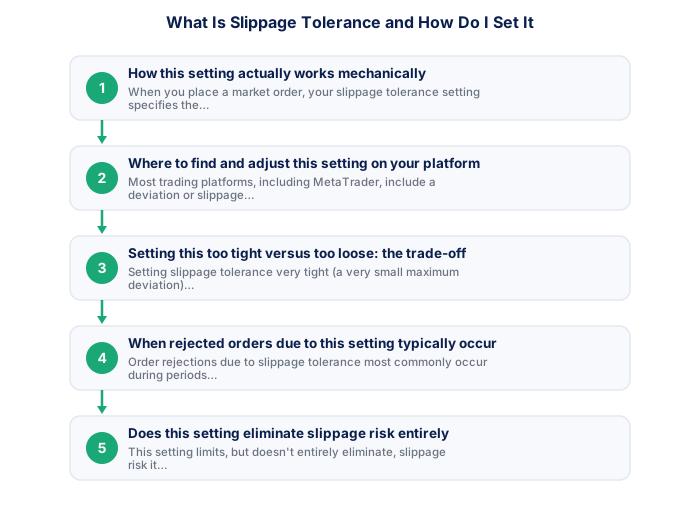
- How this setting actually works mechanically
- Where to find and adjust this setting on your platform
- Setting this too tight versus too loose: the trade-off
- When rejected orders due to this setting typically occur
- Does this setting eliminate slippage risk entirely
- Practical recommendations for setting this specific value
1. How this setting actually works mechanically
When you place a market order, your slippage tolerance setting specifies the maximum number of pips or points the actual execution price is allowed to differ from your requested price before the platform rejects the order entirely, rather than executing it at this more significantly different price.
It's worth thinking of this as a genuine, deliberate boundary you're setting on your own behalf, rather than a passive default, actively choosing your acceptable slippage range means you're making this decision consciously in advance, rather than accepting whatever slippage happens to occur.
2. Where to find and adjust this setting on your platform
Most trading platforms, including MetaTrader, include a deviation or slippage tolerance field directly within the order placement window, allowing you to specify this maximum acceptable figure for each individual order, or sometimes as a broader default setting applying to all your orders unless specifically overridden.
It's worth locating and testing this setting on a demo account before you need it for genuine, live trading, confirming exactly how your specific platform presents and applies this setting removes any uncertainty during an actual, time-sensitive trade.
- FSCA-regulated broker verified at fsca.co.za
- Demo account tested for minimum 60 days
- Trading plan written: entry, exits, position sizing
- Risk per trade defined (1-2% of account)
- Backup internet connection tested for load shedding
- Tax implications understood
- Predictable cost per trade
- Widens less during news
- Better for news traders
- Slightly wider average
- Very low in calm markets
- Widens during high-impact news
- Lower average cost
- Better for swing traders
3. Setting this too tight versus too loose: the trade-off
Setting slippage tolerance very tight (a very small maximum deviation) increases the likelihood of order rejection during normal market fluctuation, potentially causing you to miss intended trades simply due to minor, normal price movement during the brief execution window. Setting it very loose risks accepting execution at a meaningfully worse price than intended, particularly during the fast-moving conditions.
It's worth thinking of this specifically as a genuine trade-off rather than seeking a single objectively correct setting, discussed elsewhere on this site regarding the broader price-versus-execution-certainty trade-off, your own appropriate balance depends on your specific trading style and priorities.
4. When rejected orders due to this setting typically occur
Order rejections due to slippage tolerance most commonly occur during periods of rapid price movement, when the gap between your requested price and the currently available execution price can exceed even a reasonably set tolerance threshold given how quickly conditions are changing.
It's worth reviewing your own rejection history periodically if your platform tracks this, seeing how often your specific tolerance setting actually results in rejected orders gives concrete, personal evidence for judging whether your current setting genuinely fits your trading conditions.
| Item | Detail |
|---|---|
| Regulator | FSCA, fsca.co.za |
| Exchange control | SARB, resbank.co.za |
| Tax authority | SARS, sars.gov.za |
| JSE hours | 09:00-17:00 SAST Mon-Fri |
| Best forex session | 15:00-17:00 SAST |
| CGT annual exclusion | R50,000 (individuals) |
5. Does this setting eliminate slippage risk entirely
This setting limits, but doesn't entirely eliminate, slippage risk, it specifically prevents execution beyond your specified maximum deviation, but doesn't guarantee execution will occur at your exact requested price either; some degree of slippage within your specified tolerance can still occur and be accepted automatically.
It's worth understanding this limitation clearly, your tolerance setting controls the maximum acceptable deviation, it doesn't prevent slippage from occurring within that range, worth keeping this distinction in mind rather than assuming the setting eliminates the underlying risk entirely.
6. Practical recommendations for setting this specific value
Many traders set a moderate slippage tolerance reflecting their specific instrument's typical normal volatility, wide enough to avoid excessive, unnecessary order rejections during normal conditions, but tight enough to avoid accepting genuinely excessive, unfavourable execution during unusual, fast-moving conditions.
Wide tolerance accepts worse fills but reduces the chance of missing the trade.
Tight slippage tolerance gives stronger price control but can lead to order rejection when markets move fast. A wider tolerance reduces rejection risk but accepts a greater range of fill prices.
★ Why It Matters
Worth testing specifically: set your tolerance unusually tight for a short period and note how often your orders get rejected as a result, this gives you a concrete, personal sense of the trade-off between tighter tolerance and higher rejection rates for your specific traded instruments.
✕ Common mistakes
- Setting tolerance extremely tight without testing the resulting rejection rate. A tighter tolerance increases the chance an order simply doesn't fill.
- Not adjusting tolerance for known higher-volatility conditions like news events. A fixed tolerance may be poorly suited to genuinely fast-moving moments.
- Assuming default tolerance settings suit every trading style equally. Scalping and slower styles may warrant meaningfully different tolerance settings.
- Treating tolerance as a set-and-forget setting rather than periodically reviewing it. Revisiting this setting as conditions or strategy change keeps it useful.
Key Takeaways
- Slippage tolerance sets the maximum acceptable price deviation before an order is rejected rather than executed at a significantly different price.
- Slippage tolerance sets the maximum acceptable price difference between your requested and actual execution price, beyond which your order is rejected.
- How this setting actually works mechanically.
- Where to find and adjust this setting on your platform.
- Setting this too tight versus too loose: the trade-off.
Frequently asked follow-up questions
What is a typical slippage tolerance setting for major pairs?
This varies by trader preference and instrument volatility. Checking your specific platform's default and adjusting based on your own experience and risk tolerance is a reasonable approach.
Does slippage tolerance apply to pending orders too?
This setting specifically applies to market order execution; pending orders, have their own separate triggering and execution mechanics.
Can I set different tolerance levels for different instruments?
Yes, most platforms allow setting this individually per order, letting you adjust based on each specific instrument's typical volatility characteristics.
