i Short answer
Margin is the amount of your account capital required to open and maintain a leveraged position, functioning as collateral against adverse moves.
A margin call is triggered if your available equity falls below a defined threshold relative to your open positions.
📋 ON THIS PAGE
- Margin and leverage: how the two concepts relate
- Calculating the required margin for a position
- Free margin: what's actually available for new trades
- Margin level and how margin calls are triggered
- Stop-outs: the automated safeguard beyond a margin call
- Practical margin management to avoid unwanted surprises
- What a margin call looks like in rand terms
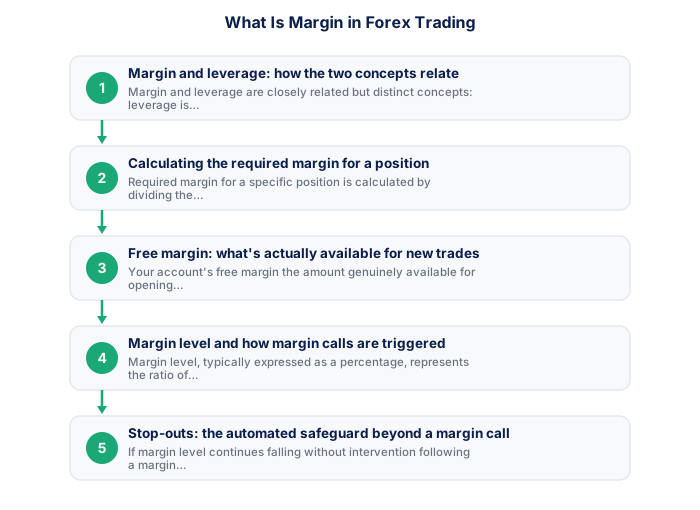
1. Margin and leverage: how the two concepts relate
Margin and leverage are closely related but distinct concepts: leverage is the ratio describing how much larger a position you can control relative to your deposited capital (for example, 1:30 leverage), while margin is the actual specific deposit amount required for any given position, calculated as a function of that leverage ratio and the position's total notional value. A higher leverage ratio means a lower required margin percentage for any given position size, since leverage and required margin percentage are mathematically inverse to each other.
Understanding this relationship clearly helps clarify why higher leverage, while allowing you to open larger positions with less initial margin deposit, doesn't change the fundamental risk dynamics. It simply changes how much margin is required upfront, while the underlying amplified risk relative to your actual deposited capital remains driven by the leverage ratio itself, not by the specific margin amount in isolation.
This is a distinction worth sitting with, because it's easy to mentally treat "low required margin" as synonymous with "low risk," when the two aren't the same thing at all. A position that only ties up a small fraction of your account as margin can still move against you by an amount that, in Rand terms, represents a meaningful share of your total equity, precisely because leverage means the position's full notional value, not just the margin you put down, is what's actually exposed to price movement. Margin tells you what's reserved as collateral; it doesn't by itself tell you how much you stand to lose.
| Feature | Margin Call | Stop-Out |
|---|---|---|
| What happens | Warning issued | Positions automatically closed |
| Trigger level | Higher margin level threshold | Lower margin level threshold |
| Action required | You can still act | Automatic, no action possible |
2. Calculating the required margin for a position
Required margin for a specific position is calculated by dividing the position's total notional value (the full value of the position you're controlling) by the leverage ratio being applied. For example, with 1:30 leverage on a position with R30,000 total notional value, the required margin would be R1,000 (R30,000 divided by 30), this is the specific amount that gets allocated from your account balance and held as collateral specifically against this particular open position.
Most trading platforms calculate and display this required margin automatically before you confirm opening any position, removing the need for manual calculation in everyday practice, though understanding the underlying calculation clearly helps build genuine intuition about how position size, leverage, and required margin interact mathematically, which supports better-informed position sizing decisions generally.
- P = Position size in lots
- R = ZAR amount at risk (1-2% of account)
- S = Stop distance in pips from entry
- V = Pip value per lot for this instrument
Set account risk %
Define maximum capital at risk per trade, typically 1-2%.
Measure stop distance
Find your stop-loss level on the chart before calculating size.
Calculate pip value
Use the instrument-specific pip value for your lot size.
Compute position size
Position size = (ZAR at risk) / (stop pips x pip value).
Confirm free margin
Ensure required margin fits within your available free margin.
note that that required margin can also shift over the life of an open position, not only at the moment you open it. Brokers may temporarily raise margin requirements around major scheduled events, such as significant economic data releases, when expected volatility is higher than usual, meaning a position can require more margin than it did when you first opened it. Checking whether your broker applies this kind of dynamic adjustment, particularly if you tend to hold positions through high-impact news events, avoids being caught off guard by a margin requirement that shifts unexpectedly.
3. Free margin: what's actually available for new trades
Your account's free margin, the amount genuinely available for opening additional new positions, equals your total account equity (your deposited balance, adjusted for any unrealised profit or loss on currently open positions) minus the margin currently allocated and held against your existing open positions. As open positions move into greater unrealised loss, free margin correspondingly decreases, since more of your overall equity is effectively being held as collateral against the increasingly negative unrealised position value.
Monitoring free margin, rather than simply your raw account balance, gives a more accurate, real-time picture of your actual capacity to open additional positions or absorb further adverse movement on existing ones, this distinction between raw balance and actually available free margin is an important practical concept many newer traders initially overlook, sometimes leading to surprise when an account has less actual trading capacity remaining than the raw balance figure alone might suggest.
| Account | Risk % | Max loss (ZAR) | At 1:30 leverage | Notional position |
|---|---|---|---|---|
| R50,000 | 1% | R500 | 1:30 | R15,000 |
| R50,000 | 2% | R1,000 | 1:30 | R30,000 |
| R50,000 | 5% | R2,500 | 1:30 | R75,000 |
| R100,000 | 1% | R1,000 | 1:30 | R30,000 |
- Access larger positions with less capital
- Amplifies returns on winning trades
- Short-selling available without share borrowing
- Losses amplified equally, 10x leverage, 10x loss
- Overnight financing reduces long-term returns
- Margin calls can force closure at worst moments
A practical habit worth building is checking free margin, not just account balance, before opening any new position, especially when you already hold one or more open trades. Two accounts with an identical deposited balance can have very different free margin available at a given moment, depending on how their existing open positions are currently performing. Getting into the habit of glancing at free margin specifically, rather than balance out of routine, closes a gap that catches out a lot of newer traders when they try to open a new position and find less room than they expected.
4. Margin level and how margin calls are triggered
Margin level, typically expressed as a percentage, represents the ratio of your account equity to your currently used margin, giving a real-time gauge of how much buffer remains before your account approaches a genuinely risky position relative to its open exposure. As losing positions push margin level lower, brokers typically define a specific margin level threshold (commonly somewhere in the region of 100% or lower, varying by specific broker) that triggers a margin call, a notification, and sometimes a restriction preventing new positions from being opened, warning that your account is approaching a genuinely critical risk level.
A margin call isn't itself an automatic, forced closure of positions, it's specifically a warning stage, giving you the opportunity to either add additional funds to your account, manually close some losing positions to free up margin and reduce risk, or take some other deliberate action, before the situation potentially deteriorates further toward the more severe automated stop-out stage discussed next.
Treating a margin call as a genuine decision point, rather than something to react to at the last possible moment, tends to produce better outcomes than either panicking or ignoring it. Traders who check their margin level periodically, rather than only discovering it via a margin call notification, generally have more options available and more time to think clearly, since they're addressing a developing situation rather than an already-urgent one.
5. Stop-outs: the automated safeguard beyond a margin call
Before funding an account, find out whether the broker absorbs a negative balance. negative balance protection should be in writing.
Understanding your specific broker's exact margin call and stop-out threshold levels, these vary somewhat between providers, gives you a clearer, more concrete sense of exactly how much buffer genuinely exists between a margin call warning and the more severe, automated stop-out stage for your own specific account and open positions at any given time.
- Confirm account equity
- Calculate 1-2% risk in ZAR
- Identify stop-loss level from chart
- Measure stop distance in pips
- Look up pip value for instrument
- Compute position size
- Verify required margin fits free margin
6. Practical margin management to avoid unwanted surprises
Practically managing margin effectively involves avoiding using an excessively high proportion of your available margin on open positions simultaneously, since this leaves minimal buffer for normal market fluctuation before approaching margin call territory; regularly monitoring your actual free margin and margin level, particularly during periods of holding multiple simultaneous open positions; and maintaining awareness of how adding new positions affects your overall margin usage across your entire account, not just considering each individual new position in isolation from your existing open exposure.
This disciplined margin management connects directly to broader risk management principles. Maintaining adequate margin buffer is, in practice, simply another concrete expression of the same disciplined position sizing and risk management approach that protects against the kind of severe, account-threatening losses that undisciplined leverage usage can otherwise produce.
One specific habit worth adopting: before opening a new position while others are already open, checking your combined margin usage across all open positions together, rather than evaluating the new position in isolation. Several individually reasonable positions can add up to an uncomfortably high total margin usage when combined, particularly if they're correlated instruments that tend to move together, since a shared adverse move then affects several positions' unrealised losses simultaneously rather than just one.
Margin is the collateral held by your broker while a leveraged position is open, not a fee. It's returned when the position closes unless losses have consumed it. Free margin is what remains available.
★ Why It Matters
Something worth tracking as an ongoing habit, not just when opening a new trade: your current free margin percentage relative to your total equity, checking this only when you want to open a new position means you might miss a buffer that's already thinner than you'd want.
✕ Common mistakes
- Checking margin status only when wanting to open a new position. Ongoing monitoring catches a thinning buffer before it becomes urgent.
- Not understanding margin as collateral rather than a fee. This distinction matters for understanding what actually happens during a margin call.
- Assuming margin requirements are identical across all instrument types. They vary by instrument and broker.
- Ignoring combined margin usage across multiple simultaneous positions. Combined exposure, not any single trade, determines proximity to a margin call.
Does this change my margin call risk?
No, because they measure different things. One is the exit you chose for a trade, the other is what your equity can still support. margin calculator page covers it in full.
Could this cost me more than my deposit?
Generally no, because protection is standard at licensed brokers for retail clients. Verify which category your account is in. Leverage against margin in practice covers it in full.
7. What a margin call looks like in rand terms
Margin is easier to understand as a countdown than as a percentage. Take a R10,000 account holding one mini lot of USD/ZAR, where a pip is worth about R1. The required margin ties up part of the balance, and the remainder is what absorbs adverse movement. A 300-pip move against the position, which USD/ZAR can produce in a volatile session, costs roughly R300 and is uncomfortable. A 2,000-pip move, which the pair has covered inside a single quarter, costs R2,000 and starts approaching the stop-out level.
That is the mechanism behind most closed accounts: not a single dramatic loss, but a position sized against the available margin rather than against the realistic range of the instrument. Brokers close positions automatically when margin level falls below a set threshold, and that closure happens at the worst possible moment by design, because it triggers when the market has already moved furthest against you.
Key Takeaways
- Margin is the deposit required to open and maintain a leveraged position, acting as collateral against potential losses. Learn how margin calls work.
- Margin is the amount of your account capital required to open and maintain a leveraged position, functioning as collateral against adverse moves.
- A margin call is triggered if your available equity falls below a defined threshold relative to your open positions.
- Margin and leverage: how the two concepts relate.
- Calculating the required margin for a position.
Frequently asked follow-up questions
Can I lose my margin deposit entirely on a single trade?
Yes, if a position moves significantly against you without sufficient stop-loss protection, the margin allocated to that position can be substantially or entirely eroded by the resulting loss, which is precisely why disciplined stop-loss usage matters significantly.
Does margin requirement differ between instruments?
Yes, different instruments can have different margin requirements (and effectively different maximum leverage) depending on the broker's risk policies and the instrument's typical volatility characteristics.
What should I do immediately if I receive a margin call?
Options typically include depositing additional funds, manually closing some losing positions to free up margin, or reducing position sizes, the specific best action depends on your overall strategy and risk assessment of the current situation.
