i Short answer
A whipsaw describes rapid, choppy price reversal shortly after entering a position, often triggering a stop-loss before the anticipated move actually occurs.
📋 ON THIS PAGE
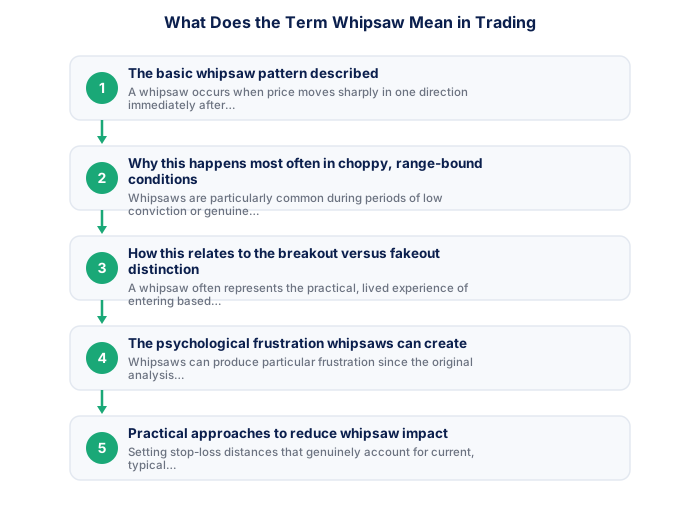
- The basic whipsaw pattern described
- Why this happens most often in choppy, range-bound conditions
- How this relates to the breakout versus fakeout distinction
- The psychological frustration whipsaws can create
- Practical approaches to reduce whipsaw impact
- Accepting some whipsaw as a normal cost of trading
- Whipsaws around scheduled South African events
1. The basic whipsaw pattern described
A whipsaw occurs when price moves sharply in one direction immediately after you enter a position, then reverses just as sharply in the opposite direction, often triggering your stop-loss before potentially continuing in your originally anticipated direction afterward, the term evokes the back-and-forth motion of an actual saw being used in this whipping, alternating pattern.
It's worth picturing this pattern concretely: price breaks convincingly above resistance, prompting a long entry, only to reverse sharply back below that same level shortly after, stopping out the position before resuming its original direction, leaving the trader having lost on a move that ultimately proved directionally correct.
2. Why this happens most often in choppy, range-bound conditions
Whipsaws are particularly common during periods of low conviction or genuine uncertainty about overall market direction, when price oscillates without establishing a clear, sustained trend, making any single directional entry more vulnerable to this kind of rapid, frustrating reversal.
It's worth checking broader market conditions specifically before treating any single breakout as reliable, a breakout occurring during a period of genuinely low overall volatility and unclear direction deserves more scepticism than one occurring alongside strong, confirming momentum elsewhere.
- FSCA-regulated broker verified at fsca.co.za
- Demo account tested for minimum 60 days
- Trading plan written: entry, exits, position sizing
- Risk per trade defined (1-2% of account)
- Backup internet connection tested for load shedding
- Tax implications understood
3. How this relates to the breakout versus fakeout distinction
A whipsaw often represents the practical, lived experience of entering based on what appeared to be a genuine breakout signal, only to discover it was actually a fakeout, the whipsaw is essentially the price action pattern this fakeout scenario produces from the perspective of the trader who entered based on the initial, ultimately false signal.
It's worth applying the same confirmation-seeking discipline discussed elsewhere on this site regarding fakeouts specifically, requiring genuine follow-through, whether through a confirmed close beyond the level or supporting volume, before committing to a breakout trade.
4. The psychological frustration whipsaws can create
Whipsaws can produce particular frustration since the original analysis sometimes proves directionally correct eventually, just after the stop-loss already triggered, recognising this as a normal, expected market characteristic rather than a personal analytical failure helps maintain appropriate perspective.
It's worth naming this specific frustration explicitly when it happens, rather than letting it build into general trading discouragement, recognising 'this was a whipsaw, a known, well-documented market pattern' rather than 'I made a bad trade' helps keep the experience in accurate, less personally damaging perspective.
| Item | Detail |
|---|---|
| Regulator | FSCA, fsca.co.za |
| Exchange control | SARB, resbank.co.za |
| Tax authority | SARS, sars.gov.za |
| JSE hours | 09:00-17:00 SAST Mon-Fri |
| Best forex session | 15:00-17:00 SAST |
| CGT annual exclusion | R50,000 (individuals) |
5. Practical approaches to reduce whipsaw impact
Setting stop-loss distances that genuinely account for current, typical market noise and volatility, rather than placing stops unrealistically tight relative to normal price fluctuation, reduces susceptibility to this kind of whipsaw, since the stop has more reasonable room to withstand normal, non-trend-changing fluctuation.
It's worth backtesting any specific whipsaw-reduction technique you adopt, rather than assuming it works based on intuition alone, confirming through your own historical data that a wider stop or confirmation requirement genuinely improves your specific strategy's results, rather than simply feeling like it should.
6. Accepting some whipsaw as a normal cost of trading
Some degree of whipsaw-related losses is a normal, expected cost within any trading strategy's overall statistical performance, a strategy's genuine profitability is assessed across its complete sample of trades, not by whether any single specific trade avoided this particular frustrating pattern.
A whipsaw occurs when price moves in one direction, triggering entries, then sharply reverses, trapping those positions. They're most common around major news events and during sideways, choppy conditions.
★ Why It Matters
Worth testing as a specific adjustment: widening your stop-loss slightly beyond the immediate technical level during known whipsaw-prone conditions, like just after a major news release, rather than placing it at the textbook-tightest possible distance.
✕ Common mistakes
- Re-entering immediately after being whipsawed out of a position. This can repeat the same costly pattern without addressing its cause.
- Treating every stop-out as a flawed entry rather than normal market noise. Whipsaws are a recognised market behaviour, not necessarily an analysis failure.
- Not adjusting strategy around known high-whipsaw conditions, like immediately after news. Some periods are simply less suited to tight, mechanical stop placement.
Key Takeaways
- A whipsaw describes rapid, choppy price reversal shortly after entering a position, often triggering a stop-loss before the original anticipated move occurs.
- A whipsaw describes rapid, choppy price reversal shortly after entering a position, often triggering a stop-loss before the anticipated move actually occurs.
- The basic whipsaw pattern described.
- Why this happens most often in choppy, range-bound conditions.
- How this relates to the breakout versus fakeout distinction.
Whipsaws around scheduled South African events
A whipsaw is a sharp move in one direction that reverses quickly enough to stop out positions taken in both. It is not random, and the conditions that produce it are largely predictable.
Scheduled announcements are the most reliable source. The Reserve Bank's September 2026 decision is a good example of the setup: the July meeting had held rates on a split 4-2 vote, the market was genuinely divided about September, and the outcome was a unanimous 25 basis point increase to 7.25%. A divided expectation resolving in one direction is the classic whipsaw structure, because positioning exists on both sides.
The mechanism is straightforward. Spreads widen ahead of the release, liquidity thins, the initial move triggers stops, and the price then settles at a level that may be closer to where it started than to the spike. Traders stopped out in both directions within minutes did nothing wrong other than being present.
The defences are equally straightforward. Avoid opening positions in the minutes around a scheduled release. Place stops outside the typical event range rather than at technically tidy levels where everyone else's stops sit. Reduce size rather than widening stops, because a wider stop on the same size increases the rand risk.
The next scheduled candidate on the local calendar is the Monetary Policy Committee statement on 19 November 2026, with monthly inflation releases in between.
Frequently asked follow-up questions
Can whipsaws be avoided entirely?
Not entirely. Some degree of this pattern is a normal market characteristic, though appropriate stop-loss placement and avoiding particularly choppy conditions can help reduce frequency.
Does whipsaw affect all trading styles equally?
Shorter-term styles with tighter stops are often somewhat more susceptible given their typically closer stop-loss placement relative to normal price noise.
Is there a specific indicator that predicts whipsaws?
No single indicator reliably predicts this specific pattern in advance. Recognising broader choppy, range-bound conditions provides general context rather than a precise predictive signal.
