i Short answer
The pattern day trader rule is a US-specific regulation requiring traders who execute 4+ day trades within five days in a margin account to maintain $25,000 minimum equity.
This does not apply to South African forex and CFD trading conducted through FSCA-regulated brokers.
📋 ON THIS PAGE
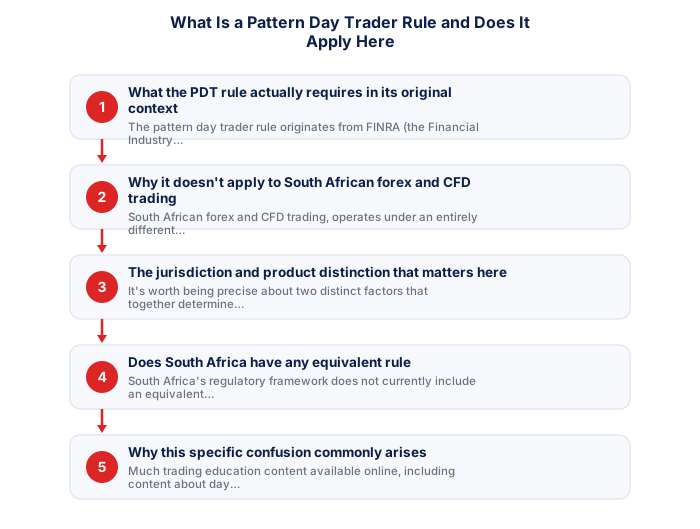
- What the PDT rule actually requires in its original context
- Why it doesn't apply to South African forex and CFD trading
- The jurisdiction and product distinction that matters here
- Does South Africa have any equivalent rule
- Why this specific confusion commonly arises
- What actually does apply to you instead
1. What the PDT rule actually requires in its original context
The pattern day trader rule originates from FINRA (the Financial Industry Regulatory Authority), a US self-regulatory organisation overseeing broker-dealers in that specific market. It requires that any trader classified as a "pattern day trader", defined by the specific trade frequency threshold mentioned above, maintain a minimum of $25,000 equity in their margin account, and restricts further day trading if equity falls below this threshold.
This rule was specifically designed to address risk concerns within the US retail brokerage and securities market structure, and its scope is explicitly limited to that specific regulatory context, US-regulated broker-dealers handling margin accounts trading US securities.
2. Why it doesn't apply to South African forex and CFD trading
South African forex and CFD trading operates under an entirely different regulatory framework, FSCA oversight of brokers and SARB exchange control rules, which has no equivalent provision mirroring FINRA's PDT rule. FSCA-regulated brokers serving South African clients aren't bound by FINRA's rules, since FINRA's jurisdiction doesn't extend to South African-regulated entities or South African residents trading through them.
This means South African day traders and scalpers can trade forex and CFDs with any account size their broker's own minimum deposit terms allow, without the $25,000 equity threshold that would apply to a comparable US pattern day trader.
- Quantifiable rules remove subjectivity
- Backtestable on historical data
- Works consistently when edge is genuine
- Clear entry/exit criteria reduce hesitation
- Past performance does not guarantee future results
- Risk of overfitting to historical data
- Market regimes change, edges decay
- Requires discipline through drawdown periods
- Price and volume patterns
- Works on any liquid instrument
- Faster to learn basics
- Ignores fundamental context
- Economic and financial data
- Better for longer timeframes
- Deeper knowledge required
- Ignores entry precision
3. The jurisdiction and product distinction that matters here
It's worth being precise about two distinct factors that together determine whether the PDT rule could ever be relevant to you: the specific jurisdiction and regulatory framework your broker operates under, and the specific product being traded. The PDT rule applies specifically to US securities (stocks, for example) traded through a US-regulated broker-dealer, it doesn't extend to forex or CFD trading even within the US itself, let alone to South African-regulated forex and CFD trading specifically.
This means even a South African resident who somehow opened an account with a US broker specifically to trade US securities directly, a different activity from CFD and forex trading, could potentially become subject to the PDT rule in that specific, narrow scenario, but this is a meaningfully different situation from FSCA-regulated forex and CFD trading.
- Written entry/exit rules with zero ambiguity
- Backtested on minimum 3 years of data
- Walk-forward tested on out-of-sample data
- SA-specific events included in test period
- Maximum drawdown within personal tolerance
- 100+ live demo trades with consistent performance
4. Does South Africa have any equivalent rule
South Africa's regulatory framework doesn't currently include an equivalent provision restricting day trading frequency based on account equity thresholds for forex and CFD trading. Capital considerations around day trading are practical, strategic guidance rather than a legal or regulatory requirement comparable to the PDT rule's binding, enforceable threshold.
This is a genuine, meaningful difference between the South African and US regulatory environments relevant to day traders, South African traders have considerably more flexibility regarding account size and day trading frequency than their US counterparts trading US securities would have under the PDT rule.
| Win rate | 1:1 RR | 1.5:1 RR | 2:1 RR |
|---|---|---|---|
| 40% | Losing | Break even | Profitable |
| 50% | Break even | Profitable | Profitable |
| 55% | Profitable | Profitable | Profitable |
| 60% | Profitable | Profitable | Profitable |
5. Why this specific confusion commonly arises
Much trading education content available online, including content about day trading specifically, originates from US-based creators and platforms primarily addressing a US audience, where the PDT rule is a genuinely significant, frequently-discussed consideration. South African readers encountering this content without the jurisdictional context can sometimes mistakenly assume the same rule applies to their own situation.
Being aware of this jurisdictional difference, and more broadly, that South African regulation often differs meaningfully from US, UK, or European frameworks even where the underlying financial products and concepts are similar, helps avoid this and similar points of confusion when consuming trading-related content not specifically written for a South African audience.
6. What actually does apply to you instead
What genuinely applies to South African day traders is FSCA broker licensing verification, SARB exchange control rules if funding an offshore account, and the practical (not legal) capital considerations around day trading's accumulated cost structure, none of which impose a binding equity threshold comparable to the US PDT rule.
Volume concentrates late in the day in South African time, in the hours London and New York share. liquidity
South Africans using US-regulated brokers are subject to the PDT rule.
The US pattern day trader rule applies to US-regulated accounts but not to FSCA-regulated ones. Most South African traders using local FSCA brokers are entirely unaffected.
★ Why It Matters
Worth double-checking if you're trading through any US-regulated entity (rather than an FSCA-regulated CFD broker): confirm explicitly whether PDT rules apply to your account type, since the regulatory framework genuinely differs by jurisdiction and account structure, not just by what you're trading.
✕ Common mistakes
- Assuming this US-specific rule applies to South African FSCA-regulated accounts. It generally doesn't apply to forex and CFD trading conducted through local brokers.
- Confusing this rule with general day trading legality. These are separate questions, one regulatory mechanism doesn't determine the other.
- Assuming all account types at the same broker face identical rules. Account structure can affect which specific regulations apply.
Key Takeaways
- The pattern day trader rule is a US-specific regulation that does not apply to South African forex and CFD trading under FSCA regulation.
- The pattern day trader rule is a US-specific regulation requiring traders who execute 4+ day trades within five days in a margin account to maintain $25,000 minimum equity.
- This does not apply to South African forex and CFD trading conducted through FSCA-regulated brokers.
- What the PDT rule actually requires in its original context.
- Why it doesn't apply to South African forex and CFD trading.
Frequently asked follow-up questions
Could the PDT rule ever apply to a South African resident?
Only in the narrow scenario of trading actual US securities directly through a US-regulated broker-dealer, a different activity from FSCA-regulated forex and CFD trading.
Does FSCA plan to introduce a similar rule in the future?
There's no current indication of this. South African regulation has developed along its own framework rather than directly mirroring US-specific rules like the PDT rule.
Are there other US-specific rules South Africans should be aware don't apply to them?
Yes, various US-specific securities regulations and leverage rules differ from South African and other international frameworks. Always verify which jurisdiction's rules genuinely apply to your specific broker and trading activity.
