i Short answer
Day trading generally requires more starting capital than swing or position trading, given its higher trade frequency and greater cumulative cost from spreads and commissions.
While general guidance suggests R5,000-R10,000 for trading generally, day trading specifically often warrants a meaningfully larger account.
📋 ON THIS PAGE
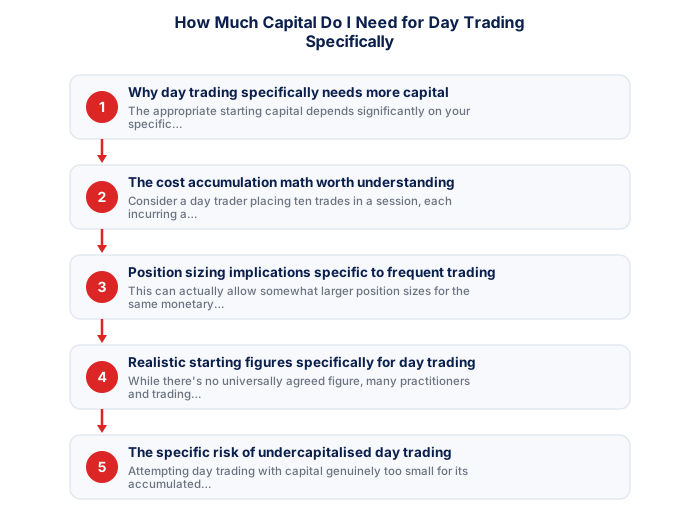
- Why day trading specifically needs more capital
- The cost accumulation math worth understanding
- Position sizing implications specific to frequent trading
- Realistic starting figures specifically for day trading
- The specific risk of undercapitalised day trading
- Building toward adequate day trading capital gradually
1. Why day trading specifically needs more capital
The right starting capital depends heavily on your trading style, and day trading's much higher trade frequency compared to swing or position trading means general guidance doesn't transfer directly without adjustment.
The core driver is simple: more trades mean more accumulated spread and commission costs, and a smaller account has less room to absorb that while still keeping a sound risk percentage per trade.
It's worth calculating this cost impact concretely for your own realistic trade frequency, rather than accepting the general principle abstractly, seeing the actual, projected monthly cost figure against your own intended starting capital gives a considerably more grounded basis for judging whether your planned account size genuinely suits day trading.
2. The cost accumulation math worth understanding
Consider a day trader placing ten trades in a session, each with a modest spread cost. Across a full month of consistent activity, that adds up to a meaningfully bigger figure than the same calculation for a swing trader placing maybe five trades a month. A day trading account needs to be big enough that this accumulated cost doesn't become a disproportionate drag relative to the account's size and the strategy's actual edge.
This is exactly why comparing broker spreads matters even more for day traders, a seemingly small spread difference, multiplied across day trading's higher frequency, compounds into a much larger total cost gap over time.
- Search FSP name or number at fsca.co.za
- Confirm licence is current and not suspended
- Check scope covers forex and CFD activity
- Confirm client funds in segregated accounts
- Read FSCA enforcement actions history
- Test customer support before depositing
- Client funds legally segregated
- FSCA complaints process available
- SA consumer protections apply
- ZAR account, no FX conversion costs
- Some offshore brokers offer wider instruments
- Regulatory overhead passed on in spreads
- Stricter position limits for retail clients
- FICA verification required before trading
- Client funds segregated
- Formal FSCA complaints process
- SA consumer protections apply
- ZAR account available
- Fund safety not guaranteed
- Overseas disputes only
- SA law does not apply
- Currency conversion costs
It's worth revisiting this calculation periodically as your actual trade frequency becomes clearer through real experience, rather than relying solely on an initial estimate, your genuine trading pattern once underway may differ from what you originally projected, worth checking your actual accumulated costs against your original assumptions.
3. Position sizing implications specific to frequent trading
Day trading's tighter, faster-moving price targets often mean correspondingly tighter stop-loss distances than swing trading's typically wider technical levels. That can actually allow somewhat larger position sizes for the same monetary risk percentage, since the calculation works backward from a smaller stop-loss distance, but that benefit can get offset by the accumulated cost above if account size doesn't keep pace with trading frequency.
4. Realistic starting figures specifically for day trading
There's no universally agreed figure, but many practitioners and trading education resources suggest day trading benefits from a starting account considerably larger than the general R5,000-R10,000 guidance, often citing R20,000-R50,000 or higher as more realistic for sustainably absorbing day trading's accumulated costs while keeping sound risk management across its higher trade frequency.
| Trading style | Commonly cited starting range |
|---|---|
| General / swing trading | R5,000 – R10,000 |
| Day trading specifically | R20,000 – R50,000 or higher |
These figures are guidelines, not fixed rules. The right amount for you depends on your strategy's typical trade frequency, the instruments you trade (given their differing typical spread costs), and your personal risk tolerance, but they illustrate why day trading's capital needs genuinely differ from the general guidance for lower-frequency styles.
| Protection | FSCA Regulated | Offshore Unregulated |
|---|---|---|
| Client fund segregation | ✓ Required | Varies by broker |
| SA complaints process | ✓ Available | ✗ Not available |
| SA consumer law applies | ✓ Yes | ✗ No |
| ZAR account available | ✓ Typically | Often USD/EUR only |
5. The specific risk of undercapitalised day trading
Trying to day trade with capital too small for its cost structure creates a difficult dynamic: the strategy has to overcome not just normal market risk but a meaningfully larger relative cost drag than the same strategy would face on a bigger account, making it considerably harder to reach real profitability even with a sound approach.
This is the same undercapitalisation risk that applies to starting capital generally, but it hits with particular force in day trading, given how directly trade frequency and accumulated cost are linked for this style.
It's worth recognising this dynamic as a genuine, mathematical trap rather than simply a matter of insufficient skill or discipline, even a genuinely sound, well-executed strategy can struggle against this compounding cost pressure if the underlying capital base is fundamentally too small for the trading frequency involved.
6. Building toward adequate day trading capital gradually
For traders interested in day trading but starting below the figures above, a sensible approach is building capital and demonstrated skill gradually, perhaps starting with lower-frequency swing or position trading on a smaller account, then moving toward day trading once both adequate capital and demonstrated discipline are genuinely in place.
This sequenced approach avoids the undercapitalisation risk above while still leaving a real path to day trading for anyone interested in the style, once circumstances actually support it.
The afternoon overlap is where a South African trader finds the most activity. liquidity
Adequate capital allows disciplined position sizing and normal variance.
Minimum capital survives technically but severely constrains position sizing and emotional stability. Adequate capital allows disciplined position sizing and absorption of normal variance.
★ Why It Matters
Worth calculating for your own situation: your strategy's typical trades per day, multiplied by your average per-trade cost (spread plus commission), over a full month. That number is routinely bigger than traders expect, and it directly determines your realistic minimum viable account size.
✕ Common mistakes
- Using general trading capital guidance for day trading specifically. Day trading's higher frequency and cost structure usually demands more capital.
- Not calculating your strategy's actual monthly cost from spreads and commissions. This figure is often larger than traders initially assume.
- Starting day trading with capital sized for swing trading instead. Undercapitalised day trading creates a disproportionate cost drag.
- Ignoring how trade frequency compounds transaction costs over a month. Frequency itself is a meaningful, often underestimated cost driver.
Key Takeaways
- Day trading generally requires more capital than swing trading given its higher trade frequency and cumulative cost exposure. Learn realistic figures.
- Day trading generally requires more starting capital than swing or position trading, given its higher trade frequency and greater cumulative cost from spreads and commissions.
- While general guidance suggests R5,000-R10,000 for trading generally, day trading specifically often warrants a meaningfully larger account.
- Why day trading specifically needs more capital.
- The cost accumulation math worth understanding.
Frequently asked follow-up questions
Is there a strict legal minimum capital requirement for day trading in South Africa?
No. There's no South African regulatory minimum specific to day trading, the figures here are practical guidance, not a legal requirement.
Can I day trade successfully with a smaller account if I'm very disciplined?
Discipline helps, but the cost-accumulation math above exists independent of discipline level, so adequate capital matters regardless of skill.
Does day trading capital need to be in a single account?
Not necessarily, though spreading day trading capital across multiple smaller accounts can add unnecessary complexity without a clear corresponding benefit.
