i Short answer
Sticking firmly to your predetermined daily loss limit, and resisting the urge to immediately recover early losses through additional undisciplined trades, prevents a bad start from compounding.
📋 ON THIS PAGE
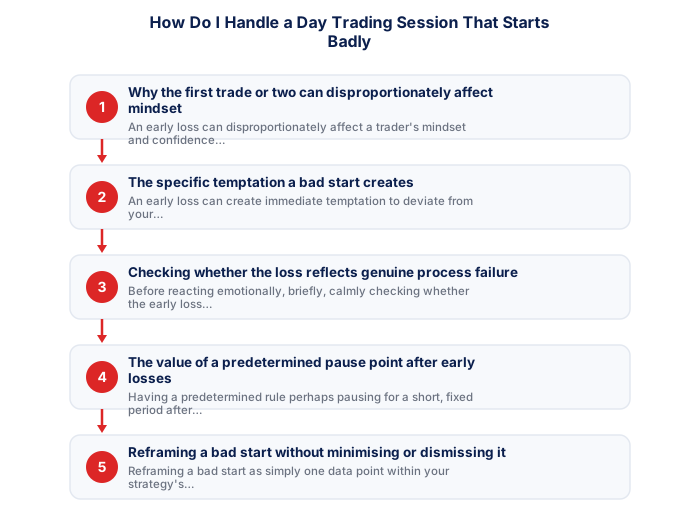
- Why the first trade or two can disproportionately affect mindset
- The specific temptation a bad start creates
- Checking whether the loss reflects genuine process failure
- The value of a predetermined pause point after early losses
- Reframing a bad start without minimising or dismissing it
- What to do for the remainder of that specific session
1. Why the first trade or two can disproportionately affect mindset
An early loss can disproportionately affect a trader's mindset and confidence for the remainder of a session, even though, statistically, this single early result shouldn't genuinely predict how the rest of the session's independent trades will unfold, connecting to the gambler's fallacy.
It's worth naming this specific bias to yourself explicitly whenever you notice it happening, recognising in the moment that 'this early loss is affecting how I feel about the whole session, even though it statistically shouldn't' creates a small but useful gap between the feeling and any resulting action.
2. The specific temptation a bad start creates
As, an early loss can create immediate temptation to deviate from your predetermined strategy criteria in an attempt to quickly recover this loss, precisely the dangerous pattern that strategy and revenge trading discussion warns against, made more acute here given how early in the session this temptation arises.
It's worth being especially vigilant early in a session specifically, since this is exactly when the temptation is freshest and your emotional reaction to the loss is most immediate, a brief pause before your next decision matters more here than at almost any other point in your trading day.
- 100+ demo trades completed with consistent rules
- Positive expectancy over full demo sample
- Every demo trade documented in journal
- Written trading plan: entry, exit, position sizing
- FSCA-regulated broker chosen and FSP verified
- Starting capital is genuinely disposable
- Backup connectivity tested
Open a demo
Choose an FSCA-regulated broker. Start with R50,000-R100,000 virtual capital.
Write trading rules
Define entry criteria, stop-loss method, and position sizing in writing.
Trade 2-3 months
Complete at least 50-100 trades across varied market conditions.
Journal everything
Record rationale, emotion, and outcome for every trade.
Evaluate objectively
Move to live only when consistent rule-following meets your benchmark.
3. Checking whether the loss reflects genuine process failure
Before reacting emotionally, briefly, calmly checking whether the early loss resulted from a genuine deviation from your strategy criteria, or whether it simply reflects normal statistical variance despite sound process, provides important, clarifying context for how to respond appropriately to what's actually happened.
It's worth actually asking yourself this question explicitly and out loud or in writing, rather than relying on a quick mental check, articulating the answer concretely, 'yes, I followed my criteria and this was simply an unfavourable outcome' or 'no, I entered without full confirmation,' gives you a clearer, more honest basis for deciding how to proceed.
4. The value of a predetermined pause point after early losses
Having a predetermined rule, perhaps pausing for a short, fixed period after any loss, regardless of how early in the session it occurs, before considering any further trade, provides a structural buffer against the immediate, emotionally-driven reaction a bad start can otherwise trigger.
It's worth setting this pause rule during a calm planning moment, well before any actual session begins, rather than trying to decide on an appropriate pause length while already emotionally affected by a real, fresh loss, the predetermined nature of the rule is precisely what gives it protective value.
5. Reframing a bad start without minimising or dismissing it
Reframing a bad start as simply one data point within your strategy's overall, larger statistical sample, rather than either minimising it inappropriately or treating it as catastrophic, supports a more balanced, accurate perspective on what's actually occurred.
It's worth holding both truths simultaneously, that this specific loss is genuinely one data point among many and doesn't predict the rest of your session, while also treating it as worth honest review afterward rather than dismissing it entirely, balanced acknowledgment serves you better than either extreme.
6. What to do for the remainder of that specific session
For the remainder of a session that started badly, maintaining strict adherence to your predetermined criteria and daily loss limit, rather than either abandoning discipline to chase recovery or becoming excessively, fearfully cautious beyond what your strategy genuinely calls for, supports the most balanced, sustainable continuation of that day's trading.
The busiest stretch of a South African trading day falls late in the afternoon, while London is still open and New York has started. liquidity
The transition from demo to live trading is one of the most psychologically significant steps in a trader's development, and the gap between demo performance and early live performance is a well-documented phenomenon. The primary driver is emotional: real capital at risk changes decision-making in ways that are invisible during demo trading. Common manifestations include premature exit from winning positions to lock in profit, reluctance to enter valid setups due to fear, and difficulty accepting losses that felt mechanical on demo but feel painful with real money. The practical solution is to start live trading with an amount small enough that the monetary amounts do not produce strong emotional reactions while still requiring genuine real-money decision-making. Starting with one to three months of discretionary income is a useful benchmark for calibrating this initial live capital.
A predetermined pause rule removes that decision from the moment.
An early loss can create immediate temptation to deviate from your plan. A predetermined rule, like a short fixed pause, removes that decision from an emotionally compromised moment.
★ Why It Matters
A rule worth adopting explicitly: define 'bad start' numerically in advance, for example two consecutive losses or a specific Rand amount, rather than relying on a vague feeling, traders consistently underestimate how bad a 'bad start' feels in the moment compared to its actual statistical size.
✕ Common mistakes
- Trying to recover early losses through larger, hastier trades. This is one of the more common and costly day-trading mistakes.
- Continuing to trade past your own predetermined daily loss limit. The limit only works if it's followed without exception.
- Not reviewing what specifically caused the bad start afterward. Without review, the same pattern tends to repeat.
Key Takeaways
- Sticking to your predetermined daily loss limit and avoiding the urge to immediately recover early losses helps prevent one bad start from becoming a worse day.
- Sticking firmly to your predetermined daily loss limit, and resisting the urge to immediately recover early losses through additional undisciplined trades, prevents a bad start from compounding.
- Why the first trade or two can disproportionately affect mindset.
- The specific temptation a bad start creates.
- Checking whether the loss reflects genuine process failure.
Frequently asked follow-up questions
Should I stop trading entirely after one bad early trade?
Not necessarily automatically, unless this single loss already approaches your predetermined daily loss limit. The key is maintaining disciplined process for any subsequent decision.
Is it normal to feel shaken after an early session loss?
Yes, this is a common, understandable reaction. The techniques above specifically address managing this reaction constructively rather than suggesting it shouldn't occur at all.
Does a bad start always mean the rest of the session will go poorly?
No, this assumption itself reflects the gambler's fallacy. Each subsequent, independent trade's outcome depends on your strategy's genuine edge and current conditions, not on how the session began.
