i Short answer
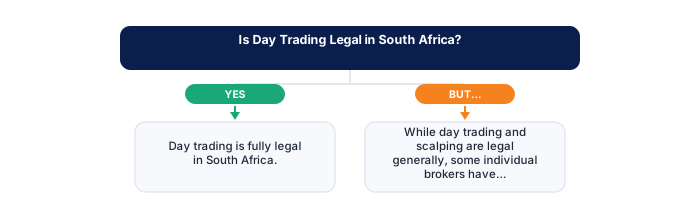
Yes. Day trading is fully legal in South Africa, falling under the same regulatory framework as forex and CFD trading generally.
There is no separate legal restriction specifically targeting day trading or scalping based on holding period or trading frequency.
📋 ON THIS PAGE
- Why there's no separate legal category for trading style
- The same broker licensing requirement applies regardless of style
- Tax implications specific to frequent, high-volume trading
- Any broker-specific restrictions worth knowing about
- Why some people mistakenly think otherwise
- Verifying your specific broker genuinely supports this style
1. Why there's no separate legal category for trading style
South African financial services regulation governs the conduct of brokers and financial services providers, and the broader exchange control framework governs cross-border money movement, neither of which distinguishes between trading styles based on how long a trader holds a position or how frequently they trade. A trade is a trade, legally speaking, regardless of whether it's closed within seconds (scalping) or held for months (position trading).
This means the legal question genuinely resolves to the same core considerations: is your broker FSCA-licensed, and are you moving money according to the SARB exchange control framework, both entirely independent of your specific trading style or frequency.
It's worth appreciating why this style-neutral approach makes sense regulatory, the FSCA is fundamentally concerned with conduct, fair treatment, proper disclosure, licensing, rather than dictating which specific trading strategies clients should or shouldn't pursue with their own capital.
2. The same broker licensing requirement applies regardless of style
Whatever trading style you adopt, day trading, scalping, swing trading, or position trading, you should still verify your broker holds an active FSCA licence before depositing funds. This verification step doesn't change based on your intended trading frequency or holding period; the underlying regulatory requirement for the broker to be properly licensed applies uniformly.
It's worth applying the exact same verification process regardless of your chosen style, checking your specific broker's FSP licence directly through the official register, discussed throughout this site's legal content, protects you identically whether you're placing one trade a week or dozens each day.
- SARB economic calendar checked for the week
- Next Eskom load shedding schedule reviewed
- GNU stability news reviewed
- Stats SA data releases noted
- Credit agency review dates checked
- US/global events that move EM risk noted
- Client funds segregated
- Formal FSCA complaints process
- SA consumer protections apply
- ZAR account available
- Fund safety not guaranteed
- Overseas disputes only
- SA law does not apply
- Currency conversion costs
3. Tax implications specific to frequent, high-volume trading
SARS considers factors including trading frequency when determining whether your gains should be classified as revenue (taxed as ordinary income) or capital gains. Day trading and scalping's inherently high-frequency, short-holding-period nature makes revenue classification considerably more likely for these specific styles compared to longer-term, lower-frequency approaches, which sometimes have a more plausible case for capital gains treatment.
This isn't a legal restriction on day trading itself, but it is a genuine, practical tax consideration specifically relevant to this style, day traders and scalpers should generally expect their profits to be taxed as ordinary income, and planning accordingly, including potential provisional tax registration, is a sound practice given this likely classification.
| Event | Frequency | ZAR impact | Source |
|---|---|---|---|
| SARB MPC | 6x per year | High | resbank.co.za |
| Budget Speech | Annual (February) | Very high | treasury.gov.za |
| Credit reviews | Annual each agency | Very high | Agency sites |
| Stats SA CPI | Monthly | Medium | statssa.gov.za |
| Eskom stage | As needed | Low-medium | eskomsepush.com |
- SA context provides genuine informational edge
- ZAR pairs accessible via FSCA brokers in ZAR accounts
- Rand volatility creates larger intraday ranges
- 6 SARB meetings/year create regular macro setups
- Higher geopolitical risk than G10 pairs
- Load shedding creates unique operational disruptions
- SA rand liquidity thinner than major G10 pairs
- SA-specific news requires constant local monitoring
It's worth discussing your specific trading frequency and pattern with a tax practitioner proactively, rather than assuming your classification, since day trading's characteristically higher frequency is precisely the kind of factor SARS weighs when determining whether your gains should be treated as revenue or capital in nature.
4. Any broker-specific restrictions worth knowing about
While day trading and scalping are legal generally, some individual brokers have historically applied their own specific account terms around very high-frequency trading, occasionally restricting certain account types or applying different conditions to clients trading at scalping-level frequency. These are broker-specific business policies, not legal restrictions, and checking your specific broker's terms directly before adopting a high-frequency style avoids any unexpected friction.
It's worth reading your specific broker's terms and conditions directly for any high-frequency trading restrictions, rather than assuming universal, unrestricted support, some brokers do apply specific policies around scalping or very rapid order placement worth confirming before building your entire strategy around that particular approach.
5. Why some people mistakenly think otherwise
Some confusion about day trading's legality sometimes stems from conflating South Africa's regulatory framework with rules in other jurisdictions, for example, certain US regulations impose specific account minimums and restrictions on "pattern day traders" trading US securities, a framework that doesn't have a direct equivalent under South African regulation for forex and CFD trading specifically.
Being clear that South Africa's framework doesn't impose this kind of style-specific restriction helps avoid this common point of confusion, which often arises from reading content written primarily for a different regulatory jurisdiction.
6. Verifying your specific broker genuinely supports this style
Beyond the basic legal question, confirming your specific broker's platform and execution infrastructure genuinely supports your intended trading style, particularly relevant for scalping given its heightened execution speed sensitivity, is a practical, non-legal consideration worth addressing directly with your broker or through your own demo account testing before committing significant capital to a high-frequency approach.
Volume concentrates late in the day in South African time, in the hours London and New York share. liquidity
Day trading for yourself is fully legal in South Africa. Providing trading signals or advice to others for payment can bring FAIS licensing requirements into play.
★ Why It Matters
Worth being precise about a common point of confusion: there's no minimum holding period or maximum trade frequency restriction under South African law, the legal framework treats a position held for two minutes the same as one held for two months.
✕ Common mistakes
- Assuming a minimum holding period restriction exists. No such legal restriction applies to forex or CFD day trading here.
- Confusing legality with suitability for your specific situation. These are separate questions worth answering independently.
- Assuming day trading rules from other countries apply locally. South Africa's framework differs from jurisdictions with specific day-trading restrictions.
- Not checking whether your specific broker imposes its own frequency limits. Some platforms add restrictions beyond the baseline legal framework.
Key Takeaways
- Yes, day trading is fully legal in South Africa under the same FSCA and SARB framework that governs all forex and CFD trading generally.
- Day trading is fully legal in South Africa, falling under the same regulatory framework as forex and CFD trading generally.
- There is no separate legal restriction specifically targeting day trading or scalping based on holding period or trading frequency.
- Why there's no separate legal category for trading style.
- The same broker licensing requirement applies regardless of style.
Frequently asked follow-up questions
Do I need a special licence to day trade in South Africa?
No, individual traders don't require any special licence to day trade. As with forex trading generally, licensing requirements apply to brokers, not individual clients.
Does the FSCA treat scalpers differently from other traders?
No, FSCA regulation focuses on broker conduct and doesn't distinguish between different client trading styles or frequencies.
Is there a minimum account size required for day trading in South Africa?
No regulatory minimum specific to day trading exists, though general position sizing and capital adequacy considerations still apply for sound risk management.
