i Short answer
Pyramiding involves adding to a winning position as it continues moving favourably.
This higher-risk technique can amplify both gains and losses, requiring careful, predetermined risk management rules. Our Scaling In & Out Calculator works out your weighted average entry price and total P&L once a position has been built across multiple tranches like this. Try our free Average Entry Price Calculator to work through the numbers yourself.
📋 ON THIS PAGE
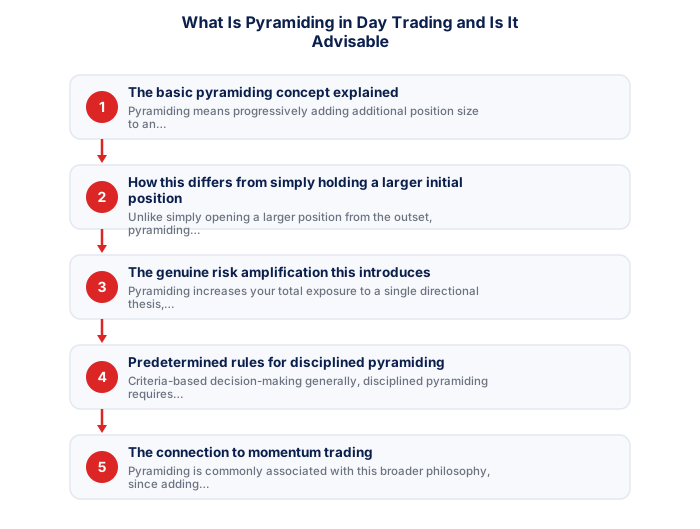
1. The basic pyramiding concept explained
Pyramiding means progressively adding additional position size to an already-open, currently profitable trade as price continues moving in your favoured direction, building a larger overall position incrementally rather than committing the full intended size at the original entry point alone.
It's worth understanding the underlying logic here specifically, the strategy adds to a position only once it's already moving favourably, meaning each additional entry is, in principle, funded by the position's own accumulating unrealised profit rather than pure additional risk from scratch.
2. How this differs from simply holding a larger initial position
Unlike simply opening a larger position from the outset, pyramiding specifically adds to an already-confirmed, currently winning trade, meaning the additional size is only committed once the market has already validated the original directional thesis to some degree, rather than risking the full amount immediately at entry.
It's worth appreciating why this distinction genuinely matters for risk management, an initial position sized larger from the start carries full risk from your entry, while pyramided additions only occur once the trade has already proven itself favourable, a meaningfully different risk profile.
3. The genuine risk amplification this introduces
Pyramiding increases your total exposure to a single directional thesis in a way that compounds broader correlation risk across your account. If the trend eventually reverses, your combined, larger position faces correspondingly larger potential loss than if you'd maintained only your original, smaller position size.
It's worth calculating your genuine combined risk explicitly across all pyramided entries together, rather than treating each addition as a separate, isolated decision, discussed elsewhere on this site regarding managing multiple positions, your overall account risk needs to reflect the full, combined exposure.
- Economic calendar checked for high-impact events
- Key levels marked for target instruments
- Maximum trades per session defined
- Stop-losses set on overnight positions
- Backup connectivity available
- Eskom schedule checked
- Post-session journal time scheduled
4. Predetermined rules for disciplined pyramiding
Disciplined pyramiding requires deciding in advance, before the trade even begins, exactly what specific conditions would trigger adding to the position, how much additional size each addition would involve, and crucially, where the stop-loss for the combined position would sit, rather than making these decisions reactively, in the moment, based purely on excitement about a currently winning trade.
It's worth writing these specific rules down explicitly before ever attempting this technique live, in the same way any trading rule benefits from being documented in advance, discussed throughout this site, rather than deciding on additional entries reactively based on how a favourable trade happens to feel.
| Session | SAST | Instruments | Liquidity |
|---|---|---|---|
| Pre-market | 07:00-09:00 | Any | Low |
| JSE morning | 09:00-12:00 | JSE shares | High |
| Midday lull | 12:00-15:00 | Any | Low |
| London-NY overlap | 15:00-17:00 | Major forex | Very high |
| NY afternoon | 17:00-21:00 | Major forex | Medium |
5. The connection to momentum trading
Pyramiding is commonly associated with momentum trading, since adding to a position specifically because it's continuing to move favourably reflects the same underlying belief in continuation that momentum trading's core premise is built upon.
It's worth appreciating why pyramiding naturally suits momentum-based approaches, discussed elsewhere on this site regarding momentum trading specifically, since both concepts share the same underlying premise, that a genuine, established move has some tendency to continue, worth applying similar analytical discipline to both.
6. Why this technique suits experienced traders more than beginners
Given the genuine risk amplification and disciplined, predetermined planning this technique requires, many experienced traders and educators suggest beginners first build solid foundational discipline with simpler, single-entry position sizing before considering pyramiding, which adds genuine complexity to risk management that benefits from prior, demonstrated experience.
The busiest stretch of a South African trading day falls late in the afternoon, while London is still open and New York has started. liquidity
Averaging down into losing positions is the opposite and far riskier.
Correct pyramiding adds smaller increments to a winning position as price confirms direction, with a tight trailing stop. Averaging down into a losing position is the opposite and far more dangerous for account survival.
★ Why It Matters
Worth defining precisely before ever trying this: a maximum number of additions and a rule that each addition uses a smaller size than the last. Pyramiding without these specific predetermined limits can quietly grow a single trade's risk well beyond what your original position sizing intended.
✕ Common mistakes
- Using the same position size for each addition rather than decreasing size. Smaller subsequent additions help manage the compounding risk of this technique.
- Pyramiding without clear rules defined before the trade even starts. Deciding rules mid-trade tends to produce less disciplined outcomes.
- Treating pyramiding as automatically safe simply because the position is currently winning. A winning position can still reverse, and pyramiding amplifies that reversal's impact.
Key Takeaways
- Pyramiding involves adding to a winning position as it moves favourably, a higher-risk technique requiring careful, predetermined risk management rules.
- Pyramiding involves adding to a winning position as it continues moving favourably.
- This higher-risk technique can amplify both gains and losses, requiring careful, predetermined risk management rules.
- The basic pyramiding concept explained.
- How this differs from simply holding a larger initial position.
Frequently asked follow-up questions
Does pyramiding always increase profit if the trend continues?
It can amplify profit if the trend genuinely continues, though this isn't guaranteed and depends entirely on the trend actually persisting as anticipated.
How is the stop-loss managed across a pyramided position?
Many traders adjust the overall stop-loss as additional size is added, ensuring the combined position's risk remains within acceptable, predetermined limits.
Is pyramiding the opposite of averaging down on a losing position?
Yes, pyramiding specifically adds to winning positions, while averaging down, a generally more discouraged practice, adds to losing positions.
