i Short answer
The FSCA shares the same core consumer protection goals as other major regulators globally, like the UK's FCA or Australia's ASIC.
Specific rules around leverage caps and compensation schemes for client losses can differ meaningfully between jurisdictions.
📋 ON THIS PAGE
- The shared core principles across major regulators
- Leverage cap differences across jurisdictions
- Compensation scheme differences: a significant distinction
- Disclosure format and specific requirement variations
- Why multi-jurisdiction brokers offer different terms by client location
- What this means practically for South African traders specifically
2. Leverage cap differences across jurisdictions
One of the more practically significant differences lies in maximum leverage caps for retail clients. European regulators operating under the ESMA framework (which historically influenced both UK FCA and Cyprus CySEC rules, though UK rules have since diverged somewhat post-Brexit) impose a hard cap of 1:30 for major forex pairs for retail clients, with lower caps for other instrument categories. South African FSCA rules, by contrast, don't impose an identical universal hard cap in quite the same codified way, meaning leverage availability can vary more by individual broker policy within South Africa's specific regulatory framework.
This difference means a South African trader and a UK-based trader using the same multi-jurisdiction broker might see meaningfully different maximum leverage figures, reflecting the different regulatory frameworks each is actually operating under, rather than any inconsistency or unfairness on the broker's part.
- Search FSP name or number at fsca.co.za
- Confirm licence is current and not suspended
- Check scope covers forex and CFD activity
- Confirm client funds in segregated accounts
- Read FSCA enforcement actions history
- Test customer support before depositing
- Client funds legally segregated
- FSCA complaints process available
- SA consumer protections apply
- ZAR account, no FX conversion costs
- Some offshore brokers offer wider instruments
- Regulatory overhead passed on in spreads
- Stricter position limits for retail clients
- FICA verification required before trading
- Client funds segregated
- Formal FSCA complaints process
- SA consumer protections apply
- ZAR account available
- Fund safety not guaranteed
- Overseas disputes only
- SA law does not apply
- Currency conversion costs
| Feature | FSCA (South Africa) | FCA (UK) | ASIC (Australia) | CySEC (Cyprus/EU) |
|---|---|---|---|---|
| Leverage cap (retail forex) | Up to 1:500 (FSP-specific) | 1:30 | 1:30 | 1:30 |
| Negative balance protection | Required for retail clients | Mandatory | Mandatory | Mandatory |
| Client compensation scheme | No FSCS-style fund | FSCS up to £85,000 | Limited scheme | ICF up to €20,000 |
| Segregated client funds | Required | Required | Required | Required |
| Complaint escalation | FSCA / Financial Services Tribunal | FOS (UK) | AFCA | FSC |
| Bonus restrictions | Not prohibited | Banned | Banned | Banned |
3. Compensation scheme differences: a significant distinction
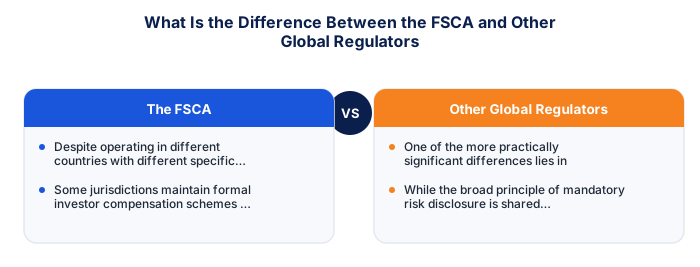
Some jurisdictions maintain formal investor compensation schemes, for example, the UK's Financial Services Compensation Scheme (FSCS), which can compensate eligible clients up to a specified limit if an authorised firm fails and cannot return client funds, even in cases where fund segregation itself proves inadequate. South Africa's regulatory framework does not currently feature an exactly equivalent broad-based compensation scheme of this type covering CFD and forex brokers specifically.
This is a genuinely significant practical difference worth understanding clearly: in jurisdictions with this kind of compensation scheme, client protection in a worst-case broker failure scenario extends beyond fund segregation alone to include this additional compensation backstop, whereas South African clients rely more heavily on fund segregation itself functioning properly, without quite the same additional safety net layered on top.
4. Disclosure format and specific requirement variations
While the broad principle of mandatory risk disclosure is shared across jurisdictions, the exact format, specific wording, and precise calculation methodology behind statistics like the retail loss percentage can vary somewhat between regulatory frameworks, reflecting each regulator's own specific rules about exactly how and when this information must be calculated, updated, and displayed to prospective clients.
This means comparing the exact disclosed loss percentage between a broker's South African-facing materials and the same broker's UK or Australian-facing materials may not always be a perfectly like-for-like comparison, given these underlying methodological differences, even though the broad concept being disclosed is fundamentally the same across jurisdictions.
| Protection | FSCA Regulated | Offshore Unregulated |
|---|---|---|
| Client fund segregation | ✓ Required | Varies by broker |
| SA complaints process | ✓ Available | ✗ Not available |
| SA consumer law applies | ✓ Yes | ✗ No |
| ZAR account available | ✓ Typically | Often USD/EUR only |
5. Why multi-jurisdiction brokers offer different terms by client location
Brokers like AvaTrade, structure their offerings so that clients are onboarded under whichever specific regulatory entity is appropriate for that client's residency and circumstances, meaning a South African client is onboarded under the FSCA-regulated South African entity specifically, subject to FSCA rules, while a client in a different jurisdiction would be onboarded under a different entity subject to that jurisdiction's own specific rules.
This structure explains why you might see different leverage limits, different specific disclosure wording, or other variations when comparing the same broker's offering across different countries, it reflects genuine regulatory compliance with each specific jurisdiction's rules, not inconsistent or arbitrary treatment of different clients.
6. What this means practically for South African traders specifically
For South African traders , this comparison underscores why understanding your own specific FSCA-based protections clearly, rather than assuming identical protections to what you might read about regarding traders in other countries, matters for setting realistic expectations. Fund segregation and the FSCA complaints process remain genuinely meaningful protections, but recognising the absence of a formal compensation scheme equivalent to some other major jurisdictions is a fair, important piece of context for accurately understanding the realistic limits of your specific protection as a South African retail trader.
This is also a further reason why broker selection due diligence, verifying genuine fund segregation practices specifically, not just basic licensing, carries particular weight in the South African context, given the absence of this additional compensation scheme layer that exists in some other jurisdictions.
If a dispute with the FSCA itself arises, for example over a licensing decision, the Financial Services Tribunal exists as an independent body where such decisions can be formally appealed, separate from the broker complaints process.
Global regulators like the FCA, ASIC, and CySEC have separate jurisdictions.
The FSCA regulates financial services in South Africa . Major global regulators like the FCA, ASIC, and CySEC have separate jurisdictions and separate verification processes. No single regulator covers all countries.
★ Why It Matters
Worth checking if comparing brokers across jurisdictions: the actual maximum retail leverage cap each regulator permits, since this single number varies meaningfully between regulators and directly affects your real position-sizing flexibility regardless of how similar the regulators' stated philosophies sound.
✕ Common mistakes
- Treating regulatory philosophy similarity as proof of identical practical rules. Shared consumer protection goals don't mean identical specific regulations.
- Not checking the specific compensation scheme differences between jurisdictions. Some regulators offer protections others don't have equivalent versions of.
- Comparing brokers across jurisdictions without checking each one's specific regulatory framework. The regulatory backdrop materially affects the protections you actually have.
Key Takeaways
- The FSCA's specific rules differ from ASIC, FCA, or CySEC in leverage caps and disclosure requirements. Learn what these differences mean practically.
- The FSCA shares the same core consumer protection goals as other major regulators globally, like the UK's FCA or Australia's ASIC.
- Specific rules around leverage caps and compensation schemes for client losses can differ meaningfully between jurisdictions.
- The shared core principles across major regulators.
- Leverage cap differences across jurisdictions.
Frequently asked follow-up questions
Is FSCA regulation weaker than European regulation overall?
Not necessarily weaker overall, but specific rules differ, South Africa's framework has its own strengths and gaps compared to European frameworks, rather than being simply better or worse across every dimension.
Can I choose to be regulated under a different jurisdiction's rules as a South African resident?
Generally no, regulated brokers typically onboard clients based on their actual residency, meaning South African residents are generally onboarded under FSCA-regulated entities specifically.
Does the absence of a compensation scheme mean my funds are unsafe?
Not necessarily unsafe, but it does mean fund segregation itself, rather than a compensation backstop, is the primary protection mechanism, making broker selection and segregation verification particularly important.
Are South African leverage limits generally higher than European ones?
Often yes in practice, since South Africa doesn't impose the same uniform ESMA-style hard caps, though specific availability still varies by individual broker policy rather than following one single universal South African figure.
Do South African regulators cooperate with regulators in other countries?
Yes, financial regulators globally generally maintain information-sharing arrangements and cooperative relationships, particularly relevant for investigating brokers or individuals operating across multiple jurisdictions.
