i Short answer
An execution policy document discloses how a broker handles and fills client orders, including dealing desk practices and pricing sources.
📋 ON THIS PAGE
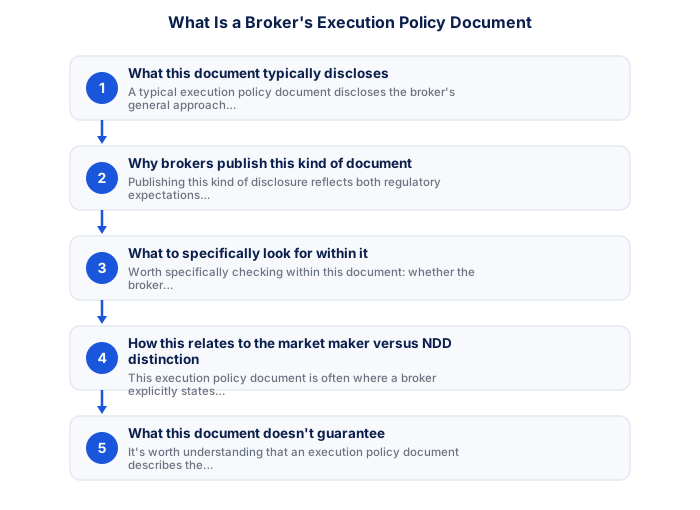
1. What this document typically discloses
A typical execution policy document discloses the broker's general approach to filling client orders, including whether and how it acts as a dealing desk counterparty, which liquidity sources or providers it draws from, and its stated commitment to providing reasonably fair pricing and execution under normal market conditions.
It's worth reading this specifically for concrete, verifiable statements rather than general reassurance language. A policy that specifically names its liquidity providers or precisely describes its slippage handling process gives more genuinely useful information than one that offers only broad, generic commitments to 'fair and transparent' execution without further detail.
2. Why brokers publish this kind of document
Publishing this kind of disclosure reflects both regulatory expectations around transparency and a broader industry practice of giving clients meaningful information about exactly how their orders are actually processed, rather than leaving this important mechanical detail entirely opaque or undisclosed.
See also: A Trading VPS vs a Dedicated Laptop
This document is worth treating as one of the more genuinely informative pieces of a broker's legal documentation, precisely because it addresses the practical mechanics of how your actual trades get filled, a detail that matters directly to your day-to-day trading experience in a way that some other, more abstract legal disclosures don't.
- Search FSP name or number at fsca.co.za
- Confirm licence is current and not suspended
- Check scope covers forex and CFD activity
- Confirm client funds in segregated accounts
- Read FSCA enforcement actions history
- Test customer support before depositing
- Client funds legally segregated
- FSCA complaints process available
- SA consumer protections apply
- ZAR account, no FX conversion costs
- Some offshore brokers offer wider instruments
- Regulatory overhead passed on in spreads
- Stricter position limits for retail clients
- FICA verification required before trading
- Client funds segregated
- Formal FSCA complaints process
- SA consumer protections apply
- ZAR account available
- Fund safety not guaranteed
- Overseas disputes only
- SA law does not apply
- Currency conversion costs
3. What to specifically look for within it
Worth checking within this document: whether the broker explicitly states its execution model (market maker, ECN, or STP), any specific commitments around slippage handling, particularly during volatile conditions, and any disclosed conflicts of interest related to the broker's business model.
It's worth cross-referencing what this document states against your own actual trading experience once you've been active with the broker for a while. A policy that promises fair handling of volatile conditions is worth more once you've seen it hold up during a genuinely fast-moving session, rather than taking the written commitment alone as sufficient confirmation.
4. How this relates to the market maker versus NDD distinction
This execution policy document is often where a broker explicitly states which of the market maker or no-dealing-desk models applies to your account, giving a more authoritative source for this important detail than relying solely on general marketing claims or third-party comparison sites.
This is worth checking directly rather than relying on a broker's general marketing positioning, since 'ECN-style' or 'STP' branding in promotional material doesn't always precisely match the specific, legally binding description found in the actual execution policy document itself.
| Protection | FSCA Regulated | Offshore Unregulated |
|---|---|---|
| Client fund segregation | ✓ Required | Varies by broker |
| SA complaints process | ✓ Available | ✗ Not available |
| SA consumer law applies | ✓ Yes | ✗ No |
| ZAR account available | ✓ Typically | Often USD/EUR only |
5. What this document doesn't guarantee
It's worth understanding that an execution policy document describes the broker's general approach and stated intentions, but doesn't guarantee identical, perfect execution on every single trade. Normal market conditions, including genuine liquidity and volatility factors, still apply, meaning some variation in actual execution experience remains normal even under a genuinely fair, well-disclosed policy.
This distinction is worth internalising specifically so that normal, expected execution variation during genuinely volatile conditions doesn't feel like a broken promise. A well-disclosed policy that's honest about this variability is, in a meaningful sense, more trustworthy than one implying perfect, guaranteed execution under all conditions, a standard no broker can genuinely meet.
6. Finding and reviewing your broker's specific policy
Most FSCA-regulated brokers make their execution policy document available directly on their website, often within a legal or regulatory documentation section alongside the broader terms and conditions. Reviewing this directly, rather than relying solely on summarised marketing descriptions, gives the most authoritative, complete picture of your broker's actual execution practices.
Ask specifically whether your account is ring-fenced against a negative balance. negative balance protection should be stated in the agreement rather than in support chat.
A broker's execution policy document must disclose how orders are routed, how slippage is handled, and conflicts of interest. FAIS requires brokers to publish this and provide it on request.
★ Why It Matters
Worth doing once: actually read this document in full for your own broker, rather than assuming it's standard boilerplate. Execution policies vary more between brokers than their similar-sounding names suggest, and this is the one document that explains exactly how your orders get filled.
✕ Common mistakes
- Never actually reading this document for your own broker. It explains precisely how your orders get filled, more specifically than most marketing material.
- Not revisiting this document after a broker updates its policies. Changes here can affect your trading without obvious notice elsewhere.
- Treating this as irrelevant unless something goes wrong. Understanding it proactively helps set realistic execution expectations.
Key Takeaways
- An execution policy document discloses how a broker handles and fills client orders, providing transparency around the dealing desk and pricing practices.
- An execution policy document discloses how a broker handles and fills client orders, including dealing desk practices and pricing sources.
- What this document typically discloses.
- Why brokers publish this kind of document.
- What to specifically look for within it.
Frequently asked follow-up questions
Is every broker required to publish this kind of document?
Disclosure requirements vary by jurisdiction and regulatory framework. Checking your broker's available documentation directly confirms what they've published.
Can I request this document if I can't find it on my broker's website?
Yes, contacting your broker's support team directly to request this documentation is a reasonable approach if it's not readily visible online.
Does this document explain spread costs specifically?
It typically focuses on execution mechanics rather than detailed fee schedules. Checking your broker's separate fee documentation addresses spread and cost specifics more directly.
